
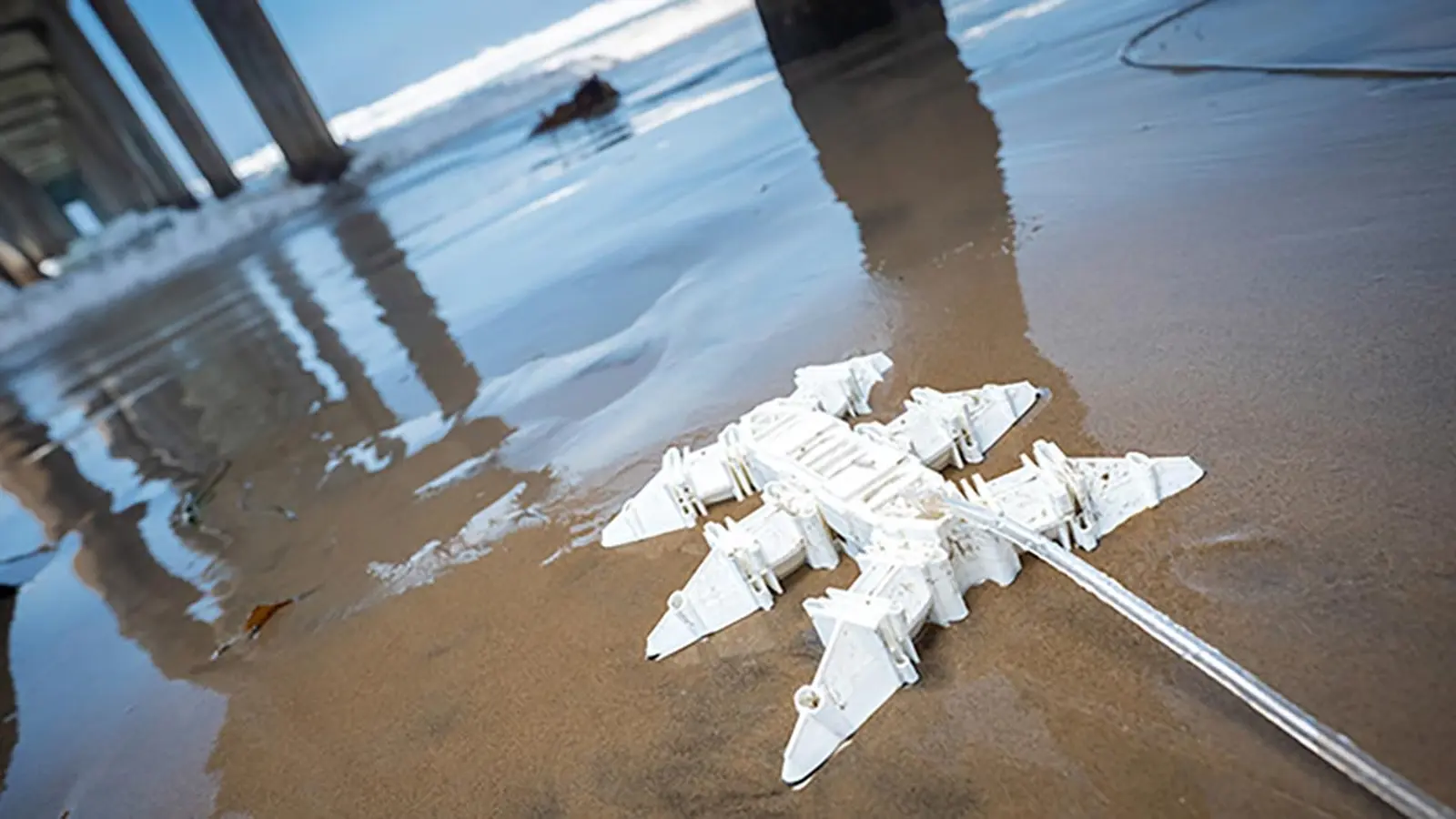
Imagine a six-legged creature dashing across sand, tumbling down concrete steps, then slipping into water and continuing to move beneath the surface. No batteries. No chips. No wiring. Just air and a body printed in one continuous piece.
This is not science fiction. It is the result of a design that borrows an old engineering trick to solve a new problem in soft robotics.
How the robot turns compressed air into motion
Engineers at the University of California, San Diego have built a six-legged, fully soft robot that reaches top speeds of 4.72 meters per second, or roughly 10.6 miles per hour. That performance makes it the fastest robot made entirely from soft materials that we know of. What makes the device striking is not only its speed but its simplicity. The body is printed in one piece using a single material. Inside that body sits a network of air chambers, valves and tubes that direct compressed air to actuate the legs. No separate electronic controllers are needed.
There is a catch. Pushing more air faster seems like an obvious way to make the robot quicker, but simply enlarging internal passages led to wasted energy in early prototypes. The breakthrough came when the team adapted the compound steam engine concept. Instead of releasing pressurized air in a single expansion, the robot uses a two-stage system. First, high-pressure chambers actuate the valves with fast, precise pulses. Then the air expands into larger, low-pressure chambers that deliver the steady, powerful motion needed to swing the legs.
That staged expansion lets the robot extract more useful work from each puff of compressed air. The result: locomotion more than 100 times faster than the group’s prior 2022 design, which managed only about 4 centimeters per second. The new robot runs on hard floors, traverses gravel and mulch, negotiates sand, climbs stairs and even swims and walks underwater while remaining operational.

Why this matters for exploration and extreme environments
Soft robots have been celebrated for years because they tolerate impacts, squeeze through tight spaces and interact safely with people. But they have often been slow or weak compared with rigid robots. Speed and power matter when you want a machine to inspect a damaged industrial site, probe a collapsed building, or scout environments where electronics are at risk from radiation or strong magnetic fields. A robot that needs no electronics could operate where conventional devices fail.
By keeping the entire actuation system mechanical and pneumatic, the UC San Diego team opens up opportunities for durable, low-cost devices that can be mass-produced on desktop 3D printers. The single-material, single-print approach reduces assembly complexity and potential points of failure.
“Our first walking robot demonstrated what was possible, but it was too slow. We hoped to overcome this limitation, and we were fortunate to find a solution to make the new robot 100 times faster,” said Yichen Zhai, a former postdoctoral researcher in Professor Michael T. Tolley’s Bioinspired Robotics and Design Laboratory at UC San Diego.
Still, the robot is tethered to an external compressed air source during these demonstrations. The team aims to reduce the unit’s air consumption so that future versions could carry a small onboard supply, perhaps a compact gas cartridge. They are also working toward more sophisticated behaviors such as steering, object manipulation and autonomous navigation without electronics.

Technical constraints and design trade-offs
Turning a compound expansion into a printable, soft structure required balancing material strength, chamber geometry and timing of airflow. Larger passages allow higher flow rates but can bleed pressure too quickly. Smaller channels preserve pressure but restrict flow. The two-stage layout successfully navigates those trade-offs by using high-pressure pathways to trigger timing-critical valves while reserving large-volume chambers for sustained leg actuation.
Because the entire mechanism is printed as a single object, the design depends on the chosen elastomer’s mechanical properties. Durability, fatigue resistance and sealing between chambers are practical concerns. The research paper in Science Robotics emphasizes that implementing a time-tested solution, the compound steam engine, inside a printable soft body is both an engineering challenge and a proof of concept for building complex, high-performance soft machines with inexpensive materials.
Expert Insight
Dr. Elena Moreno, a robotics engineer who studies untethered locomotion, commented: "This work cleverly repurposes a classical thermodynamic principle to overcome limitations that have long plagued soft robots. The two-stage pneumatic approach is elegant because it doesn't add electronic complexity but instead uses geometry and pressure sequencing to create timing and power. Making that work in a single printed piece is an important step toward practical, field-ready soft robots."
Her emphasis was practical: "To be useful outside the lab, these designs must also address durability and autonomy. Reducing air consumption and adding simple mechanical logic for steering could make such robots invaluable for missions where electronics are a liability."
Future prospects and practical uses
What could you do with a fast, inexpensive, electronics-free robot? Think about inspection in nuclear facilities, where radiation can disable sensors and microprocessors, or search-and-rescue in collapsed buildings where electromagnetic interference or water makes electronics unreliable. Space applications are also intriguing. Regions of strong magnetic fields around certain planetary bodies or spacecraft environments with high radiation levels could be explored with pneumatic machines that contain no vulnerable circuits.
There are additional advantages. A robot printed in one part can be produced rapidly and cheaply. Field teams might bring multiple disposable units into hazardous zones instead of risking expensive electronic equipment. For researchers, the platform is a testbed for different gait patterns and chamber layouts, enabling rapid iteration on locomotion strategies.
Conclusion
The UC San Diego team's soft, 3D-printed robot shows how rethinking old engineering ideas can unlock new performance in soft robotics. By using a two-stage pneumatic system inspired by the compound steam engine, the team significantly increased speed while preserving the manufacturing simplicity of a single-piece print. Challenges remain, principally the need for an onboard air supply and more advanced control capabilities, but the work points to a future where durable, low-cost robots can explore places where electronics cannot go.



“My work centers on sustainability, energy, and environmental science — examining how innovation can lead to a greener future.”
Discussion
Leave a Comment
Comments (3)
Cool trick, but tethered demos are meh. if they can fit a tiny cartridge then maybe practical, until then kinda lab toy
Is this even true? No electronics, printed in one go... sounds awesome but tethered demo kills the vibe, who hauls compressed air into a rubble site?
Wow, a soft robot that swims and climbs stairs? didn't see that coming. clever use of old steam idea, but can it survive long term, curious..