

You meet someone who lights up a room. Another person prefers a quiet corner. Why does that happen? Part upbringing, part experience. And now, an international genomic sweep suggests a sliver of the answer lies in our DNA.
Traces in the genome, patterns in behavior
Scientists at the University of Tartu and collaborators analyzed genetic and personality data from more than one million people and identified over 1,000 genetic variants linked to the Big Five personality dimensions: openness, conscientiousness, extraversion, agreeableness, and neuroticism. The work, published in Nature, did not discover a single 'personality gene.' Instead, it revealed a mosaic: thousands of tiny genetic effects, each nudging behavior in subtle ways.
Genome-wide association studies, or GWAS, look for statistical correlations between single-nucleotide variants and traits across large populations. With personality, each variant exerts a minuscule influence. Detecting those requires enormous sample sizes. By combining the Estonian Biobank with 45 other datasets, researchers reached cohorts as large as 1.1 million participants for some traits, a scale that finally exposes faint but consistent genetic signals.
The identified variants explain only a small slice of overall personality differences. Estimates ranged from roughly 4.8 percent up to about 9.3 percent of trait variation, depending on the trait and method. That leaves the vast majority of personality variation to social environments, life events, cultural context, and the complex interplay between genes and experience. Genes set the stage. Experience writes most of the script.
When self-perception meets outside observation
One strength of the Estonian contribution is a rare design feature: participants completed self-report personality questionnaires and also invited someone who knew them to rate the same traits. Which matters more, inner judgment or outward behavior? The answer appears to be both. Genetic signals overlapped substantially between self-reports and observer ratings, implying that the study is capturing traits that are publicly observable, not merely private impressions.
'This overlap strengthens the claim that personality dimensions are measurable features of people,' said René Mõttus, a co-leader of the study. 'Genetic links are not confined to self-image.' The finding also reduces concern that social-desirability bias or introspective errors would drive the genetic signals.
Still, the pattern is complex. Age, cultural background, and the instruments used to measure traits all affect how strongly genetic associations appear. The Estonian Biobank sample was one of the most thoroughly phenotyped groups in the collaboration, but achieving broader ancestral diversity remains an important next step for the field.
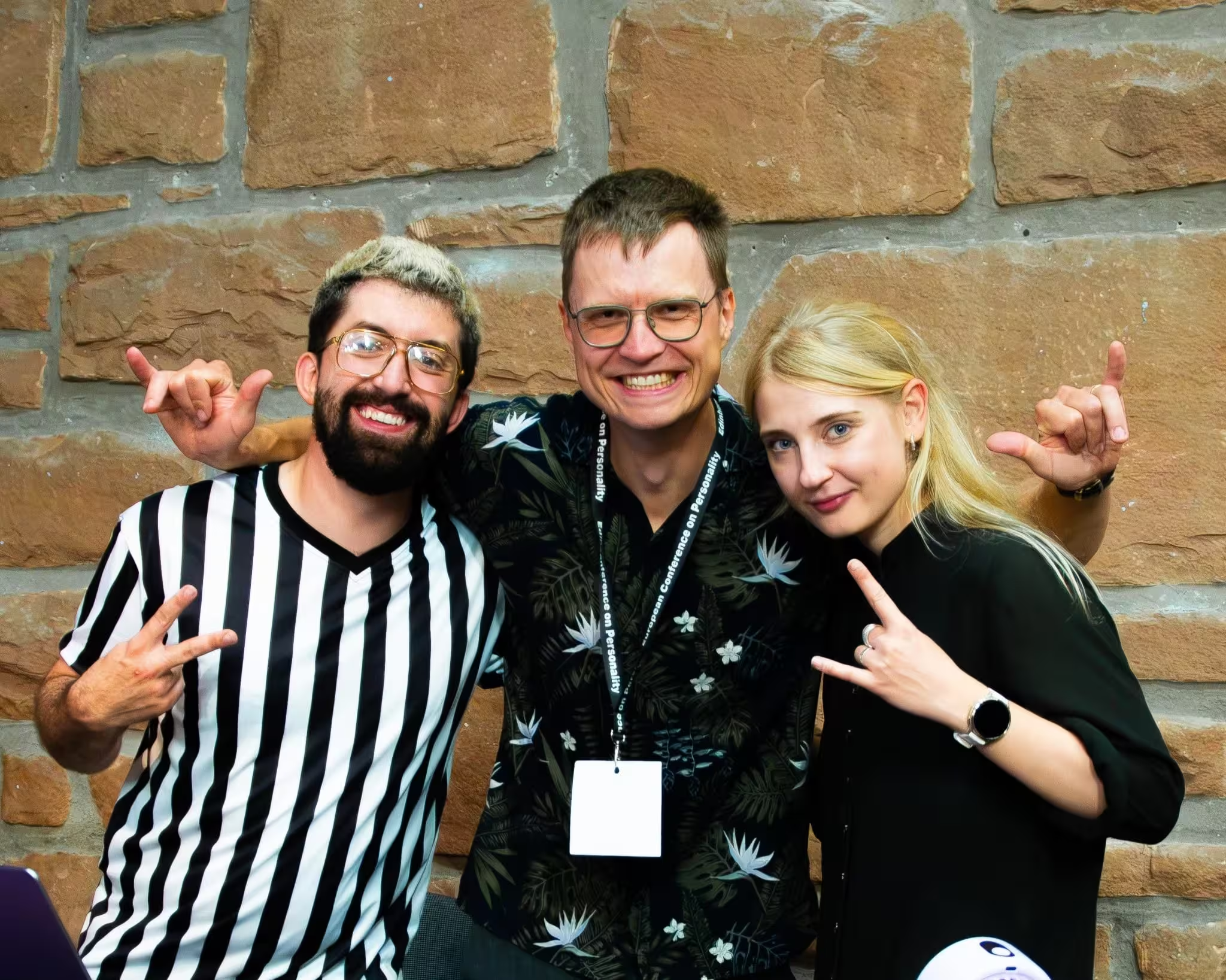
Study authors Ted Schwaba, Uku Vainik, and Kerli Ilves at the DJ booth during the European Conference on Personality (ECP) in the summer of 2026.

Connections to health and behavior
Beyond the theoretical importance of locating genetic correlates of personality, the study opens practical avenues. Personality traits correlate with health behaviors: smoking, alcohol use, diet, and exercise patterns. Junior researcher Kerli Ilves is probing whether personality might causally influence these behaviors, or whether the relationship runs the other way.
Early results hint at bidirectional effects. Smoking, for example, can shape social habits and stress reactivity over time, and those shifts might in turn alter personality reports. Establishing cause and effect will require longitudinal data and methods that can separate genetic predisposition from behavioral feedback loops. The research team plans follow-up studies that combine genetic scores with repeated behavioral and health measures across years.
There is also potential for applications in personalized public health. If personality-related genetic patterns help predict risk-prone behavior, interventions could be better tailored. But researchers caution against simplistic uses. Genetic effects are small. They cannot, and should not, be used to label or stereotype individuals.
Expert Insight
'The real advance here is not that genes determine who we are,' said Dr. Elena Markov, a behavioral geneticist unaffiliated with the study. 'It is that we now have a map of the subtle genomic contours that guide tendencies people express. That map helps us ask smarter questions about development, environment, and health. Large-scale genomics gives us statistical power. Theory and careful longitudinal research give us meaning.'
Markov's point underscores a recurring theme: genetic discoveries are tools to refine hypotheses, not blunt instruments for prediction. Polygenic scores derived from these GWAS can modestly predict trait tendencies at the population level, but they are far from determinative for any single person.
Limitations and future directions
Several caveats temper the headlines. First, even with more than a million participants, the explained variance remains small. Second, most large genomic cohorts still over-represent people of European ancestry. Expanding diversity is essential to ensure findings generalize worldwide. Third, measurement differences across studies—how questions are phrased and who answers them—introduce noise that can blur genetic signals.
Researchers are already planning next steps. The Estonian Biobank will run longitudinal analyses that track personality and cognition over time. Teams elsewhere aim to integrate brain imaging, environmental exposures, and developmental histories to trace how genetic propensities unfold across the life course.
Conclusion

Personality, it seems, is neither wholly written by genes nor entirely sculpted by experience. The new million-person study paints a nuanced picture: thousands of genetic variants subtly bias temperament, while life steers, amplifies, or overrides those tendencies. For scientists, clinicians, and curious readers alike, the message is modest but powerful. DNA contributes threads to the tapestry of personality. But the pattern that emerges depends on all the threads woven beside them.


“The cosmos has always fascinated me. I write about space missions, astronomy, and the technologies pushing humanity beyond Earth.”
Discussion
Leave a Comment
Comments
No comments yet. Be the first.