

Imagine walking into heavy fog and spotting, not headlights, but the faintest halos of light around a cluster of streetlamps. They are bright. You simply cannot see most of their glow because the fog swallows the wavelengths your eyes need. Astronomers have run into the same trick while surveying nearby galaxies: 84 objects that lurk in the softest reaches of the X-ray band and were essentially invisible until someone looked with the right method.
An observational reappraisal of archival data from NASA's Chandra X-ray Observatory uncovered these sources. The team, led by Mustafa Muhibullah at the University of Alabama, calls them hypersoft X-ray sources. The label refers to the unusually low-energy X-ray photons Chandra detects from these objects; most of their radiative power appears to lie at even softer, extreme ultraviolet wavelengths that our telescopes rarely capture.
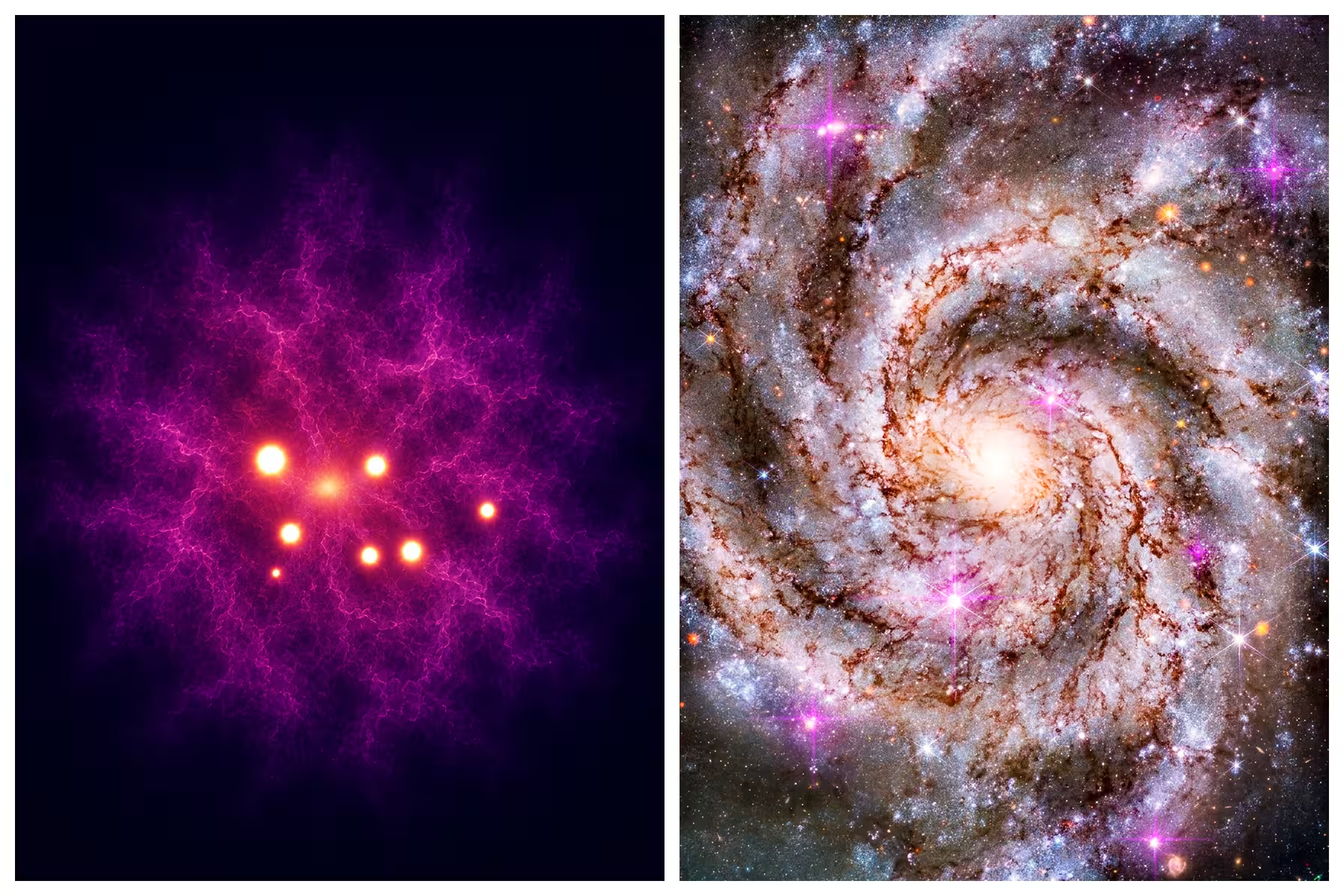
An illustration of hypersoft X-ray sources in the elliptical galaxy NGC 3379 (left) and the spiral galaxy M101 (right), where the sources are highlighted in purple and magenta. The image has been enhanced for illustration.
Why these objects stayed hidden
Chandra registers significant signal for high-energy X-rays, but as photon energy drops below a few tenths of a kilo-electronvolt, the telescope’s sensitivity declines. Interstellar gas compounds the problem. Extreme ultraviolet light, or EUV, is absorbed efficiently by gas between stars. What reaches Chandra is only the low-energy tail of emission, typically in the 0.15 to 0.3 keV window. The faintness at those energies made the objects easy to miss in earlier surveys.
Detection was not blind luck. The sources reappeared at identical sky positions across independent observations and, in some cases, were confirmed by XMM-Newton. They show spatial patterns too: several follow the spiral arms of M101, while others are associated with older stellar populations in elliptical galaxies like NGC 3379. Statistical models suggest fewer than 3 percent of these detections are chance alignments with unrelated background objects.
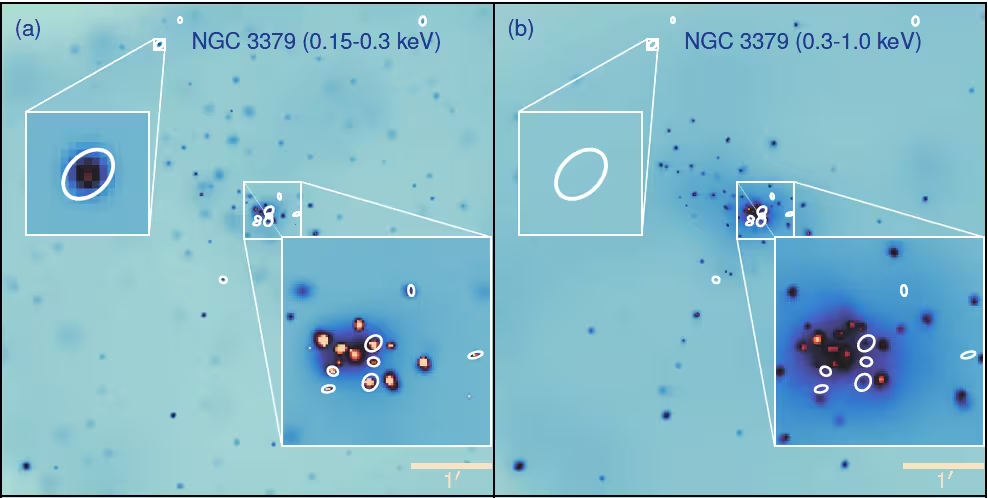
Hypersoft X-ray sources in the central region of the elliptical galaxy NGC 3379. The sources appear at the lowest X-ray energies accessible to Chandra, between 0.15 and 0.3 keV (left), but show little or no radiation between 0.3 and 1.0 keV (right). The white ellipses mark their locations.
What could each glow be?
There is no single smoking gun. Hypersoft describes the spectrum that reaches our instruments, not a unique physical engine. Plausible classes include nuclear-burning white dwarfs accreting from a companion, recent novae still cooling after an eruption, neutron stars in unusual accretion regimes, or stellar-mass black holes with emission strongly shifted into EUV bands.
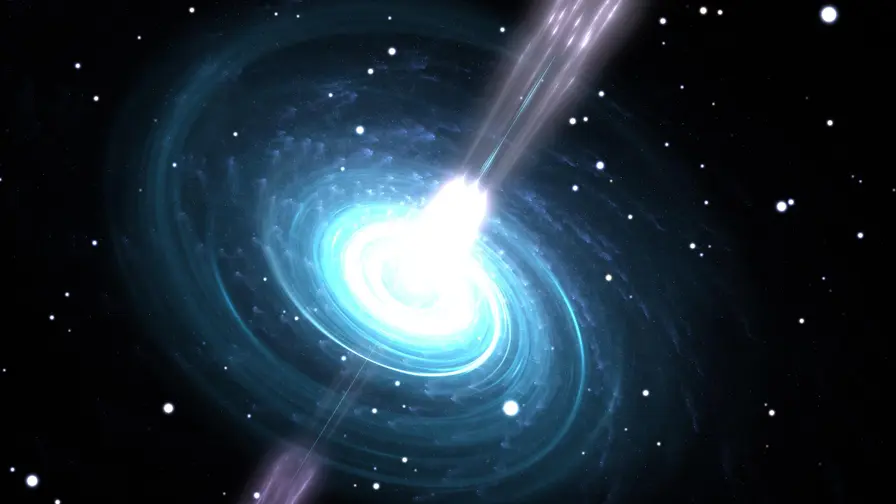
One reason this matters: Type Ia supernovae, the thermonuclear explosions used to measure cosmic distances, require white dwarfs that grow toward a critical mass. Observationally we see many explosions but far fewer candidate progenitors in their steady, accreting phase than models predict. If a subset of hypersoft sources are white dwarfs quietly burning accreted material while emitting mainly in EUV, they could fill part of that missing population.
"What surprised us most is that, despite being so difficult to detect, they can be extremely luminous," Muhibullah said. Detecting the EUV-dominated output directly would be the clincher, but the interstellar medium intervenes.
How many more are out there?
Chandra's declining low-energy sensitivity and detector contamination mean the 84 identified objects are likely the tip of an iceberg. The team estimates Chandra captured the brightest among a much larger population. If so, galaxies host a hidden cohort that can influence local ionization, heating, and the chemistry of the interstellar medium through EUV radiation. In other words, they could quietly reshape their environments without obvious optical or high-energy X-ray signatures.
What observations will break the degeneracy?
Temperature is the key. Simultaneous ultraviolet and soft X-ray observations can constrain spectral energy distributions and reveal whether an object is a hot white dwarf, a cooling nova shell, or an accreting compact object. Future missions with better low-energy X-ray throughput and instruments sensitive to the EUV band would be transformative. Concepts such as the Lynx X-ray Observatory or ESA's Athena could help, as could targeted campaigns using Hubble's ultraviolet instruments and coordinated X-ray observations from Chandra or XMM-Newton.
Beyond new missions, careful mining of archival data, improved detector calibrations, and joint multiwavelength campaigns will sharpen the picture. If even a small fraction of the hidden population proves to be nuclear-burning white dwarfs, astronomers would gain a rare look at pre-supernova evolution and a handle on the Type Ia progenitor problem.
Expert Insight
Dr. Lena Ortiz, an astrophysicist who studies compact binaries, commented: "This discovery highlights a selection effect we have lived with for decades. The universe emits across a wide range. If you only listen in a limited band, you will miss entire populations. These hypersoft sources are an invitation to broaden our observational strategy. Pinning down their temperatures and variability will tell us whether they are the missing seeds of Type Ia supernovae or an unexpected class of accreting objects."
Conclusion
These 84 hypersoft X-ray sources remind us that powerful emitters can hide in plain sight when their photons are shifted into wavelengths our instruments cannot easily sample. The discovery opens practical and theoretical lines of inquiry: pursue coordinated ultraviolet and X-ray observations, re-evaluate progenitor demographics for Type Ia supernovae, and plan instruments that recover the EUV sky. Step by careful step, the fog clears.


“My work centers on sustainability, energy, and environmental science — examining how innovation can lead to a greener future.”

Discussion
Leave a Comment
Comments (2)
Hmm is this just a detector artifact or real? feels like a selection bias could sneak in... need simultaneous UV + soft X campaigns asap
Wow, the idea that whole luminous sources are hidden in EUV is wild. If some are steady-burning white dwarfs, that could help explain the Type Ia shortage. curious..