
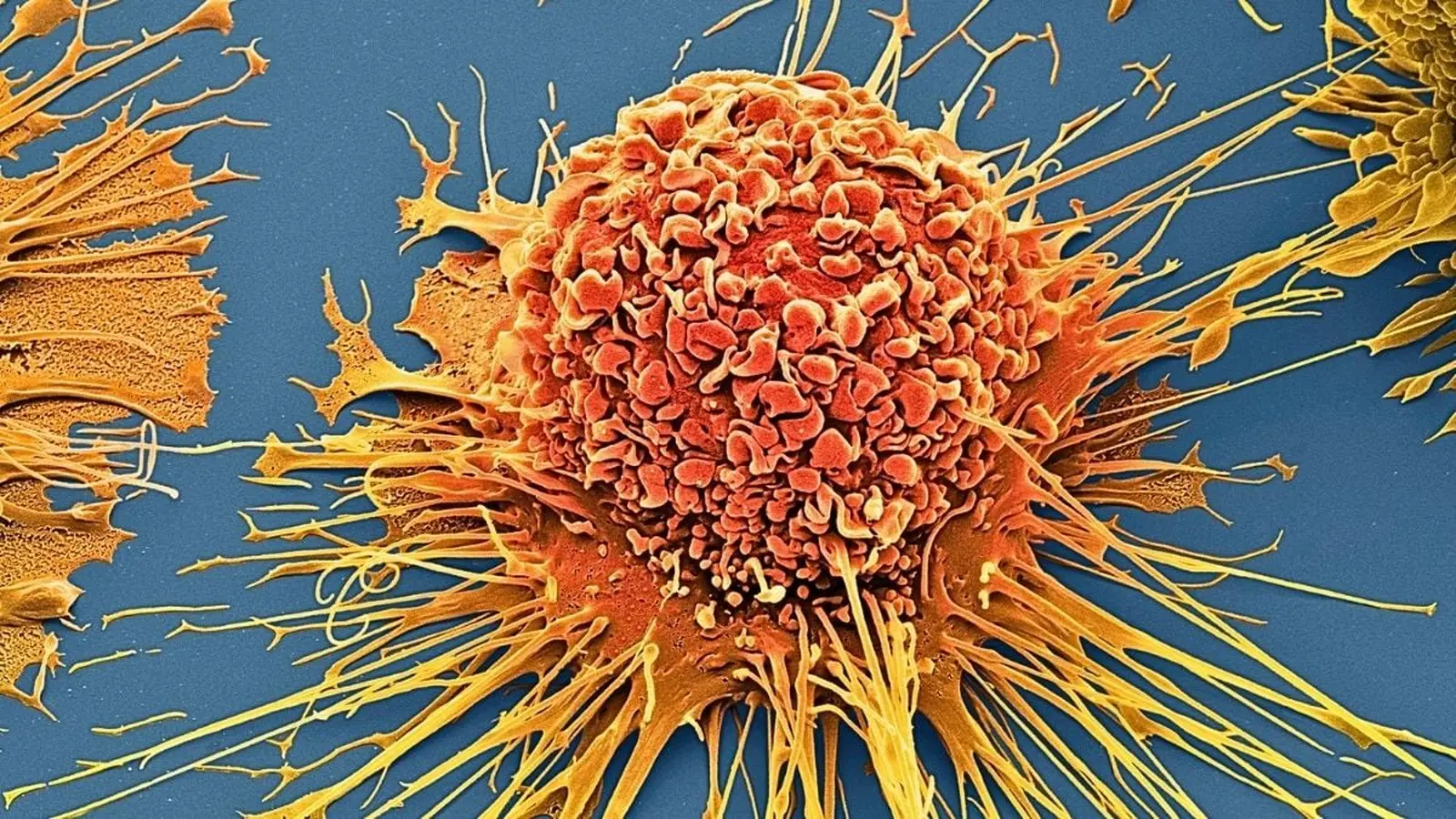
The idea feels almost cinematic: tiny machines, invisible to the eye, vibrating so violently that they rip cancer cells apart. But researchers have turned that image into a laboratory reality using light and a familiar medical dye.
When molecules behave like jackhammers
At the center of this work are aminocyanine molecules, synthetic dyes already used in medical imaging. Expose them to near-infrared light and they begin to oscillate together at astonishing speeds—roughly 40 trillion cycles per second. Those collective vibrations, known as molecular plasmons, transmit a mechanical force across the whole molecule. When an aminocyanine sits in a cancer cell membrane, the motion is strong enough to tear that membrane apart.
Researchers first reported this molecular jackhammer phenomenon at the end of 2023 in Nature Chemistry, in experiments led by teams at Rice University, Texas A&M, and the University of Texas. In petri-dish cultures the technique eliminated about 99 percent of targeted cancer cells within minutes, even at low dye concentrations. In mouse models of melanoma, about half of treated animals became cancer-free.

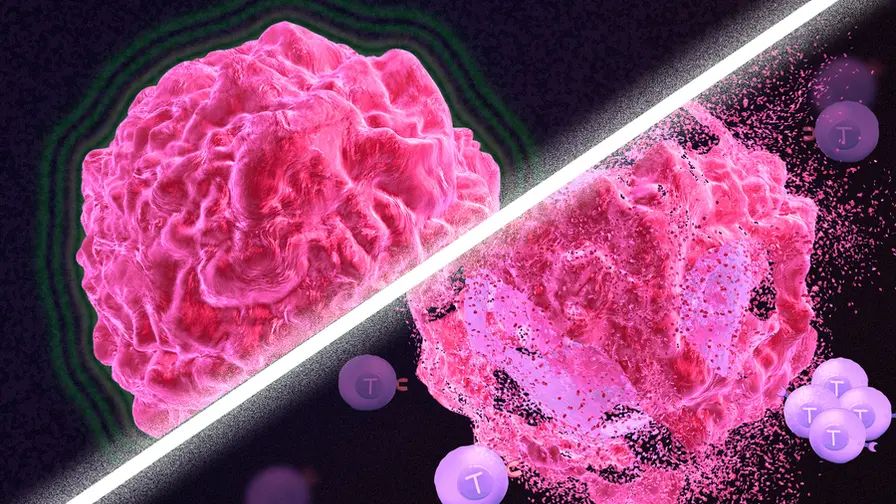
How the vibration mechanism works. The 'molecular jackhammer' is a molecule embedded in the cell membrane that vibrates when hit with near-infrared light.
Why near-infrared matters
Near-infrared light penetrates tissue better than visible light, which is key to reaching tumors buried in organs or bones without cutting them open. Aminocyanine dyes are water-stable, bind readily to cell surfaces, and have a history of safe use at imaging doses. Under the right illumination, electrons across the dye synchronize into plasmons. Those plasmons act like an internal engine, converting light energy into mechanical motion that can disrupt a cell’s outer shell.
That mechanical mode of action is important because it sidesteps a common problem in oncology: resistance. Unlike chemical drugs that target biochemical pathways and can select for resistant cells, a physical tearing of the membrane is not something a cell can easily adapt to through mutation.

The structure of an aminocyanine molecule (a molecular jackhammer) overlaid on top of the calculated molecular plasmon.
From proof of concept to a growing family of tools
After the initial paper, the same research group expanded the concept. A late-2024 study in Advanced Science cataloged multiple variations of molecular jackhammers, tuned to different wavelengths and binding patterns. Some versions are engineered to target particular cancer types by adjusting the dye chemistry so it prefers certain membrane environments.
Early work shows two encouraging safety signals. First, unactivated dyes at low doses are rapidly internalized and cleared by healthy cells. Second, because activation requires external near-infrared illumination, clinicians can confine the destructive action to a chosen region. These features suggest a pathway toward acceptable safety profiles, though extensive toxicology and clinical trials remain essential.
"This study explores a different way to treat cancer by harnessing mechanical forces at molecular scale," said Ciceron Ayala-Orozco, a chemist at Rice University, when discussing the Nature Chemistry report. Coauthor James Tour described the new molecules as a step-change compared with earlier Feringa-type molecular motors, noting they operate millions of times faster and can be driven by near-infrared light rather than visible light.
Expert Insight
"The appeal here is both practical and conceptual," says Dr. Marina Bowers, a fictional biomedical engineer with experience in targeted therapies. "Practically, you have a dye that clinicians already know how to deliver and an activation method that can be focused. Conceptually, shifting from chemistry to mechanics opens a fresh battlefield against cancer. That said, moving from cell cultures and mice to humans presents hurdles in dosing, light delivery to deep tumors, and rigorous safety testing."
Challenges and next steps
Several technical gaps remain before any human application. Delivering uniform near-infrared light to deep or irregularly shaped tumors is nontrivial; endoscopic fibers, implanted LEDs, or pulsed lasers might be necessary. Biodistribution studies must confirm that dyes do not accumulate in sensitive tissues, and long-term toxicity studies need completion.
There is also the matter of selectivity. Even if the dye clears rapidly from healthy cells, ensuring it concentrates sufficiently on malignant cells to avoid collateral damage will be a central concern. Researchers are already pursuing molecular tags and formulations that improve tumor targeting while preserving the mechanical action.
Conclusion
Molecular jackhammers represent a provocative new direction in cancer therapy: instead of poisoning or irradiating malignant tissue, the approach uses light-driven mechanical force at the molecular level to physically destroy cell membranes. The initial results are striking in laboratory and animal studies, but translating that promise into safe, effective human treatments will require careful engineering, comprehensive preclinical work, and clinical trials. Still, the idea that a simple imaging dye could be repurposed as a light-activated nanoscale tool adds an intriguing option to the future oncology toolbox.


“My work centers on sustainability, energy, and environmental science — examining how innovation can lead to a greener future.”

Discussion
Leave a Comment
Comments (2)
Is this even real? 40 trillion cycles per sec sounds nuts. how do they deliver near‑infrared deep in organs, and won’t nearby healthy cells get ripped too? curious but skeptical
wow this gave me chills. a dye becoming a nano jackhammer? crazy. hope safety checks hold up, tho. big if true