

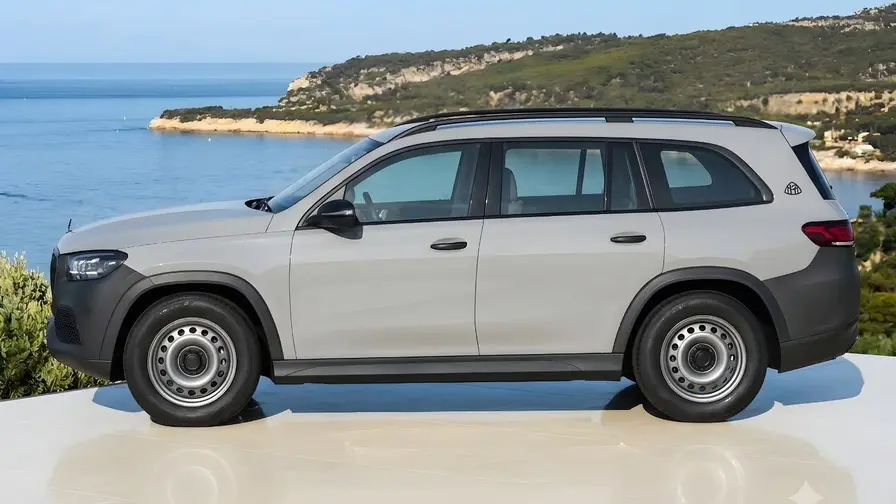
Picture a Maybach GLS cruising past a seaside hotel on plain steel wheels, black plastic bumpers scuffed at the corners, and a little four-cylinder diesel murmuring where a V8 should be. It reads like a prank. It also reads like a challenge to everything the Maybach badge stands for.
Mercedes-Maybach recently updated its flagship full-size SUV and renamed it the GLS 680. Under the skin sits a 4.0-liter twin-turbo V8 with a flat-plane crank and 48-volt mild-hybrid assistance driving all four wheels. Official output: 603 horsepower and 627 pound-feet of torque. That jump in power over the former GLS 600 translates to noticeably quicker sprint times; estimations drop the 0 to 60 miles per hour number under four seconds for some configurations. Thermodynamics, turbocharging and the mild-hybrid system all play roles in that performance, with the 48-volt architecture smoothing torque delivery and recovering energy during deceleration.
Against that technical backdrop, a recent CGI rendering circulated online that swaps all of it for Renault’s humble 1.5-liter dCi diesel. The image is clever. It leans on cognitive dissonance. It also exposes how much brand identity depends on a car’s mechanical and material cues.

When pixels rewrite a luxury script
Pixel artists often borrow reality to make surreal ideas land. This render borrows a very recognizable Renault engine bay and plunks it under a Maybach bonnet. The 1.5 dCi has been the workhorse of many economy cars: Clio, Megane, Captur, Duster, Logan, Sandero and others, along with Nissan models such as the Qashqai and Micra. It is compact, efficient for its displacement, and tuned for modest torque at low revs. It is not built to accelerate two-and-a-half tonnes of ultra-luxury SUV with the kind of refinement Maybach buyers expect.
The image exaggerates the mismatch. The exterior wears cheap-looking headlamps and unpainted plastic bumpers. Wheel arches are trimmed with black plastic. Steel rims and narrow tyres complete the picture. Inside, the mockup shows an unexpectedly Spartan dash: analog dials, an old CD player, manual windows, exposed cavities in the passenger side of the dash, a five-speed manual gear lever and traditional mechanical heating knobs. Little details convey age and economy: a plain headliner, a handbrake lever, a steering wheel without buttons. Those choices create cognitive friction. Put simply: the hardware no longer matches the badge.
Why this makes technical sense but market no sense
From an engineering perspective, the swap is plausible only at the most basic level: engines can be physically placed into many chassis if mounts and ancillaries are reworked. But engineering is rarely only about fit. Noise, vibration and harshness (NVH) control becomes a major obstacle. The V8’s characteristics call for extensive sound insulation, tuned mounts, and exhaust routing to meet Maybach standards. The 1.5 dCi would require a different isolation strategy to avoid rattles and a droning character that luxury customers would notice immediately.
Packaging and cooling are another set of constraints. The V8 and its hybrid components distribute heat differently than a small diesel. Radiator sizing, intercooler placement for turbocharging, and the thermal management systems that keep cabin comfort consistent all shift. Gearbox compatibility is a further hurdle. The mockup shows a five-speed manual. That is mechanically feasible if the drive ratios and torque capacity matched the target mass. In reality, modern full-size SUVs use multi-speed automatic transmissions optimized for broad torque curves and emissions targets. A five-speed would wreck fuel consumption at highway speeds and fail to meet modern emissions and noise regulations in many markets.
There is one truthful detail in the fantasy: a diesel of that size would yield impressive fuel economy figures when measured on a light car. When mated to a heavy, feature-rich SUV, those gains evaporate. Acceleration would suffer dramatically. The 0 to 60 miles per hour sprint that a Maybach customer expects in under four seconds would take forever with a four-cylinder diesel. Power-to-weight ratio and drivetrain gearing are blunt instruments in this trade-off.
Pricing reality in euros
While the render pokes fun at extravagance, market numbers put things in perspective. Mercedes listed the pre-facelift Maybach GLS 600 with an MSRP around €167,400 for the 2026 model year. Early unofficial pricing for the successor suggests a starting price near €172,050 to €176,700. Opt for Manufaktur options and the total climbs above €232,500. That price bracket overlaps with a core Bentley Bentayga and remains well below the starting figures for a Rolls-Royce Cullinan, which can reach about €372,000, and exceed €465,000 for high-spec variants like a Black Badge when options are added.
Put another way: turning a Maybach into an economy-spec vehicle would erase the margins that justify the bespoke materials, advanced powertrain engineering and the intensive NVH treatments buyers pay for.
Expert Insight
"This rendering is a reminder that visual cues matter as much as mechanical ones," says Dr. Elena Kovacs, an automotive engineer who has worked on vehicle acoustics. "Luxury is a systems problem. It is not just about horsepower. It is about how components interact: thermal management, acoustic damping, drivetrain calibration and even the ergonomics of controls. Swap one major element without re-engineering the rest, and the whole package feels wrong."
Dr. Kovacs adds that computer graphics and computational modeling have lowered the barrier to imagining radical combinations. Those tools are powerful for prototyping and education, but they can also produce images that read like social commentary rather than engineering proposals.
Conclusion
The 1.5 dCi Maybach GLS is a joke with a sharp technical edge. It highlights the invisible engineering that underpins luxury automotive experiences: materials science, thermodynamics, hybrid electronics and NVH control. As a piece of digital art it succeeds at sparking debate. As a plausible production plan it fails on brand logic and mechanical grounds. Still, the image is useful. It forces an appraisal of what buyers actually pay for when they choose a Maybach: not just velocity, but also acoustic comfort, thermal refinement and finely tuned materials. That is the real gulf between a pixel-perfect prank and the real-world science of high-end automotive design.

“My work centers on sustainability, energy, and environmental science — examining how innovation can lead to a greener future.”

Discussion
Leave a Comment
Comments (3)
Feels a bit smug, the image hits the point about systems engineering. You cant just drop in parts and call it luxury. kinda obvious.
is this even true? swapping a tiny diesel into a Maybach would wreck NVH and resale, cooling and gearbox probs. pure meme, right?
Wow, that render made me laugh, feels like photoshop trolling luxury buyers but it nails the NVH point 😅 clever prank.