
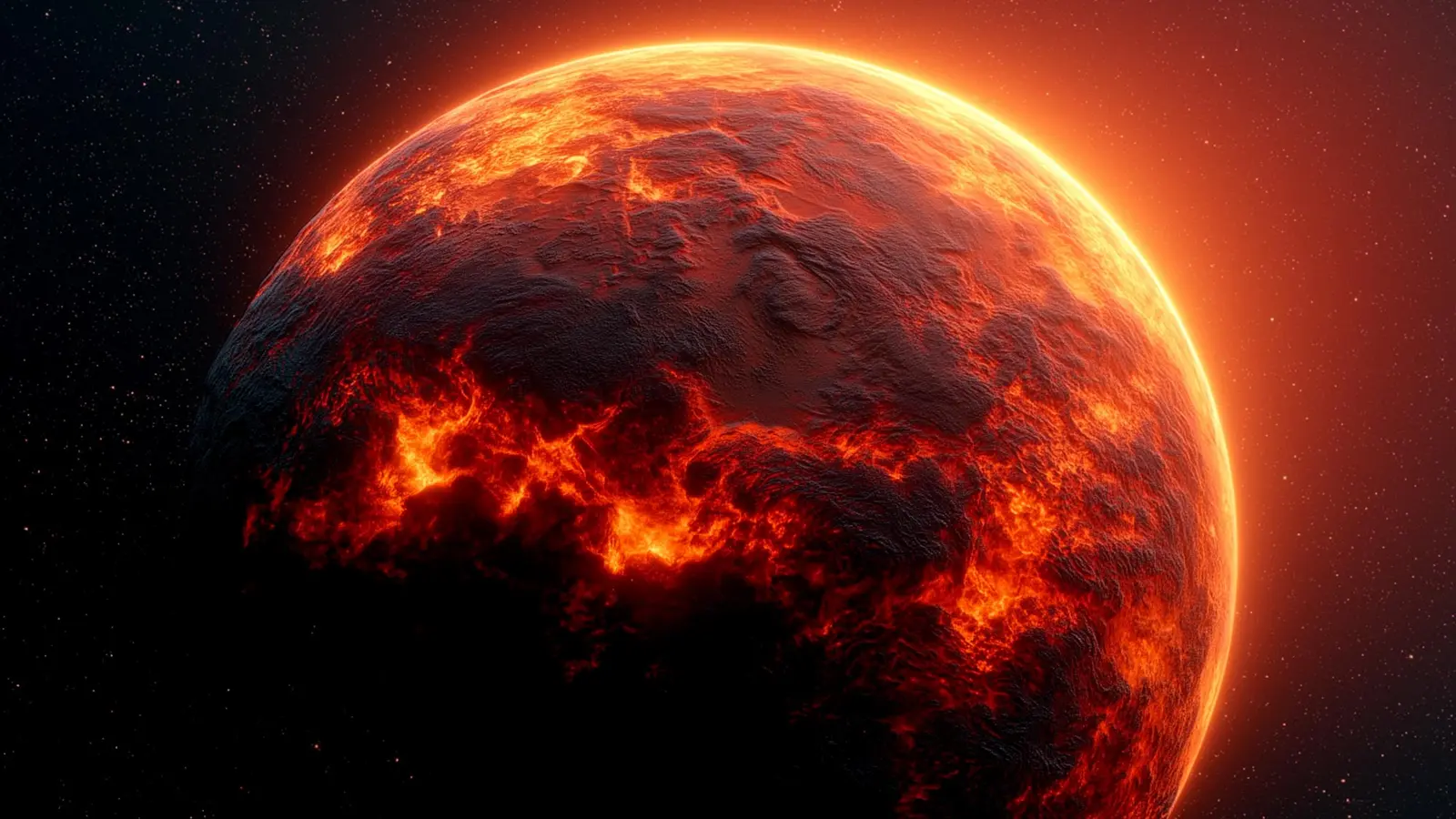
A planet coated in molten rock, its surface glowing like an oven, yet wrapped in a surprisingly thick atmosphere. That image has been puzzling astronomers. Intense stellar radiation should strip gas away from worlds this close to their stars, but observations keep turning up exceptions that refuse to fit the standard rulebook.
When a shoreline needs an update
For years, researchers have used the idea of a cosmic shoreline to estimate which rocky planets can keep an atmosphere and which will be left bare. Imagine a boundary in space that separates airless rocks from gas-harboring worlds. It sounded tidy and useful, until the data grew noisy. Several lava-drowned exoplanets sit well inside that boundary and yet still have thick gaseous envelopes. The mismatch exposed a blind spot in the model.
Stanford planetary scientists have now proposed an extension to the shoreline picture. Their simulations introduce a new regime, which they call the cosmic sandbar. The sandbar is a narrow band of orbital distances where molten surfaces can act like regulators, controlling how quickly internal gases reach the atmosphere. In effect, outgassing and atmospheric escape can reach an uneasy truce, and a planet can keep an atmosphere far longer than the classic shoreline would predict.
How molten rock changes the rules
The core mechanism is simple but powerful. High-energy photons from a nearby star drive atmospheric loss. At the same time, a molten surface can release volatiles from a planet's interior in a process known as outgassing. If outgassing keeps pace with escape, an atmosphere can persist. If it cannot, the world drifts into an airless state.
The Stanford model tracks three interacting processes: loss of gas to space, replenishment from the interior, and the cooling and solidification of the lava layer. Timing is everything. Massive rocky planets with large heat budgets cool slowly. Their molten lids stay fluid long enough to feed the atmosphere. Smaller, faster-cooling worlds solidify before they can replace the lost gas and therefore end up in what the team dubs the airless valley.
That distinction helps explain why Mercury and certain hot super-Earths diverge so dramatically despite similar stellar irradiance. Mass matters. Surface state matters. And so does the chemical inventory locked inside the rock.
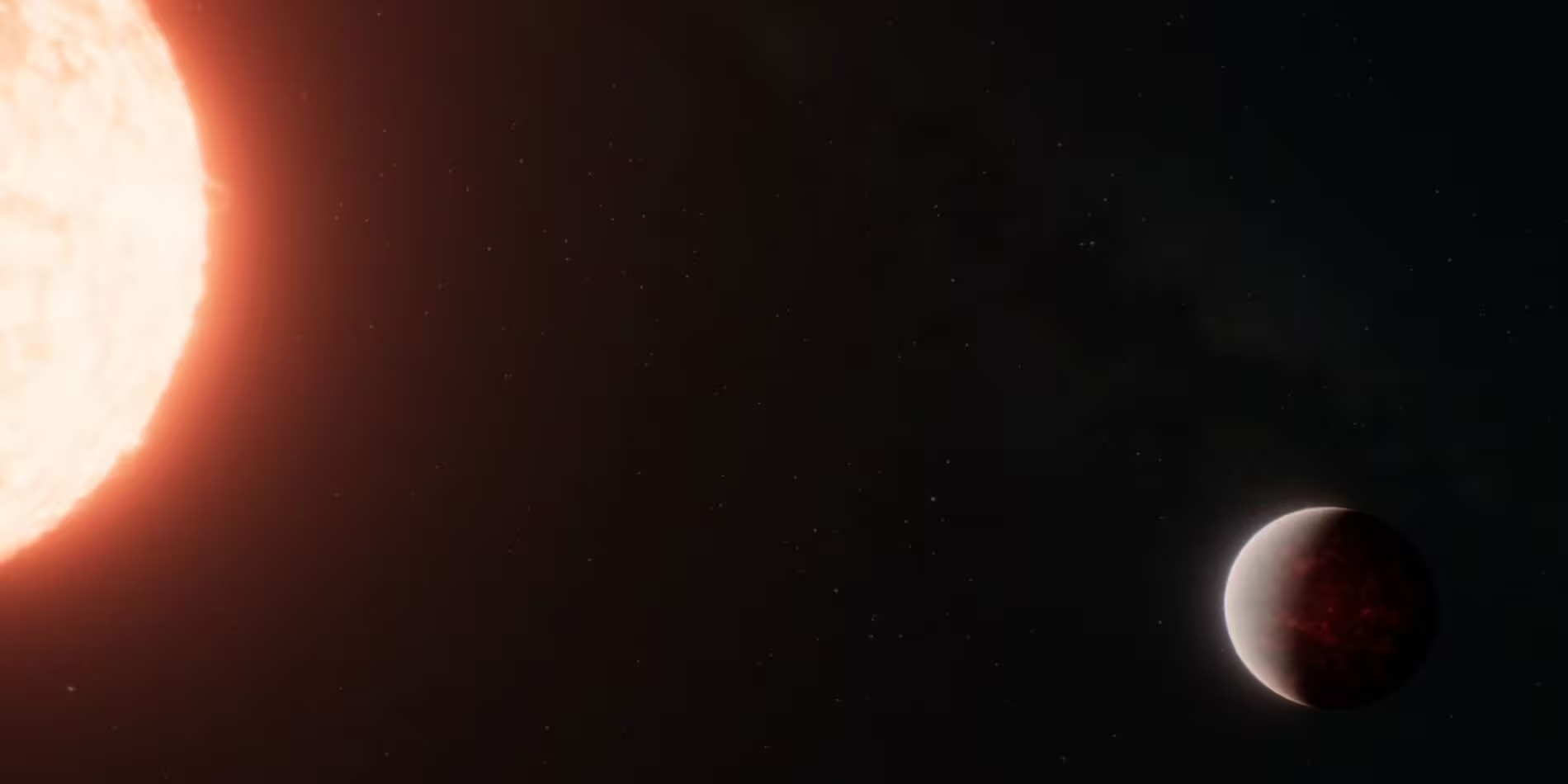
An artist’s rendering of “cosmic sandbar” planet TOI-561b orbiting its star, with its atmosphere illuminated.
Evidence from stubborn planets
One of the best-known troublemakers is 55 Cancri e, a super-Earth roughly eight times Earth’s mass that orbits extremely close to its star. Observations from the James Webb Space Telescope revealed a surprisingly robust atmosphere, contradicting simple escape-based expectations. The cosmic sandbar provides a physical pathway for such a planet to retain gas: its mass and prolonged molten state allow continued outgassing that balances the loss.
The model also maps naturally onto familiar solar system examples. Venus and Earth sit outside the most severe loss regime and thus can keep atmospheres even without an extended molten phase. Mercury, smaller and faster to cool, lost the capacity to replenish gas and remained largely airless.

What this means for habitability and surveys
The practical implications are significant. Determining whether a newly discovered rocky exoplanet could plausibly host an atmosphere is a first-order filter for selecting targets that merit follow-up with telescopes like JWST or upcoming missions. The cosmic sandbar widens the set of planets that might sustain atmospheres, especially among massive, hot rocky worlds that would previously have been dismissed.
It also shifts how scientists should think about volatile budgets and thermal evolution in planet formation models. Rather than treating atmospheric loss as a one-way ticket, researchers must consider whether interior reservoirs can act as long-term buffers. That nuance matters when estimating surface pressures, composition, and ultimately the potential for transient habitable conditions on planets that are otherwise inhospitable.
Model details and testable predictions
Nguyen and colleagues ran simulations that couple thermal evolution of a molten surface with gas solubility and atmospheric escape rates tailored to stellar flux and planetary gravity. The output is not a sharp cutoff but a region of parameter space where outgassing equals escape for extended timescales. For super-Earths in that region, atmospheres can survive for billions of years, provided the interior volatile inventory is sufficient.
The proposal delivers clear, observable fingerprints. Planets in the cosmic sandbar should show spectral signs of replenished species, possible temporal variability if outgassing fluctuates, and a correlation between retained atmosphere and planetary mass for a given irradiation level. Upcoming surveys that measure atmospheres across a range of hot rocky planets will be able to confirm or falsify these predictions.
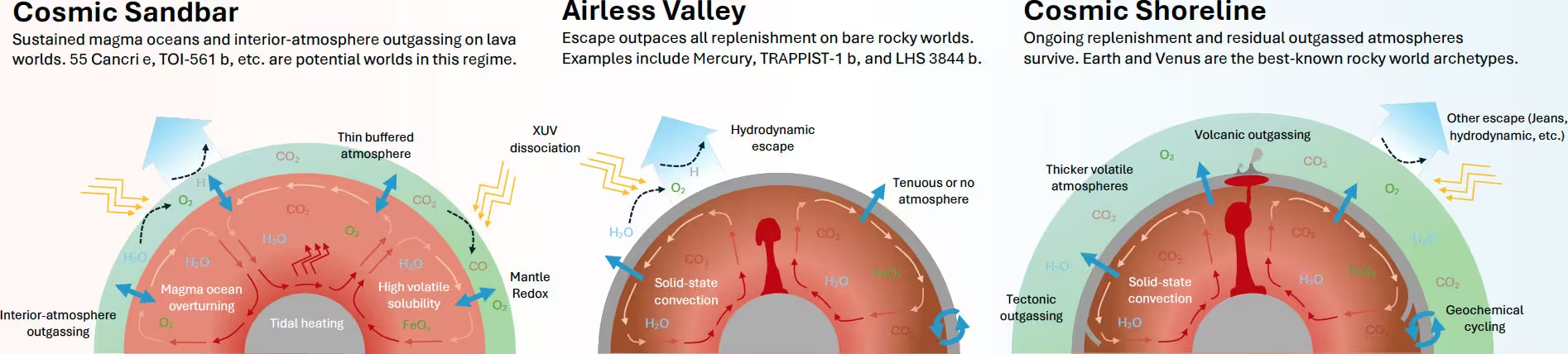
Whether a planet sits on the cosmic shoreline, the cosmic sandbar, or in the airless valley depends on a complex interplay between planetary and stellar forces.
Expert Insight
"This work reminds us that a planet is not just a passive victim of its star," said Dr Elena Márquez, a planetary scientist at the University of Arizona who was not involved in the study. "Interior processes can push back, sometimes effectively. The cosmic sandbar concept gives observers a concrete framework to search for signatures of that push back in spectra and time-series data."
The line between a world that is truly barren and one that is merely simmering is more blurred than previously thought. That has consequences for the cataloguing of potentially interesting targets and for how models treat volatile retention during planetary assembly.
Conclusion
The cosmic sandbar is not a magic fix. It does not make all hot rocky planets hospitable or preserve atmospheres indefinitely. Rather, it adds a physically grounded regime that helps reconcile stubborn observations with theory. As telescopes collect richer atmospheric data, this expanded framework will help astronomers decide which planets deserve the close scrutiny that comes with the search for life beyond our solar system.
If the idea holds up, the next generation of exoplanet discoveries may include worlds that are molten at the surface yet surprisingly well shrouded in gas. That contrast is precisely the kind of complexity that pushes planetary science forward.

“The cosmos has always fascinated me. I write about space missions, astronomy, and the technologies pushing humanity beyond Earth.”

Discussion
Leave a Comment
Comments (3)
Feels kinda overhyped, but the mass vs irradiation link is a cool prediction. will be interesting to see JWST followups if it holds
is this even true? sounds plausible but models hinge on volatile inventory, observational proof pls
Wow didnt expect molten rock to act like a gas tap! makes planets way more stubborn than i thought, curious how common that sandbar is...