

Imagine a planet older than Earth by billions of years, bathed in faint starlight, and yet populated only by microbes. It sounds like bad news for fans of galactic civilizations, but a new line of research offers a clear reason why age alone does not guarantee complexity.
Some nearby exoplanets may be far older than Earth yet still host only simple life. A new study suggests that the decisive factor may be how much photosynthetic energy a planet has accumulated over billions of years.
When time is not the same thing as progress
Researchers led by Chris Doughty at Northern Arizona University argue that the evolutionary clock on other worlds ticks according to energy captured by photosynthesis, not simply years since formation. The team analyzed 29 planets near our solar system that could, in principle, hold liquid water. The verdict: only two of those worlds look like plausible candidates to have advanced beyond Earth’s evolutionary stage. Most appear stuck at simpler, microbial levels.
The two exceptions are GJ 1061c and K2-3d. Both are larger, warmer, brighter, and older than many nearby Earth-sized candidates. Three additional planets might have reached an evolutionary state similar to Earth’s Mesozoic Era, the epoch when dinosaurs dominated. Yet even these are outliers.
The takeaway is counterintuitive. Older does not automatically mean more biologically advanced. The critical variable is cumulative photosynthetic output across geological time. How much light is converted into chemical energy, and how consistently that conversion has supported plant-like primary producers, determines the ecological scaffolding available for complex life.
Photosynthesis as an evolutionary yardstick
On Earth, warm wet regions—tropical rainforests, for example—support dense plant growth and high species richness. Cold or arid regions do not. That correlation is straightforward: more plant biomass means more energy moving into food webs, which can sustain larger, more diverse animal populations and open ecological niches that favor complexity.
But to compare Earth with another planet you need a long view. How much carbon has photosynthesis fixed over the planet’s lifetime? Doughty and colleagues used Earth’s own record as a benchmark. Before vascular plants evolved, roughly 3.2 billion years of photosynthesis fixed about 2.4 times 10 to the 25th grams of carbon into organic matter. After vascular plants appeared, another 7 times 10 to the 25th grams were fixed before humans arrived on the scene. These numbers give a way to scale potential evolutionary progress on other worlds.
On some exoplanets, even if life had billions more years, the total photosynthetic throughput may be far lower than Earth’s. Lower throughput translates to fewer resources for the cascade of evolutionary steps that produce large animals and, ultimately, intelligence.
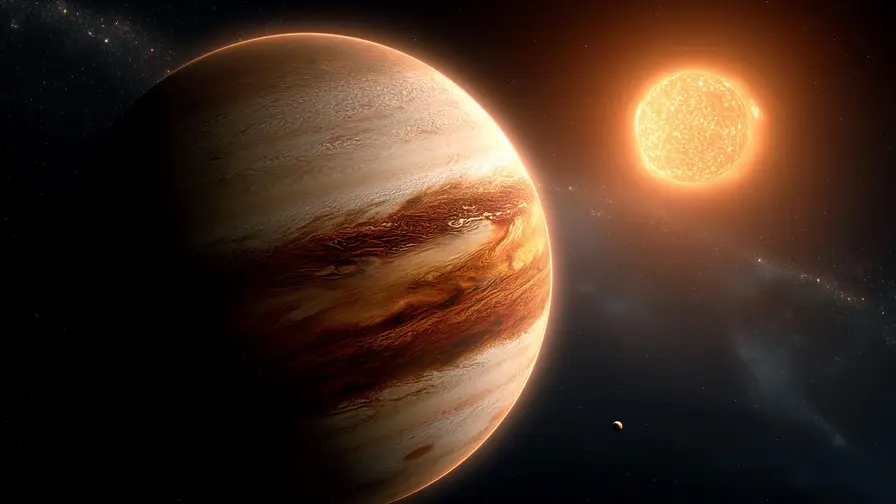
Red dwarfs, tidal locking and the math of light
Red dwarf stars are common, and many prime exoplanet candidates orbit them. These stars produce less light than sunlike stars, and planets close enough to be warm may become tidally locked. One hemisphere bakes in perpetual daylight, the other freezes in permanent night. That geometry reduces the global area available for photosynthesis.
Michael Gowanlock, a coauthor, put it plainly: if photosynthetic life exists on tidally locked worlds, it may have been photosynthesizing for longer than on Earth but at a lower annual rate because of limited illumination and surface area. Who is ahead? We do not know, but the researchers set out to quantify the difference.
Estimating photosynthesis on another world required more than counting photons. Plant growth depends on temperature and precipitation as well as light. Denis Sergeev of the University of Bristol produced climate simulations for candidate planets that mapped temperature, rainfall and surface illumination. Combining those climate maps with models of plant productivity gave estimates of potential lifetime carbon fixation.
TRAPPIST-1e, a planet about 40 light-years away, is a revealing example. Despite being several billion years older than Earth, estimates suggest its lifetime carbon fixation could be just 21 percent of Earth’s total. Under the study’s framework, that would place TRAPPIST-1e at a microbial-only stage of evolution. Atmospheres could change the outcome, and the authors stress their calculations assume life, if present, follows Earthlike pathways. Observations from telescopes such as the James Webb Space Telescope may soon provide atmospheric clues that refine these numbers.
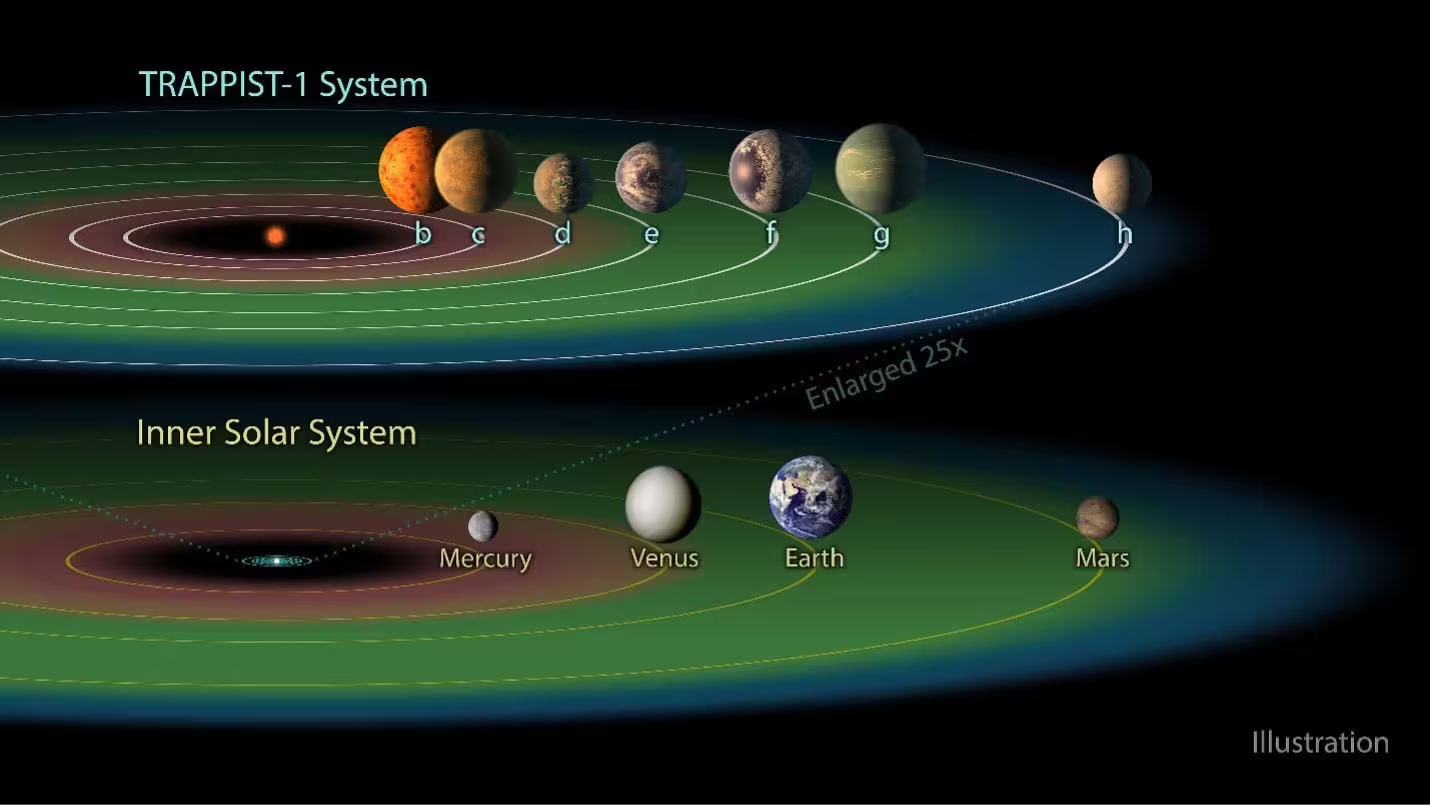
The TRAPPIST-1 System.
Rainfall, deserts and the character of alien ecosystems
Surprisingly, the dominant limiting factor in many of the planets that might surpass Earth’s cumulative carbon fixation was precipitation. Sunlight can be abundant but useless without water. A desert receives more light than a rainforest, yet supports far less biomass. That simple ecological fact shapes evolutionary trajectories.
If complex life evolved on those rare exoplanets with sufficient cumulative photosynthesis, the environments that fostered it may not look like Pandora from Avatar. Instead they might be closer to dunes and scrub, perhaps analogous to the savanna woodlands where humans likely emerged—environments shaped by moderate rainfall and seasonal variability rather than continuous abundance.

To invoke two pop culture references, the ecosystems shaping any advanced life may be more Dune than Avatar. That matters because the physical character of ecosystems influences the kinds of intelligence and technologies that might arise. Scarce water and patchy resources select for different behaviors, social structures and innovations than perpetual abundance.
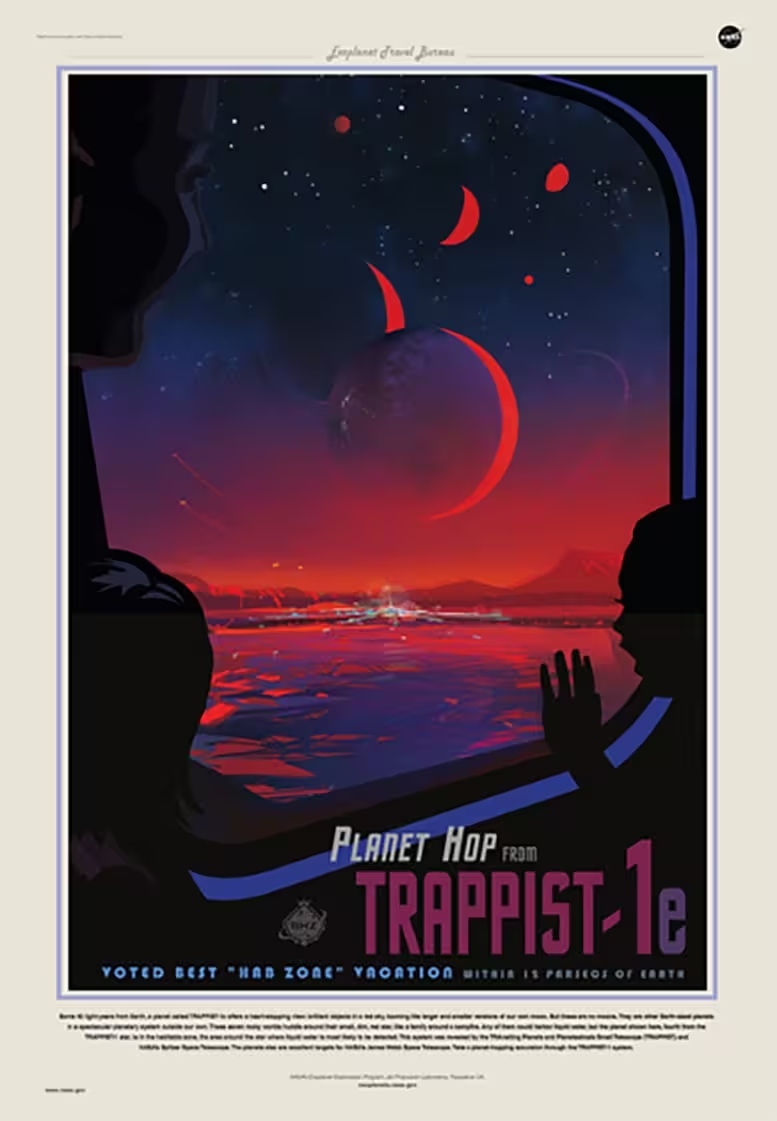
What would it be like to vacation in the TRAPPIST-1 planetary system? The poster invites you to "Take a planet-hopping excursion through the TRAPPIST-1 system." The star system was revealed by the TRansiting Planets and PlanetIsmals Small Telescope, or TRAPPIST, and NASA’s Spitzer Space Telescope.
Expert Insight
"Cumulative energy flow through ecosystems is a powerful, underappreciated lens for thinking about astrobiology," says Dr. Elena Ruiz, an astrobiologist at the European Space Agency not involved in the study. "You can have billions of years, but if the energy is thinly distributed, complexity struggles to emerge. This research gives us a practical way to rank targets for future atmospheric and biosignature observations."
Methods, caveats and the path forward
What this study offers is a framework, not a final verdict. The team combined stellar and orbital data with climate simulations and models of plant productivity calibrated to Earth. That produced ranked estimates of lifetime photosynthetic carbon fixation for each planet. From those numbers the authors inferred plausible evolutionary stages, mapping microbes, multicellular ecosystems and the rare possibility of more advanced life.
Major caveats remain. The model assumes life, if present, relies on photosynthesis and unfolds along pathways similar to Earth’s. It also assumes planetary atmospheres fall within a certain range; an unexpectedly thick or thin atmosphere could alter surface temperatures and rainfall patterns enough to change productivity estimates. Non-photosynthetic metabolisms or exotic chemistries would escape this framework entirely.
Observationally, the next step is atmosphere characterization. James Webb and future telescopes can detect gases such as oxygen, methane and water vapor, and those data will narrow uncertainties. If a planet shows clear biosignature gases combined with low cumulative photosynthetic potential under the model, that would challenge assumptions and force a rethinking of how life uses energy in the cosmos.
Conclusion

The study reframes a classic question about life beyond Earth. Instead of asking how old a planet is, we should ask how much usable energy its biosphere has harvested over time. Complexity needs sustained, abundant energy. Local conditions that limit light, temperature or especially water can leave an old planet biologically youthful.
For now, the nearby stellar neighborhood may be quieter than romanticized visions suggest. That does not rule out life; it simply changes expectations. Many of our nearest potentially habitable worlds could be vast microbial reservoirs, quietly rich in biochemical activity but short on the ecological horsepower required to produce civilizations. And if we hope to find company among the stars, we must look not only for age, but for a planet that has been fed well enough, for long enough, to let complexity bloom.

“My work centers on sustainability, energy, and environmental science — examining how innovation can lead to a greener future.”

Discussion
Leave a Comment
Comments (1)
wow, kinda bummed, old planets could stay microbial… still kinda poetic. imagine whole worlds of tiny life, quietly humming