
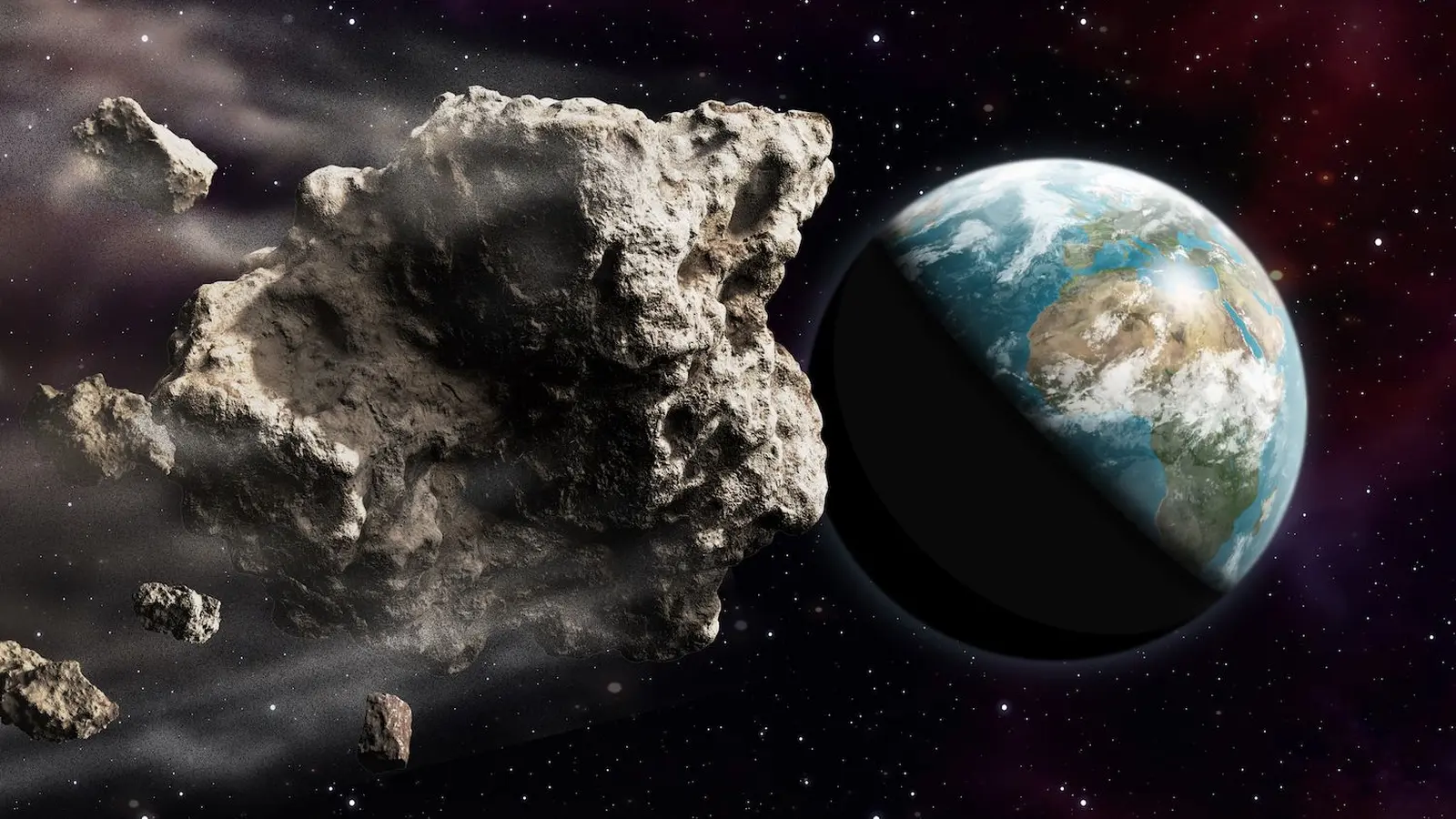
On a geological stopwatch, 800 million years is a blink. But the inner solar system remembers. Around that time the Moon registered an uptick in large impacts. Apollo samples carried tiny glass beads that froze the memory of violent collisions. Now researchers trace that spike to a single catastrophic event in the main asteroid belt.
The Eulalia breakup and the celestial escape hatch
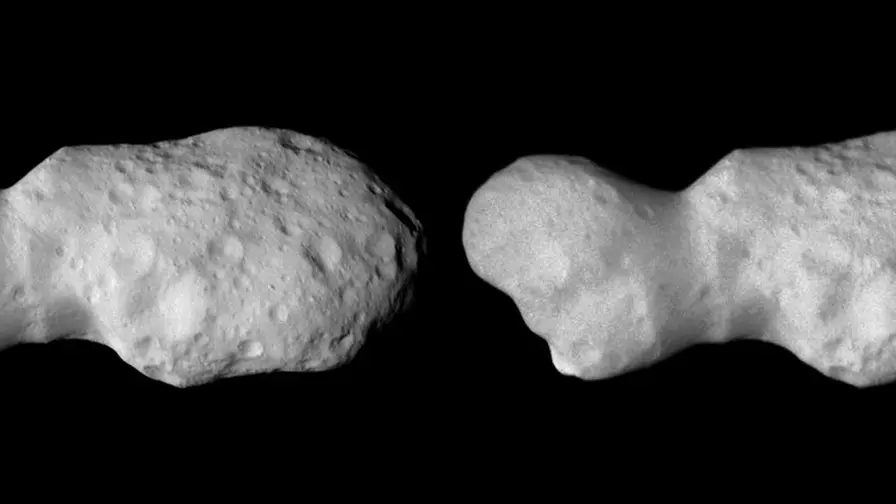
In the outer reaches between Mars and Jupiter a substantial, carbon-rich asteroid—what scientists call the Eulalia parent body—broke apart. Picture a large rock smashing into another rock, fragments flying outward, orbits scrambled. The timing and location of that breakup matter because it happened near a precarious orbital gateway: the 3 to 1 mean motion resonance with Jupiter, commonly abbreviated J3:1.
That resonance is not a physical tunnel. It is an orbital rhythm. An object that completes three trips around the Sun while Jupiter completes one experiences a repeated gravitational tug. Over time, those tugs can push a fragment out of the main belt and onto a path that intersects the inner planets. The research team used collisional modeling and orbital simulations to follow millions of fragments. Their conclusion: a large fraction of the debris from the Eulalia family entered the J3:1 resonance quickly, sending a dense wave of projectiles inward.
Some fragments moved fast. Some drifted slowly.
Fast arrival offered an initial shock: a surge of impacts that could explain the cluster of large lunar craters dated to that era. Slow arrival stretched the event out. Over tens to hundreds of millions of years, thermal forces nudged smaller pieces into Jupiter's drain and kept the bombardment going. The result was not a single moment but a prolonged episode, a dirge of impacts reverberating across the inner planets.

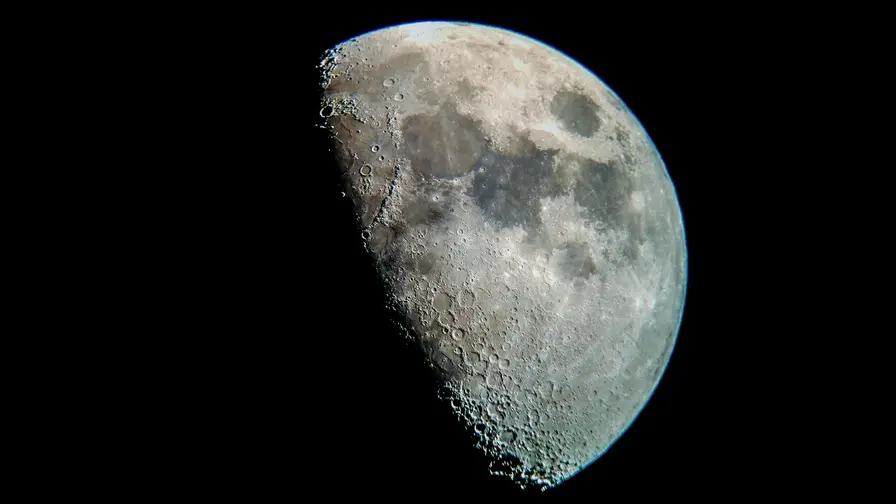
A Southwest Research Institute-led study has connected a specific asteroid collision in the main belt to an inner-solar-system-wide bombardment episode that may have had measurable biological and geological consequences on Earth and Mars. The research linked the catastrophic breakup of the Eulalia parent body with an impact shower that struck the Moon and terrestrial planets 800 million years ago.
Moon glass, crater ages, and the forensic trail
Unlike Earth, the Moon keeps a tidy record. No plate tectonics. No oceans to wash features away. Space weathering happens slowly. So when the Moon shows an increase in large craters and delivers impact glass with matching dates, planetary scientists pay attention.
Impact glass forms when surface rock melts instantly under the heat of a strike and then cools into glassy droplets. Those droplets can be dated with radiometric methods, yielding timestamps for the impacts. Apollo missions returned samples that later revealed a cluster of ages near 800 million years. That cluster needed a source. Enter the Eulalia breakup.
Simulations indicate that the size distribution and composition of Eulalia fragments are compatible with the objects that produced the lunar record. Eulalia is thought to be a primitive, carbonaceous chondrite-like body. Those materials match some of the chemical signatures observed in lunar impact glasses and meteorites linked to carbonaceous sources.
How small pushes become system-changing shifts
Not every fragment needed a massive shove. The Yarkovsky effect provided a steady, patient hand. When sunlight warms an asteroid and that heat radiates away as infrared light, a minute thrust develops. Over millions of years this thermal recoil alters orbits—especially for small bodies. The simulations showed that after the initial surge, the Yarkovsky effect delivered a trickle of additional fragments into the J3:1 resonance, prolonging the inner-system exposure to impacts.
It is a neat chain: break the parent body near a resonance, let gravity and thermal physics do the rest, and watch the inner planets receive an extended bombardment. The models estimated that roughly half of the fragments entered resonance almost immediately, and another quarter migrated in over the following 100 to 150 million years. Those numbers line up with the lunar crater statistics for the same interval.
Possible consequences for Earth and Mars
Linking lunar craters to terrestrial change requires caution. Earth erases evidence. Plate tectonics, volcanism, erosion, and burial all conspire to hide ancient scars. Yet dynamical scaling tells us this: for every large object that hits the Moon, Earth statistically receives about twenty similar hits. Earth is bigger. Its gravity is stronger. It is simply a heavier target.
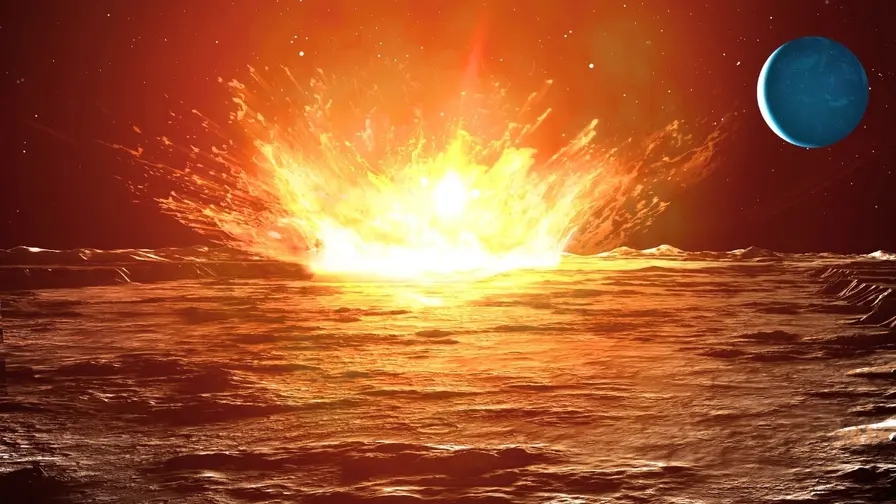
So the ancient spike that the Moon preserves probably translated into a heavier impact load for Earth. Why does that matter? Because the timing overlaps with a stretch of global cooling and major biosphere shifts preserved in the geochemical record. The coincidence does not prove causation, but it does open plausible pathways. Repeated impacts can inject dust and aerosols into the atmosphere, alter ocean chemistry, and trigger cascading environmental responses. Large impacts can vaporize rock, generate acid rain, and transiently change climate regimes. Smaller, frequent impacts might nudge ecosystems over thresholds rather than produce a single cataclysm.
Mars would not have been immune. The models predict strong seismic shaking from multiple large strikes. Impact-induced tremors can destabilize crustal faults, and the thermal and mechanical consequences can interact with subsurface reservoirs. Some researchers note a correlation between the putative bombardment and a pulse of volcanic activity on Mars. If impacts disturbed the planet's crust, that might have provided a trigger for magmatic systems already under stress.
Expert Insight
"We are reading the solar system's history in two registers, the Moon's preserved scars and the dynamical fingerprint left in asteroid orbits," said Dr. Amara Singh, an astrophysicist and planetary dynamics specialist. "When models and sample ages align, the case becomes persuasive. It does not settle every question, but it gives us a coherent narrative: a breakup in the main belt can seed long-lived consequences that echo across worlds."
Dr. Singh added that future work needs more refined crater chronologies and additional isotopic analyses to tighten the link between specific fragments and impactites. "Precision matters," she said. "One well-dated sample can change the whole story."
Methods, limitations, and how researchers tested the idea
To construct this scenario the authors combined collisional physics, orbital dynamics, and thermal modeling. Collisional codes recreate the breakup, estimating fragment sizes and velocity dispersions. Orbital integrators then map the subsequent trajectories, including resonant interactions with Jupiter and the slow drift from the Yarkovsky effect. Finally, the simulated flux of impactors is compared to lunar crater statistics and impact glass ages. When different lines of evidence point in the same direction, confidence grows.
There are limits. Radiometric dates can carry uncertainties. Sample provenance on the Moon is not always straightforward, meaning an impact glass might not have formed at the surface feature with which it is associated. Dynamical models rely on assumptions about fragment properties, surface temperatures, and long-term forces. And absolute impact rates depend on initial conditions that are still debated.
Despite these caveats, the scenario remains compelling because it accounts for multiple independent observations: the composition inferred for Eulalia-like material, the orbital mechanics of the J3:1 resonance, the timing preserved in lunar glasses, and the expected scaling of impacts between the Moon and Earth. As in any good forensic case, the strength lies in converging evidence rather than a single smoking gun.
Looking ahead: what to test next
Several avenues can sharpen the picture. More precise dating of lunar impact glasses would refine the temporal pattern. New lunar samples, ideally returned from regions near dated crater chains, could tie isotopic signatures to specific impactors. On the asteroid side, better physical characterization of Eulalia family members would improve inputs for collisional models. Telescopic spectroscopy and spacecraft reconnaissance can reveal composition, porosity, and spin states that affect how fragments drift under the Yarkovsky effect.
Instruments on upcoming lunar missions will also improve crater counts and stratigraphic context. And on Earth, refined paleoclimate records from multiple continents can test whether the proposed bombardment coincides reliably with shifts in ocean chemistry, glaciation patterns, or biotic turnovers. If a consistent signal emerges across independent archives, the case for a causal link strengthens.
Conclusion
One event in the main asteroid belt may have changed the rhythm of impacts across our neighborhood. The breakup of the Eulalia parent body, located close to a powerful orbital resonance with Jupiter, provides a plausible source for a burst of debris that reached the Moon, Earth, and Mars about 800 million years ago. The evidence is not a closed case, but it is persuasive: orbital dynamics, impact glass dating, and compositional clues point to a connected episode. The implications are wide. If a single fragmented asteroid can increase impact rates for tens of millions of years, those collisions could have nudged climates, shaken planetary crusts, and left an imprint on the histories of multiple worlds. Future sample returns, refined dating, and targeted observations of asteroid families will test this hypothesis and, if confirmed, add a dramatic chapter to the story of how small bodies shape planetary evolution.

“My work centers on sustainability, energy, and environmental science — examining how innovation can lead to a greener future.”

Discussion
Leave a Comment
Comments (4)
Interesting model but sounds a bit cinematic, like one asteroid gets a movie. Still, cool work. more crater dating pls, and better asteroid spectra.
I work with microfossils, and 800 mya signals are messy. If impacts added dust to oceans, that could explain shifts i've seen in cores. but timing tricky...
Really? linking Eulalia to global climate shifts seems neat but correlations aren't causation. dating uncertainties and sample provenance still big hurdles. show me more data
wow didn't expect a single breakup to send so much chaos across planets... mind blown. If half the debris hit Earth, that's wild. Curious about dating errors tho, hmm