
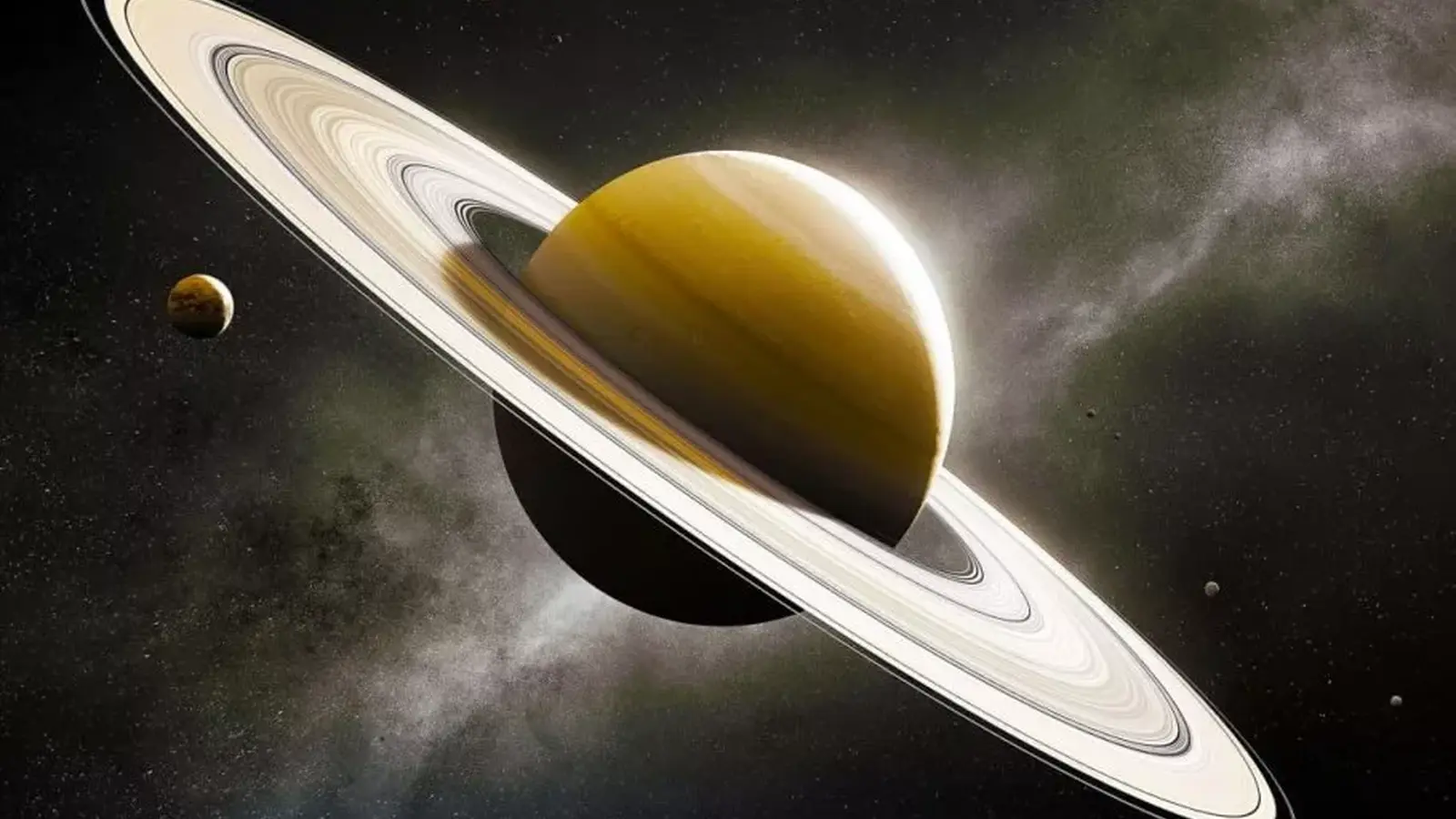
Imagine Saturn not as a static jewel in the night sky but as the aftermath of an ancient train wreck: moons smashed, debris strewn, a great ring system born. That is the startling picture emerging from new computer simulations and careful re-examination of decades of spacecraft data. The rings we admire today might be the fresh scars of a collision that occurred about 100 million years ago — when dinosaurs still roamed Earth.
Saturn's array is dramatic: iconic icy rings and at least 274 known moons. Yet some puzzles have nagged planetary scientists for years. Why do Saturn's rings look so young? Why does Titan, the planet's largest moon, follow a slightly odd, eccentric orbit and show fewer impact craters than expected for its size and age? A fresh study from researchers at the SETI Institute, accepted by the Planetary Science Journal, proposes a single, violent episode that could answer both questions at once.
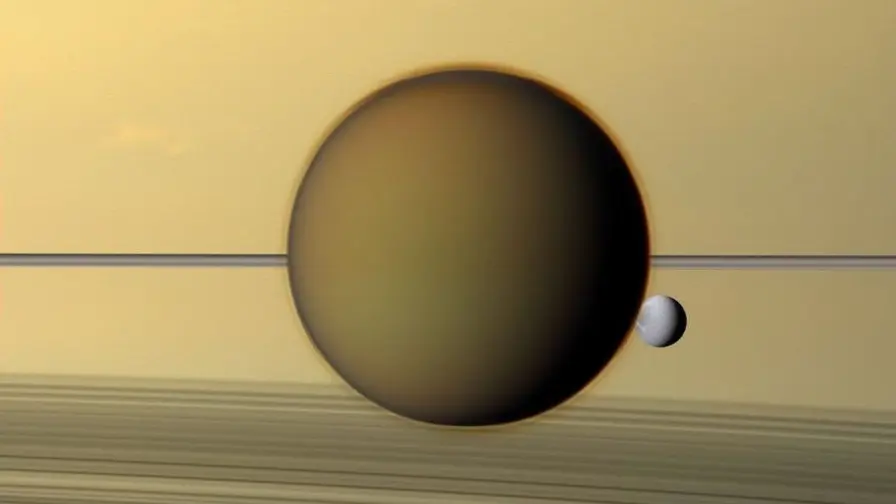
Matija Ćuk, lead author of the paper, says the key clue came from a quirky little moon called Hyperion. Hyperion's chaotic rotation and orbit make it exceptionally sensitive to disturbances. In many simulated histories where an extra unstable moon existed, Hyperion would have been destroyed unless another specific sequence of events had taken place. That led researchers to test a more complex scenario: rather than one lost moon, two primordial satellites — a proto-Titan and a smaller proto-Hyperion — collided and merged.
Collision, rings, and Titan's oddities
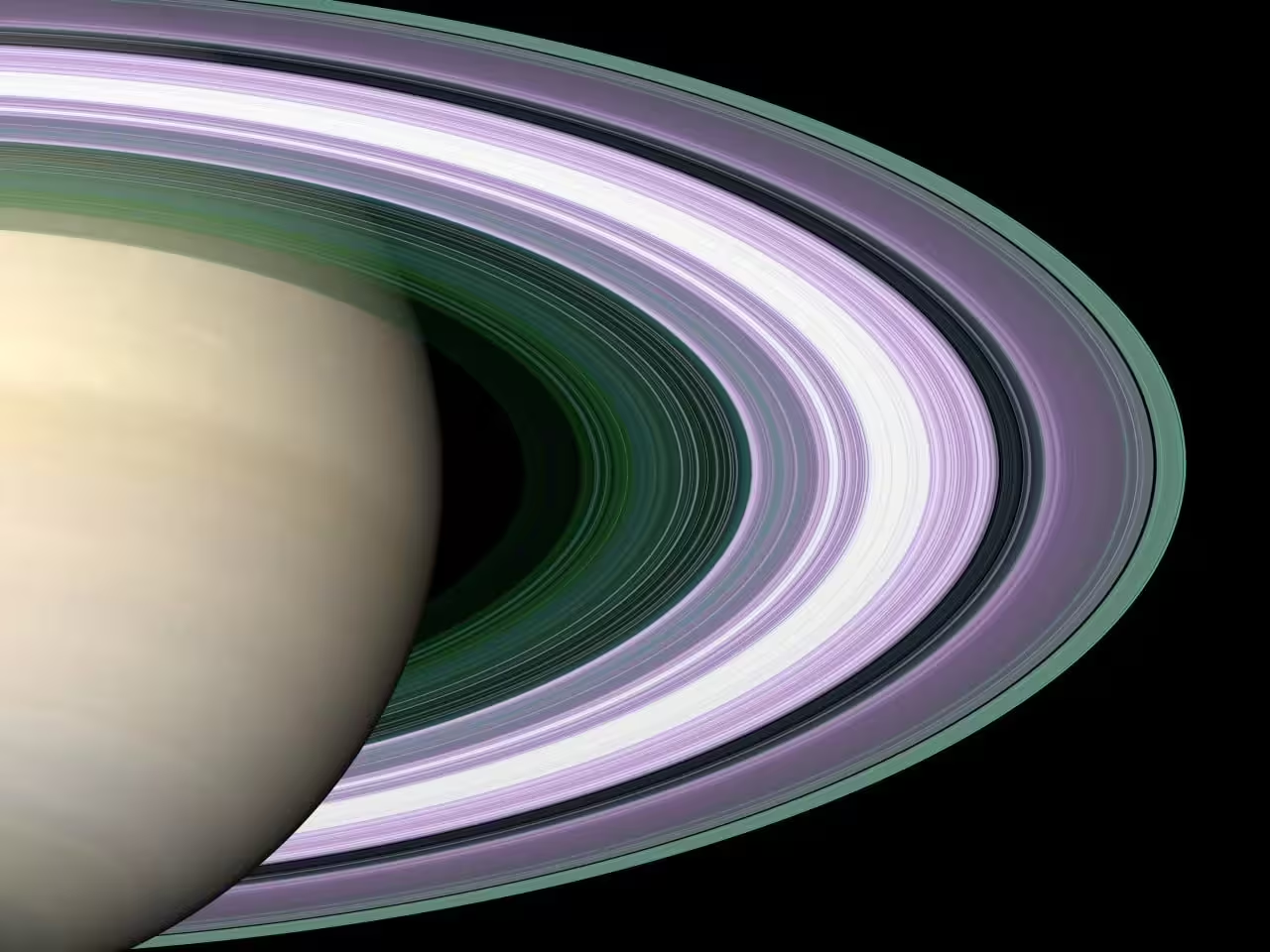
The simulations show the consequences in sharp detail. A high-energy merging of proto-Titan and proto-Hyperion could have produced the present-day Titan while imparting a significant eccentricity to its orbit. At the same time, the newly disturbed Titan orbit would have gravitationally scrambled the orbits of the inner, smaller moons. Those moons were thrown into colliding, destructive trajectories, grinding themselves into fragments that settled into the spectacular rings we see now.
If this model is correct, a single cosmic merger explains both Titan's unusual orbit and the youthfulness of Saturn's rings. That tidy connection is why many in the planetary community are taking the result seriously: it ties together dynamical modeling with tangible observables.
Cassini's 13-year exploration of the Saturn system transformed what we know. Pioneer 11 and the Voyager missions gave the first close looks, but Cassini's detailed gravity, imaging, and compositional data upended older assumptions and revealed the rings' fine structure and surprising mass. Still, simulations can only go so far without fresh, in situ confirmation.
That confirmation may arrive from NASA's Dragonfly mission, scheduled to reach Titan in the mid-2030s. Dragonfly is a rotorcraft lander designed to sample surface materials and probe Titan's chemical history. By measuring isotopic ratios and surface composition, Dragonfly could test predictions of a merger origin — for example, whether Titan bears geochemical signatures consistent with formation in a violent collision rather than a slow accretionary history.
There are larger implications. If rings can form from moon-moon collisions relatively recently in Solar System history, then ring systems may be far more ephemeral and dynamic than we presumed. Planetary systems are not museum pieces; they are evolving, sometimes in dramatic bursts. What other planets hide similar scars? And what does this mean for interpreting exoplanetary rings and satellites?
Answers will come slowly, piece by piece. For now, the idea of a lost moon crash giving birth to Saturn's young rings and reshaping Titan's destiny offers a vivid reminder that even familiar worlds can harbor surprising, violent pasts.

“My work centers on sustainability, energy, and environmental science — examining how innovation can lead to a greener future.”

Discussion
Leave a Comment
Comments (2)
Is this even true? Simulations look convincing but models get tweaked. Cassini gave hints, Dragonfly might confirm — years away, so kinda skeptical yet curious
Wow, a moon crash 100 million yrs ago? mind blown. If Titan formed in a violent merge that could explain a lot, but are the isotope predictions really solid…