
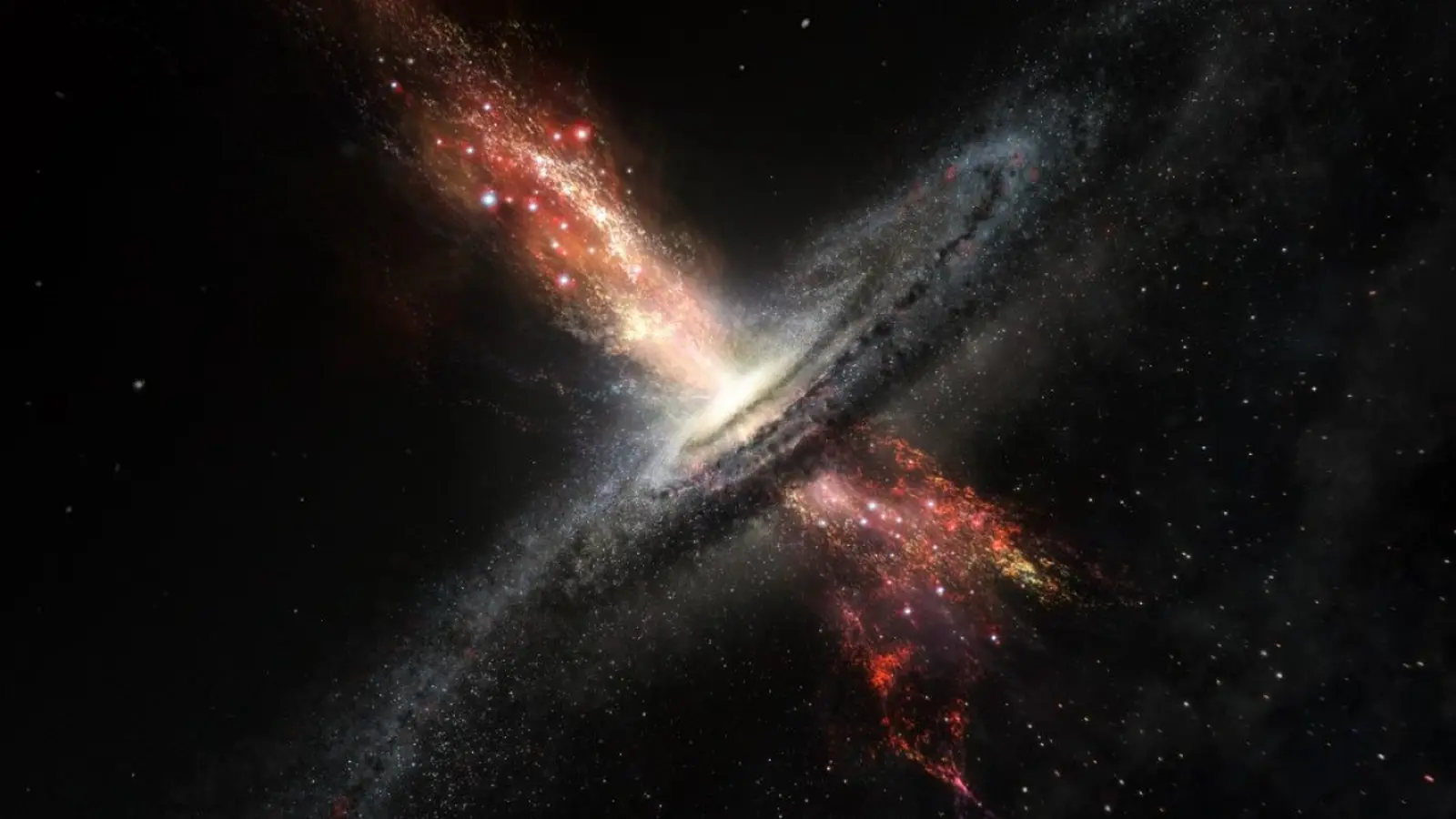
A cold, faint pinprick of infrared light arrives after more than 13 billion years of travel. It is not a star. It is the ferocious glow of a supermassive black hole feeding at the edge of cosmic dawn. These are quasars, and a new haul of them is changing how astronomers read the universe’s opening chapter.

A quasar emits exceptional amounts of energy generated by matter falling into a supermassive black hole.
Euclid’s sweep turned rarity into a population
Until recently, the earliest quasars were curiosities: isolated, extremely bright beacons found one by one after long hunts. Then the European Space Agency launched the Euclid telescope and opened a different kind of search. By mapping near-infrared light from above Earth’s atmosphere, Euclid avoids the background glow that blinds ground telescopes. The result is both depth and breadth across the sky, and that combination matters when targets are vanishingly scarce.
In the most recent survey release, teams working with Euclid identified 31 quasars that formed when the universe was less than 700 million years old. Fourteen of those sit at redshifts of 7 or greater, and two reach redshifts of 7.69 and 7.77. To put that in context, a redshift near 7.7 shows us light emitted when the cosmos was about 5 to 6 percent of its present age. It is a look almost straight into the first billion years.
Why is that important? Because finding many early quasars lets astronomers move beyond anecdotes and start mapping a population. Do these black holes live in dusty starburst galaxies or in rare, pristine environments? Do they grow by steady accretion or by rapid, exotic pathways? Euclid’s larger census begins to answer those questions by supplying targets in numbers that matter.
When giants appear too soon
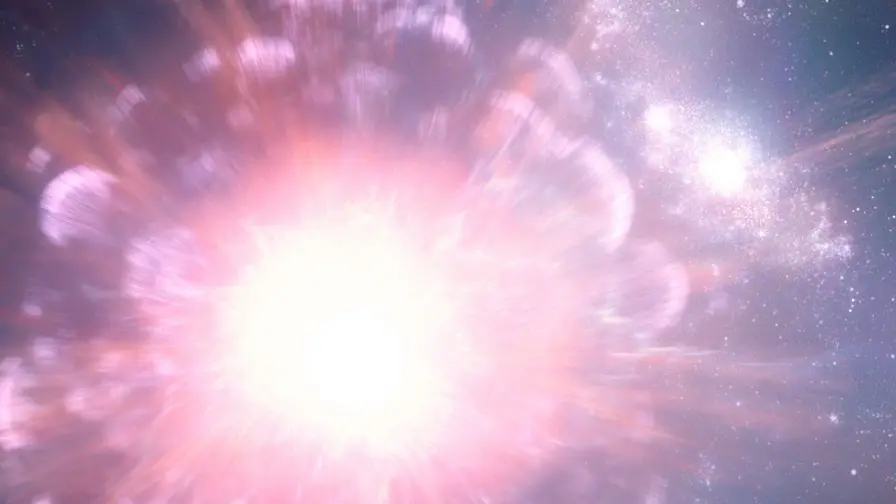
One stubborn surprise keeps resurfacing. These quasars are powered by black holes with masses of hundreds of millions to billions of suns. How do such giants exist when the universe was barely getting started? Theoretical models struggle. Standard growth by steady feeding from a host galaxy has a hard time producing billion-solar-mass black holes in a few hundred million years.
Several routes are under consideration. One possibility is that seeds formed heavier to begin with, perhaps from the direct collapse of massive gas clouds rather than from the deaths of the first stars. Another idea is that black holes grew in bursts, fed by frequent galaxy mergers and dense gas reservoirs that allowed super-Eddington accretion episodes. Observations will distinguish between these scenarios, but only if astronomers can measure black hole masses, host gas contents, and star formation rates for a sizable sample.
Follow-up work has already begun. The second oldest quasar in the new sample, for example, sits inside a dusty, gas-rich galaxy with intense star formation. That pairing hints at a coevolution of black hole growth and galaxy building during the epoch of reionization, a time when the first luminous sources ionized the neutral hydrogen filling intergalactic space. Each newly found quasar is therefore not only a probe of black hole physics, but also a probe of how the earliest galaxies assembled and how their light changed the intergalactic medium.
How they were found and confirmed
Detecting quasars at redshift 7 and beyond is technically demanding. Their ultraviolet emission is redshifted into the near-infrared, the same part of the spectrum where Earth’s atmosphere glows. From the ground, distinguishing a distant quasar from a much closer star is like finding a matchstick next to a lighthouse at dusk. Euclid changes that because it operates above the atmosphere and surveys large swaths of sky at the right wavelengths.
But finding candidates is only the start. Machine learning pipelines trained on millions of sources help sift the Euclid catalogs and flag promising quasar candidates. Spectroscopic confirmation is required to measure redshift and verify that the object is indeed a distant quasar. Using privileged time on very large ground telescopes, including the Keck observatory, astronomers have confirmed two-thirds of the new sample and secured the three most distant sources so far.
Software tools also matter. The teams used advanced data reduction packages to extract faint spectral signatures from noisy images. PypeIt, a data processing toolkit developed and refined by groups with access to Keck, played a significant role in turning candidate lists into confirmed high-redshift quasars.
What comes next for the quasar chronicle
Finding the quasars is a first mile, not the finish line. To understand formation pathways, astronomers need detailed measurements of black hole masses and the gas around them. Approved observations with the James Webb Space Telescope will measure emission lines and continuum properties that yield black hole mass estimates. ALMA, the Atacama Large Millimeter Array, will map cold dust and molecular gas in the host galaxies and trace star formation. Together these facilities provide complementary diagnostics: JWST for the central engine and ionized gas, ALMA for cold fuel and stellar nurseries.
The immediate milestone on many teams wish lists is a confirmed quasar beyond redshift 8. That would be a direct glimpse into the first 600 million years and place even tighter constraints on seed formation and growth rates. Euclid’s survey footprint will continue to expand, and machine learning will keep improving, so the odds of finding such a source are better now than they were a year ago.
Expert Insight
Dr. Joseph Hennawi, whose group led much of the candidate selection and follow-up effort, summarizes the stakes plainly. He says that every additional quasar at these redshifts tightens limits on plausible growth histories and forces models to account for both the number density and the masses we observe. This is not a minor tuning exercise; it asks whether our basic narratives for early galaxy and black hole coevolution are complete.
To add perspective from a different angle, Dr. Mira Patel, a fictional expert in observational cosmology and a science communicator who has worked with multiwavelength surveys, comments on the technological leap involved. She notes that Euclid's combination of area and near-infrared sensitivity turns rare objects into statistical samples, and that coordinated follow-up with JWST and ALMA will convert cataloged sources into physical stories about growth, feedback, and the reionization timeline. Her view highlights that discoveries become science only when we connect photons to physical models.
Implications beyond the headlines
These deep-time quasars are more than record holders. They are laboratories for fundamental physics and cosmic history. Measuring how the ionized zones around early quasars grew will inform when and how the universe completed reionization. Mapping the metal content and dust in their host galaxies will tell us how quickly the first generations of stars enriched their surroundings. And tracking the demographics of black holes at high redshift informs predictions for gravitational wave sources that future detectors may see.
The discovery of 31 ancient quasars in a single survey year is also a reminder of how advances in instrumentation and data analysis change the kinds of questions astronomers can answer. Once, models about the early universe were built on handfuls of extreme examples. Now, populations are within reach, and that changes both the statistical power of tests and the surprises they can reveal.
Conclusion
Euclid has pushed a window open onto the universe when its first giants were forming. The next steps will be forensic: measuring black hole masses, mapping host galaxies, and piecing together how these monstrous objects grew so quickly. The combination of Euclid’s wide reach, machine learning candidate selection, and powerful follow-up facilities like JWST, ALMA, and Keck gives astronomers the toolkit to turn discovery into understanding. The story of the first billion years is being rewritten, one quasar at a time.

“The cosmos has always fascinated me. I write about space missions, astronomy, and the technologies pushing humanity beyond Earth.”

Discussion
Leave a Comment
Comments (3)
Feels a bit hyped. 31 objects is cool but we still need more detailed spectra before rewriting cosmic history. still excited tho
Is this even true or are selection effects skewing the numbers? curious how robust the mass estimates are, esp at z~7.7… followup pls
wow, a quasar from the first billion years? mind blown. such monsters so soon, makes you rethink seeds and fast growth... unreal.