
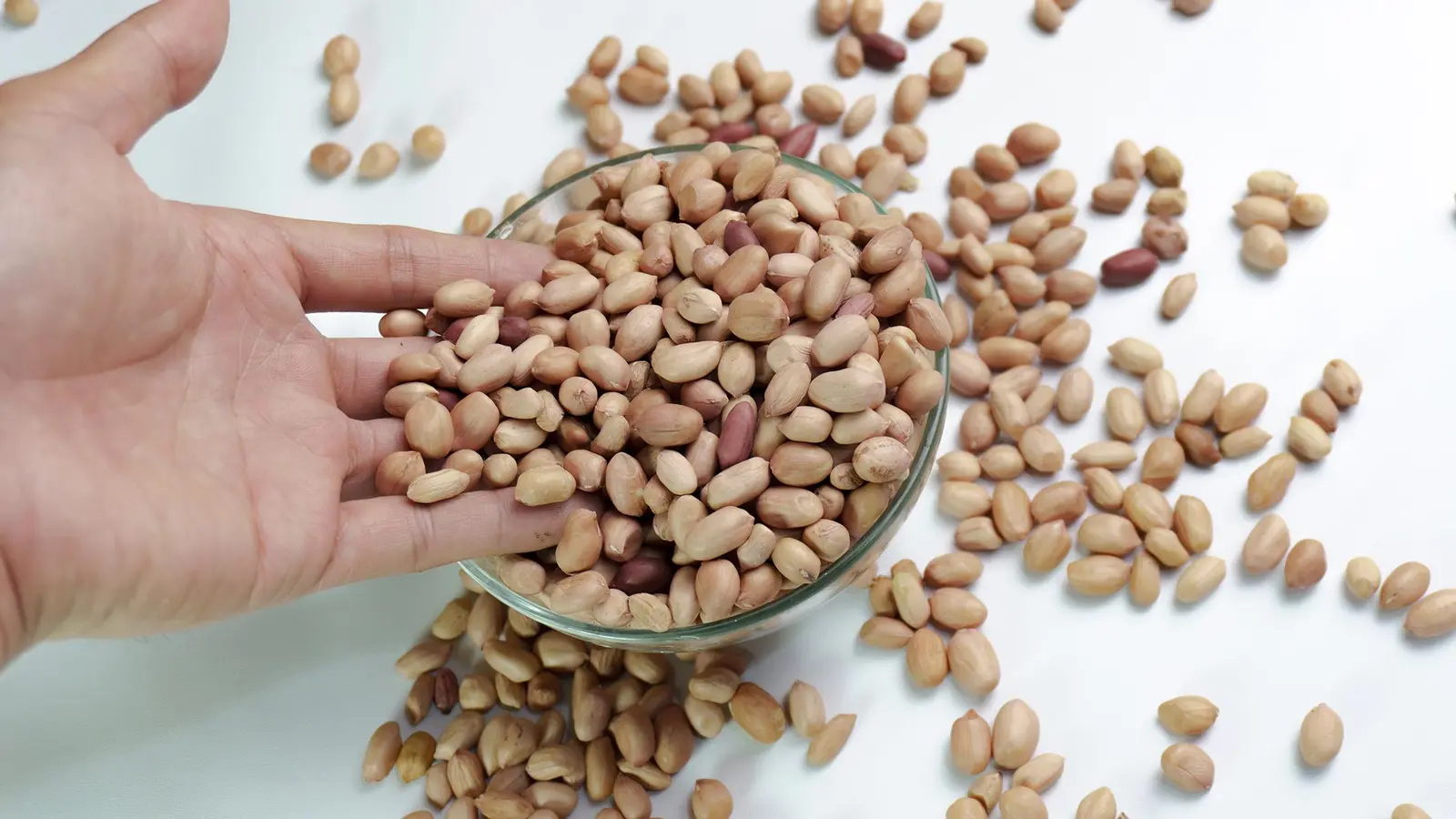
Imagine a small, crunchy habit nudging the aging brain back toward sharper memory. It sounds almost too simple. Yet a controlled clinical trial from Maastricht University suggests that a daily serving of unsalted, skin-roasted peanuts can improve how parts of the older brain respond to insulin, a hormone tightly linked to learning and memory.
A small clinical trial suggests that a common food may improve how the aging brain responds to insulin in regions involved in memory.
What the study did and who took part
Researchers at the Institute of Nutrition and Translational Research in Metabolism at Maastricht University Medical Center enrolled 31 healthy adults aged 60 to 75. Each participant completed two 16-week periods: one in which they ate 60 grams of peanuts per day and another control period without peanuts. The trial used a randomized, controlled crossover design so every person served as their own comparison.
Participants received premeasured packets holding about 60 grams, roughly two modest handfuls. They could consume the portion in a single sitting, spread it across the day, or add it to meals. Timing was flexible but participants were asked to take the peanuts in the morning or afternoon.
How brain insulin response was measured
The team tested the brain response by administering insulin intranasally, a method that delivers the hormone directly toward the central nervous system without major effects on blood sugar. They then measured local changes in regional cerebral blood flow using arterial spin labeling magnetic resonance imaging, or ASL-MRI. Regional blood flow shifts act as a proxy for neuronal activity and metabolic responsiveness to insulin.
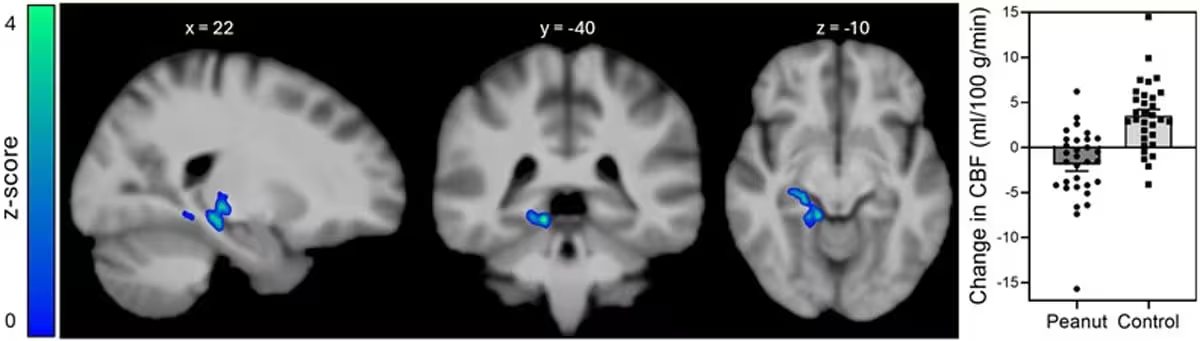
Insulin-induced changes in regional cerebral blood flow (CBF; mL/100 g/min). Whole-brain analysis revealed one cluster in the right hemisphere where CBF responses to intranasal insulin were beneficially affected after the peanut intervention compared with the control period (-5.4 ± 5.4 mL/100 g tissue/min). This cluster encompassed parts of the lingual gyrus, hippocampus, parahippocampal gyrus, thalamus, and posterior cingulate gyrus. The color map corresponds to Z-values.
Where the changes showed up and what they mean
After the peanut period, researchers observed improved insulin responsiveness clustered in a right-hemisphere region that includes the hippocampus and parahippocampal gyrus, areas central to memory encoding and retrieval, along with parts of the lingual gyrus, thalamus, and posterior cingulate gyrus. Those regional shifts suggest that the brain became more receptive to insulin’s signaling in circuits that support memory.

These neuroimaging results dovetail with earlier findings from the same 16-week intervention, published in Clinical Nutrition in 2025, which reported a 3.6 percent increase in global cerebral blood flow and a 5.8 percent improvement in verbal memory after daily peanut consumption. Cognitive tests in the trial included the Cambridge Neuropsychological Test Automated Battery, known as CANTAB. The researchers also tracked liver fat with abdominal MRI as part of their metabolic profiling.
Why peanuts might help
Peanuts pack a range of nutrients that could plausibly influence brain health. They contain unsaturated fats, dietary fiber, vitamins and minerals, and a range of bioactive phytochemicals. Peanuts are also a rich plant source of the amino acid L-arginine, which the body uses to make nitric oxide. Nitric oxide has been implicated in synaptic plasticity, the cellular foundation for learning and memory.
- L-arginine and nitric oxide signaling
- Monounsaturated and polyunsaturated fats that support vascular health
- Antioxidant phytochemicals that may reduce low-grade inflammation
Dr. Peter Joris, the study’s senior author and an associate professor at Maastricht University Medical Center, summarized the results by noting that enhanced regional insulin responsiveness could be one mechanism behind the observed cognitive benefits of unsalted, skin-roasted peanuts. He emphasized that multiple nutrients likely act together rather than any single component being solely responsible.
Limitations and what remains uncertain
Several caveats matter. The trial was small, with 31 participants, and lasted 16 weeks. That is enough to detect short-term changes in blood flow and memory tests, but not to prove long-term prevention of cognitive decline. The crossover design strengthens within-subject comparisons, yet larger and longer trials are needed to confirm durability, dose effects, and whether the observed brain changes translate to meaningful functional outcomes years later.
Also, the study focused on a specific peanut preparation: unsalted, skin-roasted. Results may not generalize to peanut butter with added sugar and salt or to salted, heavily processed snack products.
Expert Insight
"This study adds to a growing body of evidence linking diet to brain insulin signaling, a pathway increasingly recognized in aging and dementia research," says Dr. Elena Cortes, a fictive but representative neurologist and nutrition researcher. "It is not a magic bullet, yet a modest, practical dietary change that supports vascular and metabolic health could compound with other lifestyle factors to preserve cognition."
Conclusion
Daily unsalted, skin-roasted peanuts appear to improve regional brain responsiveness to insulin in older adults and were associated with small gains in verbal memory and cerebral blood flow in this trial. The findings are promising but preliminary. They point to a low-cost, accessible dietary strategy worth testing in larger studies as part of broader efforts to slow age-related cognitive decline.

“The cosmos has always fascinated me. I write about space missions, astronomy, and the technologies pushing humanity beyond Earth.”

Discussion
Leave a Comment
Comments
No comments yet. Be the first.