
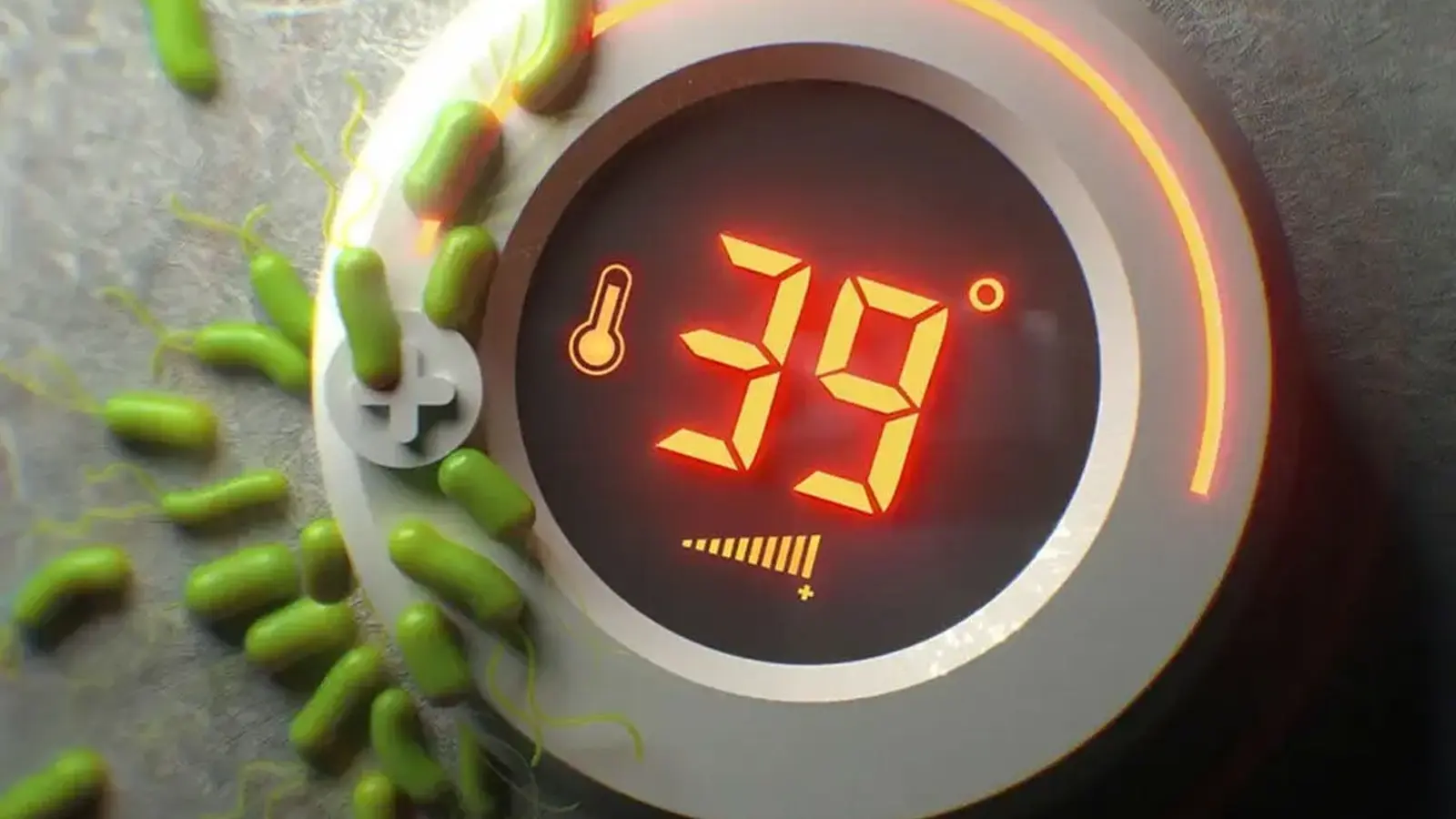
Gut microbes may help shape how strongly the body responds to vaccination. Flagellins produced by motile gut bacteria can promote inflammation and contribute to differences in fever responses after vaccination.
Imagine two people standing side by side at a clinic. They receive the same vaccine. One goes home with a sore arm and a low-grade fever for a day. The other walks away barely noticing. Why such a gap in reactions? New research points to a surprising suspect: the bacteria that live inside our intestines and the tiny whip-like proteins they make.
The microbial starting line matters
Vaccination is a controlled test of the immune system. Yet individuals arrive at that test carrying vastly different immune landscapes. Trillions of microbes in the gut don’t merely coexist with their host; they shape baseline immune activity through constant chemical conversations. That means a shot into two arms might meet two very different immune setups.
Researchers led by Ruth Ley at the Max Planck Institute for Biology Tübingen launched the µHEAT study to probe those differences. The team recruited healthy young adults who were scheduled to receive SARS-CoV-2 vaccines in 2021 and 2022. Participants collected stool samples, provided blood for immune profiling, and tracked their temperature in the week before and after vaccination.
What emerged was a pattern: people who mounted stronger fevers following vaccination often showed signs of heightened inflammation before their shots. Their gut microbes were not just different in composition; they were more active in genes that program bacterial motility — building and operating flagella, the microscopic propellers some bacteria use to swim.
Flagellin: a small protein with a big signal
Flagella are built from a protein called flagellin. Because flagellin is common to many motile bacteria — including pathogens — the immune system treats it like a familiar alarm bell. When flagellin is detected, the body can ramp up inflammatory responses. In the µHEAT cohort, higher microbial flagellin activity correlated with stronger post-vaccine fevers and raised markers of systemic inflammation in blood.
Correlation, however, is not causation. The team needed an experimental lever to test whether those microbes could change how a host reacts to vaccination.

From people into mice: testing causality
To move beyond association, the researchers transplanted human stool communities into germ-free mice — animals raised without any intestinal microbes. When mice received microbiomes from people who had experienced stronger fever responses, the mice also developed heightened inflammation after vaccination compared with mice receiving microbiomes from low-fever donors.
The effect depended in part on the animals’ ability to sense flagellin. Mice with intact flagellin-detection pathways showed exaggerated inflammatory responses, implicating the bacterial protein as a mechanistic contributor rather than a mere biomarker. In short: some gut communities bring a pro-inflammatory tilt that can amplify how the immune system reacts to a vaccine.
Those findings shift the conversation. Instead of seeing vaccine side effects solely as stochastic host responses, we can view them as interactions between vaccine antigens and the host’s microbial ecosystem. That opens two big questions: what drives higher flagellin production in some guts, and can that be modified?
Diet, industrialized foods, and microbial behavior
To explore drivers of flagellin production, the team looked at diet. Preliminary signals pointed toward diet as one modulator: participants who reported more plant-based diets tended to have milder fever responses, while components common in industrialized food were associated with increased flagellin activity in laboratory tests.
Benoit Chassaing of Institut Pasteur and colleagues found that certain food additives can stimulate flagellin production by gut microbes in vitro. In parallel, animal experiments showed that a high-fat Western-style diet enhanced inflammatory vaccine responses in mice. These results stop short of proving direct causation in humans, but they suggest that modern dietary patterns might favor the growth or activity of flagellated bacteria.
Does that mean a dietary tweak before vaccination could blunt fever? The authors caution that interventional human trials are needed. Still, the idea is plausible: change the microbial composition or behavior, and you may ease excessive inflammation without undermining the protective effect of vaccines.
Expert Insight

“The gut microbiome acts like a dial on the immune system,” says Dr. Maria Kline, an immunologist who studies host-microbe interactions. “Some dials are set higher by microbial products such as flagellin. That doesn’t mean vaccines become less effective if we adjust the dial — it means we might be able to reduce unnecessary collateral inflammation while preserving immune memory.”
Dr. Kline’s point highlights a practical tension in vaccine design and public health: side effects like fever are uncomfortable and can discourage uptake, yet they sometimes indicate an active immune engagement. The challenge is to reduce disruptive symptoms without blunting protective responses.
What this means for vaccine science and public health
Beyond immediate side effects, the study underscores a broader lesson: the gut microbiome is an integral variable in human immune health. If microbial communities influence responses to vaccines, they may also modulate how people react to infections, immunotherapies, and other immune challenges.
- Predictive value: Microbial signatures could one day help predict who is likely to experience stronger reactogenicity and who may need targeted counseling or management.
- Interventions: Probiotics, prebiotics, tailored diets, or short-term microbial modulation might become tools to smooth vaccine experiences.
- Equity: Dietary patterns and microbiome composition vary by region and socioeconomic status, meaning microbial-driven differences in vaccine responses could intersect with public health equity.
The research adds nuance rather than simple answers. It does not claim that gut microbes are the whole story; genetics, age, prior infections, and vaccine type all play roles. Still, flagellin emerges as a plausible biochemical link between food, microbiota, and inflammation.
Conclusion
When two people get the same vaccine and end up with different fevers, part of the explanation may be microscopic tenants in the gut and the proteins they produce. The µHEAT study suggests that bacterial flagellin can prime an inflammatory baseline that amplifies vaccine reactogenicity. Diet and lifestyle may influence that baseline, offering a potential route to reduce uncomfortable side effects without compromising protection.
Next steps will require carefully designed human intervention trials to test whether changing the microbiome or diet around the time of vaccination can reduce fever while preserving immune protection. If successful, such strategies could make vaccination easier to tolerate and help address a subtle source of vaccine hesitancy.

“My work centers on sustainability, energy, and environmental science — examining how innovation can lead to a greener future.”

Discussion
Leave a Comment
Comments
No comments yet. Be the first.