
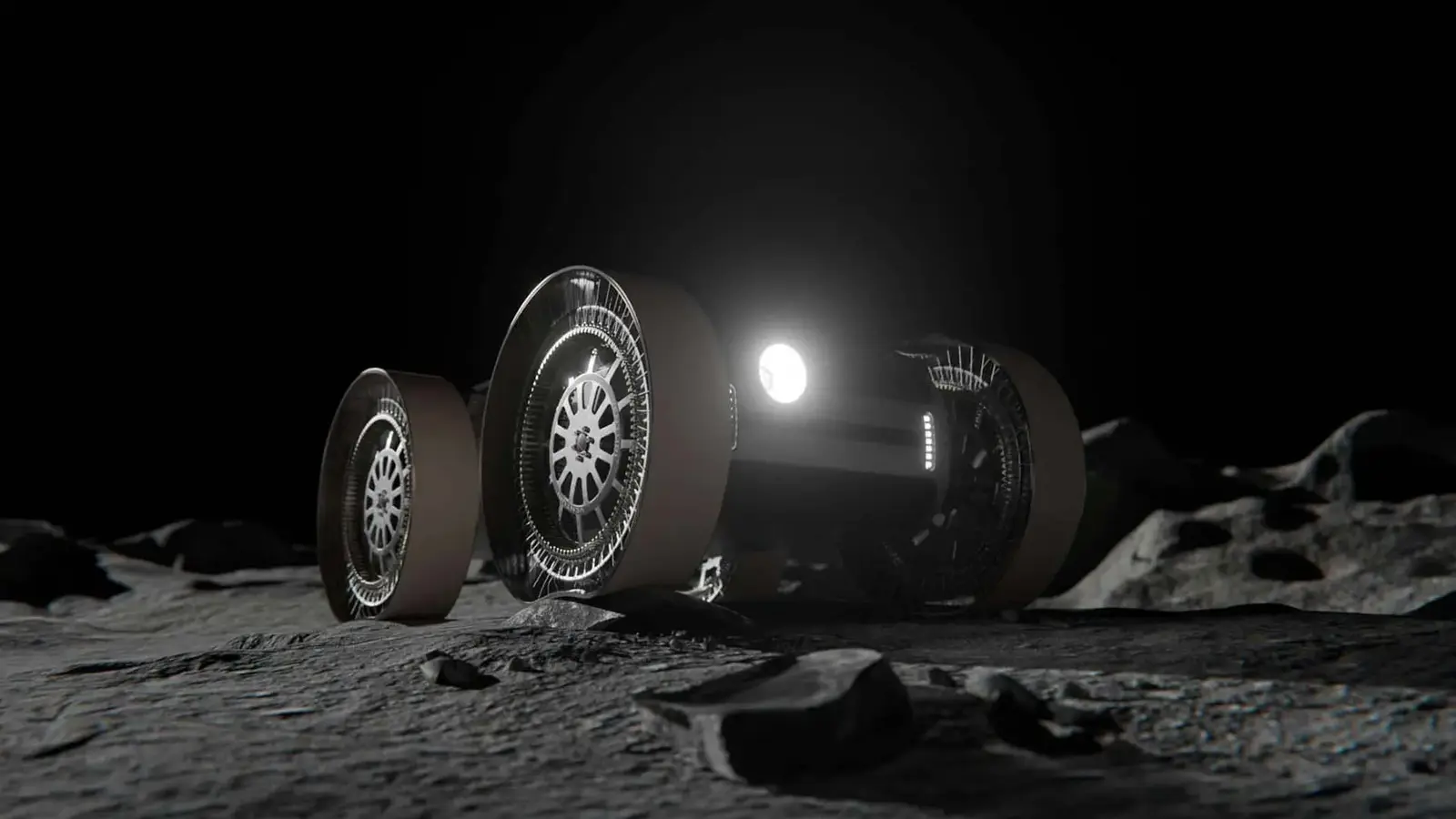
The first thing to know: this is not a software demo. Early November 2026 will see a private lunar rover touch ground with the explicit goal of running large language models beyond Earth. The mission is small in time but big in implications. Imagine a robotic field scientist that can read its own sensors, prioritize what to send home, and act on split-second decisions when radio silence makes human oversight slow or impossible.
Flip arrives with a computing brain
Flip, a 480 kilogram vehicle whose name stands for Flexible Lunar Innovation Platform, is being built by the private company Astrolab and is scheduled to land near the Moon's south pole. It carries a powerful onboard computer from Hewlett Packard Enterprise called Spaceborne-4. That computer is designed to run demanding models locally and to support more autonomous behavior than earlier rovers could manage.
Design choices are pragmatic. Flip uses deformable wheels to cross uneven terrain and is rated to survive at least 150 hours of the Moon's brutal nights. The payload list reads like a planetary scientist's wish list: a lidar system for three dimensional mapping, instruments to search for water ice in shadowed craters, and a sensor tuned to measure helium-3 isotope concentration in lunar soil. Twenty science payloads in total will ride on this vehicle.
How onboard AI will change lunar exploration
Why run models on the rover instead of on Earth? The answer is latency and scale. Communications to deep space are slow. A command sent from Earth may arrive minutes to tens of minutes later. That delay makes real-time oversight impossible for many tasks. Onboard AI can analyze camera feeds and lidar returns, choose safe paths, and compress or summarize the most relevant data to reduce the bandwidth needed to send findings home.
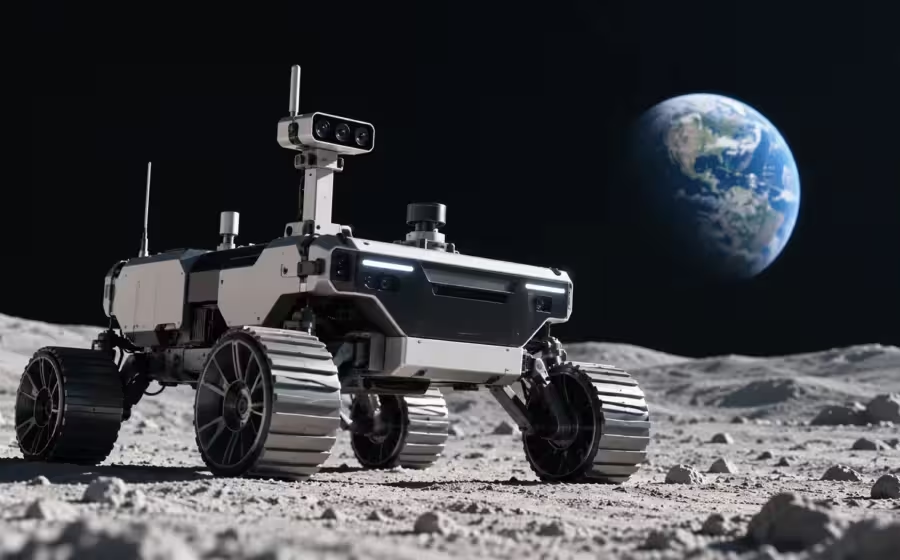
Flip's onboard models will do two main jobs. First, perception: they will interpret camera images and lidar point clouds to identify hazards and scientific targets. Second, data triage: instead of streaming raw telemetry, the rover can send short, curated reports that highlight anomalies or discoveries. The result is more science returned per unit of communication time, and fewer mission hours lost to waiting for instructions.
Hardware and resilience

Spaceborne-4 is not a consumer gaming PC dropped on the lunar surface. It is a radiation-tolerant architecture that pairs a 64 bit central processor with a capable graphics processor to handle parallel workloads. HPE relied on incremental engineering rather than a wholesale redesign: software routines detect charged particle hits, then throttle power and clock speed to reduce the risk of permanent damage. That approach helped earlier Spaceborne units survive and operate on the International Space Station beyond initial expectations.
HPE previously sent Spaceborne-2 and Spaceborne-3 to the ISS, where they ran Meta's Llama 3.2 in 2025 as part of an initiative informally called Space Llama. Astronauts used the system to accelerate experiment planning and data interpretation. Now those lessons will be tested in a harsher setting. The lunar surface near the south pole exposes electronics to roughly three times the cosmic radiation present inside the ISS, and temperatures swing from plus 80 degrees Celsius in sunlit spots to minus 200 degrees Celsius in deep shadow.
Still, HPE expects Spaceborne-4 to operate through Flip's planned ten day mission. Thermal control, radiator panels, and software-managed power states all work together to keep the computer within safe operating envelopes.
Practical risks and past lessons
Autonomy is not a silver bullet. Historical examples show how operator delays can cascade into mission loss. In fact, past lunar rovers have been lost after operators sent commands without full situational awareness, a hazard increased by radio lag. Onboard intelligence reduces that reliance on ground control, but it introduces new risks: models can hallucinate, misinterpret sensor noise as meaningful signals, or prioritize the wrong data to send home. In space, even a small mistake can have large consequences.
Roser Almenar, an AI and space law researcher at the University of Valencia, cautions that these models are still maturing. Model outputs must be validated and cross-checked against hard sensor measurements. The safety architecture must include fallbacks and human-in-the-loop reviews for critical decisions.
Expert Insight
Dr. Elena Cruz, a planetary robotics specialist, offers a practical view: "Running advanced models on the rover changes how we think about operations. Instead of micromanaging every maneuver, mission teams will set high-level objectives and let the system handle low-level execution. That reduces response time and increases scientific productivity, but it requires rigorous testing and transparent failure modes. You need to know when to trust the machine and when to step in."
Conclusion

Flip will not rewrite lunar exploration in a single mission, but it will test a critical idea: that sophisticated AI can be trusted to operate in extreme environments and to make the right calls when Earth is silent. If the tests go well, the architecture demonstrated by Spaceborne-4 and Flip could scale to support long duration missions, crewed operations in Artemis-era exploration, and even robotic scouts sent to Mars and beyond. The next decade of planetary science will be as much about algorithms and autonomy as it is about launch vehicles and instruments. Flip will show whether running language models on the Moon is a useful tool or merely an experiment in applied audacity.

“The cosmos has always fascinated me. I write about space missions, astronomy, and the technologies pushing humanity beyond Earth.”

Discussion
Leave a Comment
Comments (1)
Wait, so Flip runs LLMs on-board? Sounds risky, need more on validation, tests and fail safes. Model hallucinations in a crater could be mission-ending, pls explain