
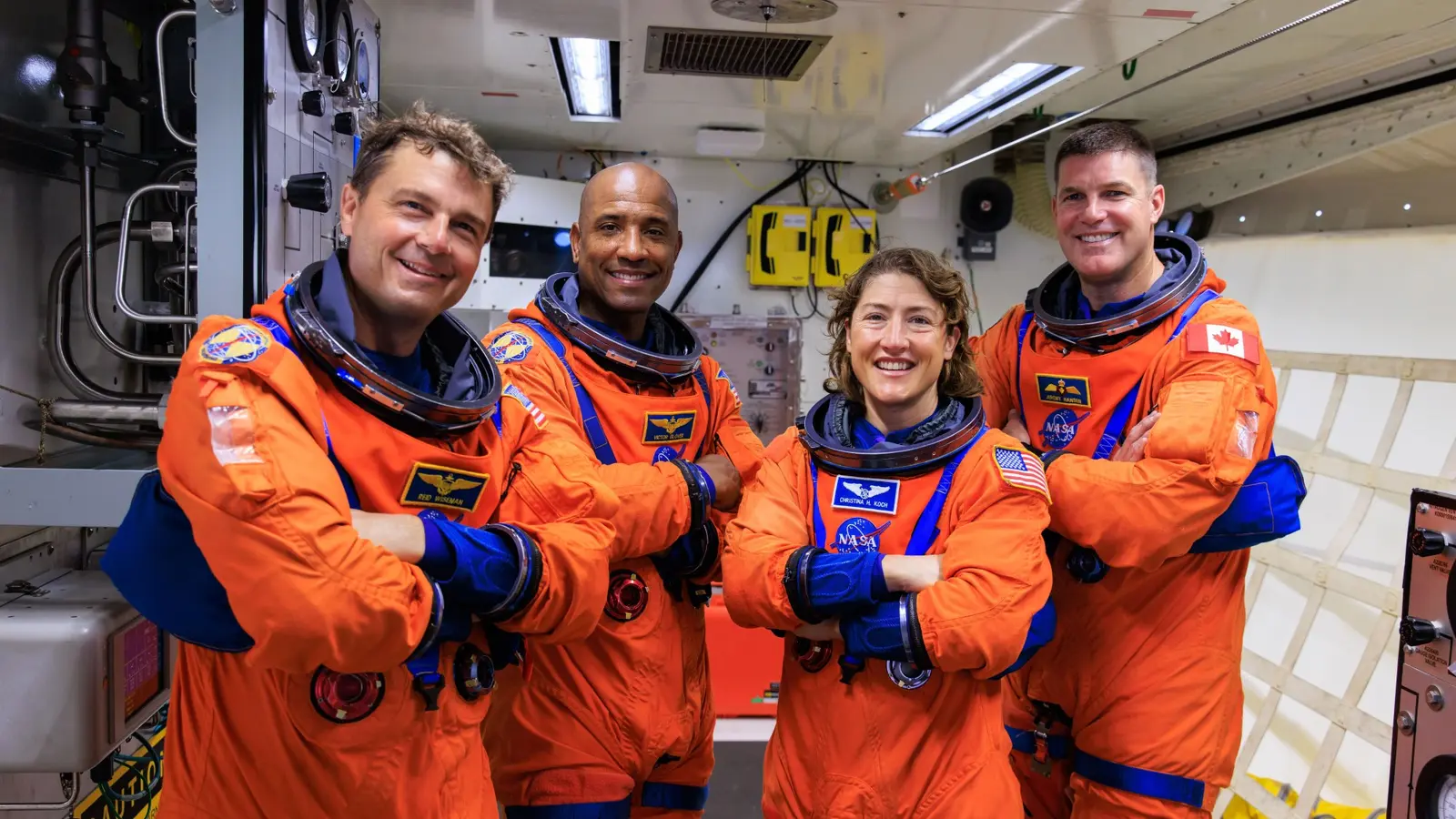
They pushed human presence farther than anyone before. Ten days. One spacecraft. A new distance record for people in space. And now, recognition in a public ceremony.
On Friday, August 28 at 11 a.m. EDT, President Donald J. Trump will present the Congressional Space Medal of Honor to each member of the Artemis II crew at NASA’s Johnson Space Center in Houston. NASA Administrator Jared Isaacman will join the President and the four astronauts for the event.
Why this matters
Artemis II was more than a test flight. It was the first crewed mission to ride NASA’s Orion spacecraft, validating life-support systems, guidance, communications, and the human factors that matter when you send people beyond low Earth orbit. Reid Wiseman, Victor Glover, Christina Koch and Canada’s Jeremy Hansen completed a ten-day lunar flyby that returned them to Earth on April 10.
But the mission’s headline is simple and stark: during that journey the crew traveled farther from Earth than any humans in history. That distance is not just a number. It is a practical boundary pushed outward — testing hardware and human endurance under conditions we will face on future lunar and deep-space missions.

From left, Artemis II crew NASA astronauts Reid Wiseman, Victor Glover, Christina Koch, and CSA (Canadian Space Agency) astronaut Jeremy Hansen are photographed on April 29, 2026, in the White House Oval Office with President Donald J. Trump.
What did Artemis II accomplish for science and exploration? It exercised Orion’s reentry profile after a deep-space trajectory, proved communication links over long distances, and gave engineers high-value human-centered data on living and working in cislunar space. All of this reduces risk for the Artemis program’s next steps: sustained lunar presence and eventual missions to Mars.
Who benefits from that data? Future astronauts. Mission planners. Robotic and scientific experiments that will ride future missions. And the ground teams that translate telemetry into safe operations.
Questions remain. How quickly will lessons from Artemis II be folded into Artemis III and beyond? How will international partners use the operational knowledge gained? Answers will unfold as mission teams analyze the flight data and update procedures.
The Houston ceremony is therefore both symbolic and practical: an acknowledgment of human achievement, and a public moment to underscore the program’s technical returns.
For a public eager to see humans return to deep space, awards like the Congressional Space Medal of Honor put faces to the abstract idea of exploration. They remind us that progress in space depends on people, tested systems, and the willingness to go a little farther than before.

“My work centers on sustainability, energy, and environmental science — examining how innovation can lead to a greener future.”

Discussion
Leave a Comment
Comments
No comments yet. Be the first.