
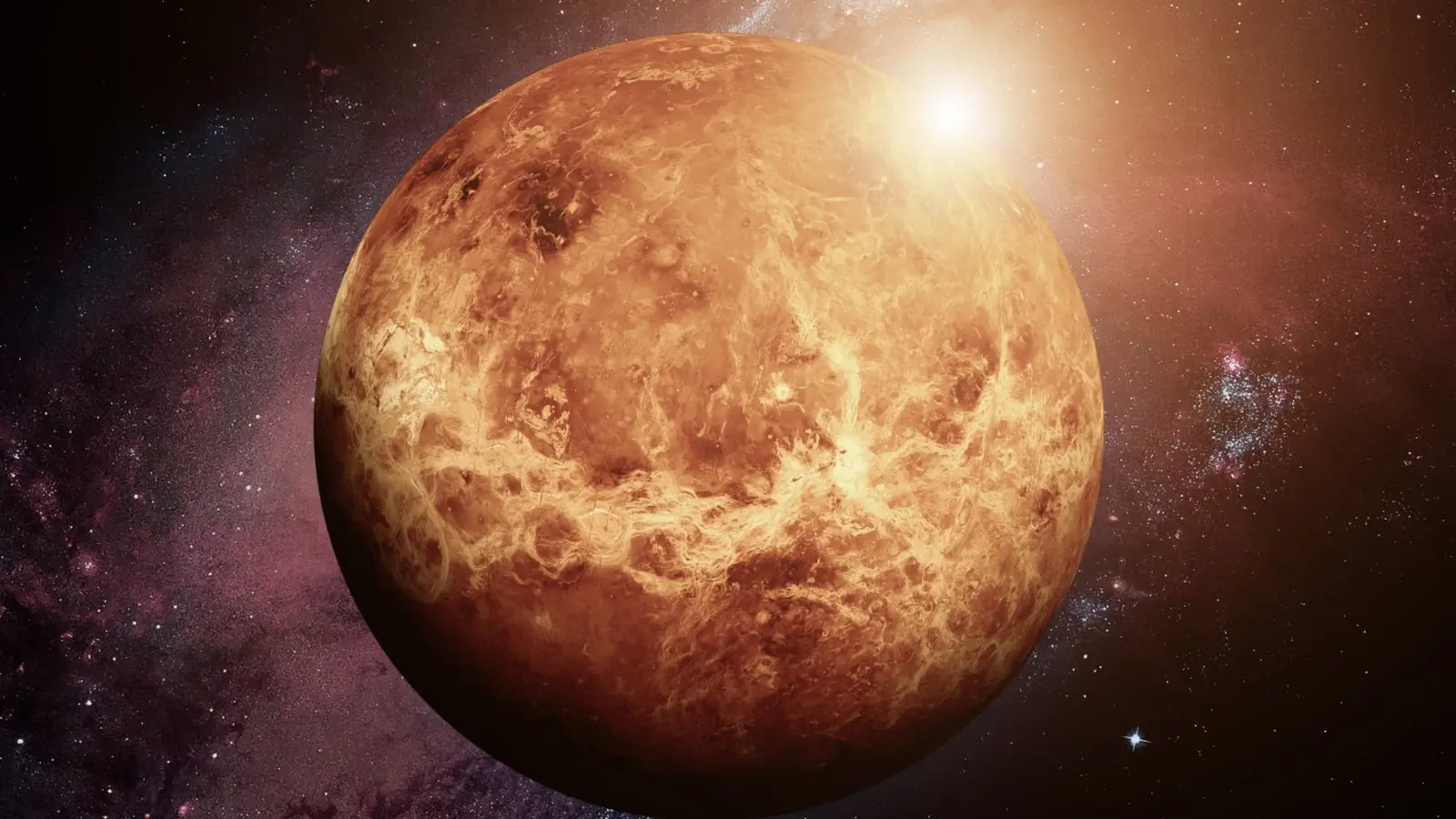
Picture a night sky where our sister planet once glowed with a companion. Now imagine that companion falling inward, a slow, inevitable descent until it vanished beneath a sulfurous atmosphere. It sounds like science fiction. But recent computer simulations offer a sober, scientific version of that story: Venus might not lack a moon because one never formed, but because its own gravity and glacial spin could have pulled a satellite back to the surface.
When planetary spin writes the script
On Earth, the Moon drifts away. Laser reflections from Apollo-era mirrors show our satellite recedes at roughly four centimeters per year. That outward motion is tied to Earth’s relatively brisk 24-hour rotation. Angular momentum transfers from planet to moon, nudging the orbit outward.
Now change one parameter: slow the planet’s rotation to a crawl. Venus needs 243 Earth days to complete a turn. That lethargic spin alters the choreography of tidal forces. In a set of simulations led by astrophysicist Stephen Kane at the University of California, Riverside, the outcome flips. Instead of pushing a moon outward, Venus’s rotation and gravity combine to drag a range of hypothetical moons inward until they collide with the planet.
Kane’s team began by validating their model on the Earth-Moon system, reproducing known orbital evolution to ensure realistic physics. Then they introduced variations: moons between half and ten times the mass of our Moon, and a sweep of rotation rates for Venus-like planets. Across most permutations, the moon’s orbital energy bled away. Larger moons met the surface sooner. Smaller ones took longer, but rarely survived indefinitely.
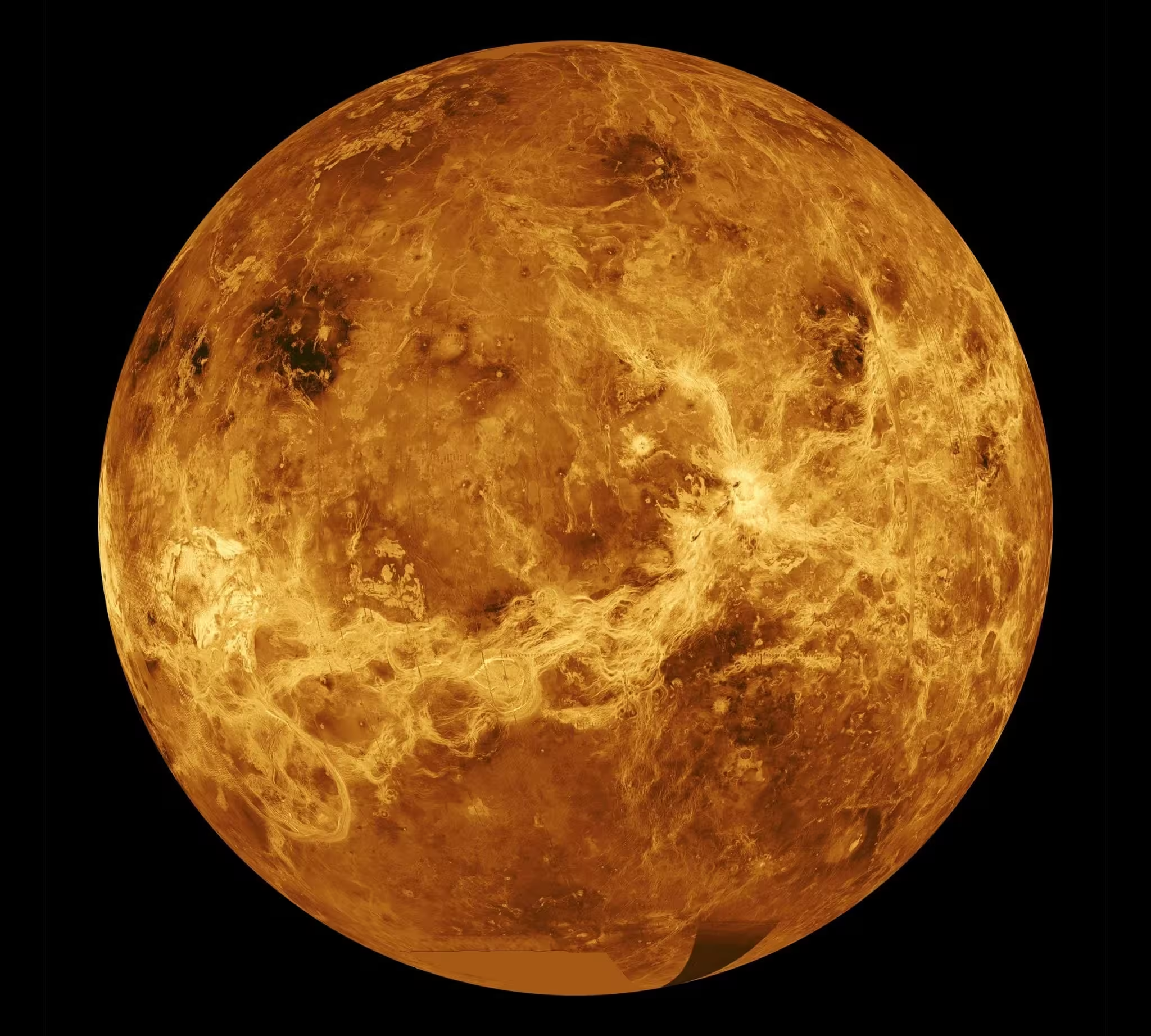
"My study shows Venus didn’t require a catastrophe to arrive at what we can see today," Kane has said. "It turns out the gravity of the planet itself combined with the rate at which it spins naturally caused the moon to collapse on top of it." That finding reframes how we think about satellite survival: not only violent early collisions, but long-term tidal dynamics can erase moons.
What happens when a moon plunges into a planet? The collision would inject vast amounts of energy and angular momentum. That can reconfigure a planet’s rotation, stir its mantle, and alter surface conditions and climate. If Venus ever hosted oceans or clement surface environments, a moon impact could have been a decisive, transformative event.
Implications beyond our neighborhood
The paper’s implications extend past Venus. When astronomers search for Earth-like exoplanets, they often ask whether those worlds have moons, because satellites influence tides, rotational stability, and possibly long-term climate. Kane cautions that a slow-rotating Earth twin might not keep a moon. "If these planets don’t rotate fast enough, the moon will crash to the surface, and that would change the course of history for those planets," he noted.
That raises a pragmatic point for habitability studies. A large moon can contribute to tidal mixing in oceans and may help stabilize axial tilt, which moderates seasonal extremes. But whether a moon is essential for life is unresolved. Kane suggests moons are beneficial but not strictly required; life may find other pathways on worlds without long-lived satellites.
Detecting geological fingerprints of a vanished moon on Venus is difficult. About 80 percent of Venus’s surface bears the mark of a global resurfacing event roughly a billion years ago, which obscured much of the planet’s earlier geology. Subsurface probes would offer a better chance. On Earth, seismic studies have revealed deep structures that some researchers associate with the aftermath of the Moon-forming impact. Comparable measurements on Venus could reveal anomalies hinting at a swallowed satellite.
Expert Insight
"Tidal dynamics are underappreciated architects of planetary history," says Dr. Aisha Patel, a planetary scientist who has modeled tidal evolution for exoplanet systems. "Kane’s results remind us that slow rotators have a fundamentally different destiny. A moon that looks stable on human timescales can be doomed over millions of years. For exoplanet surveys, that means we should treat moon presence as a time-sensitive feature, not a permanent badge of habitability."
That perspective has practical consequences for future missions. Instruments capable of probing Venus’s deep interior, or refined observations of exoplanet rotation rates and satellite candidates, could shift our understanding of how common moon loss is across the galaxy.
Conclusion
The idea that Venus might have literally swallowed its moon reframes old puzzles about a planet that shares Earth’s bulk but not its habitability. Whether by cataclysmic impact or by slow tidal siphoning, a vanished moon would leave its mark—if we can find it. These models do not prove Venus once had a satellite, but they open a plausible, testable pathway for its disappearance. In planetary science, sometimes silence—an absence of a moon—tells as rich a story as what we can see.

“My work centers on sustainability, energy, and environmental science — examining how innovation can lead to a greener future.”

Discussion
Leave a Comment
Comments
No comments yet. Be the first.