
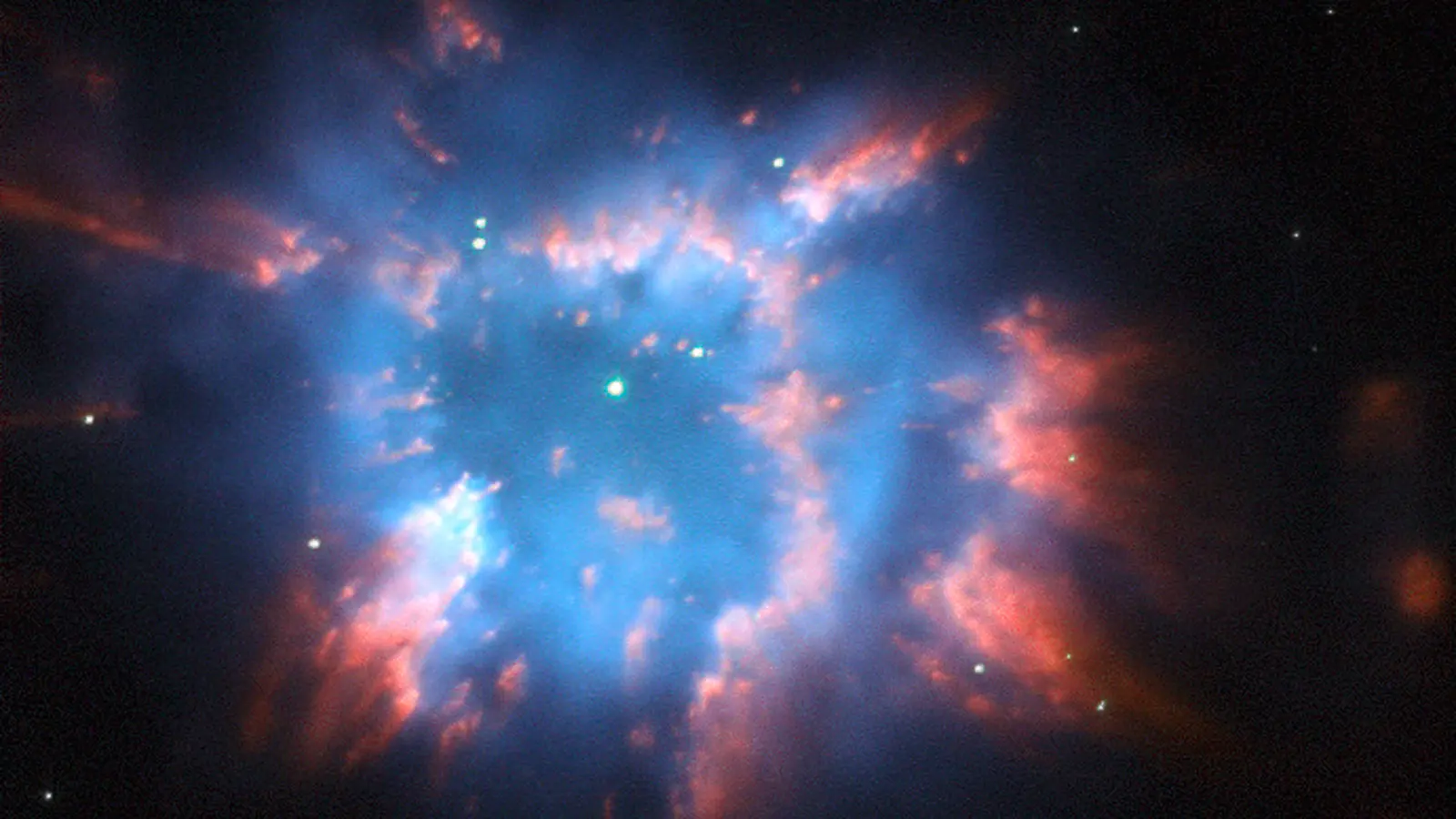
Imagine a universe wrapped in a haze so thick that the first starlight could not travel far. That haze lifted roughly 13 billion years ago in a process astronomers call reionization, when energetic photons ripped electrons from hydrogen atoms and transformed the cosmos from opaque to largely transparent. New Hubble observations now challenge a neat, long-standing story about how those photons escaped their home galaxies.
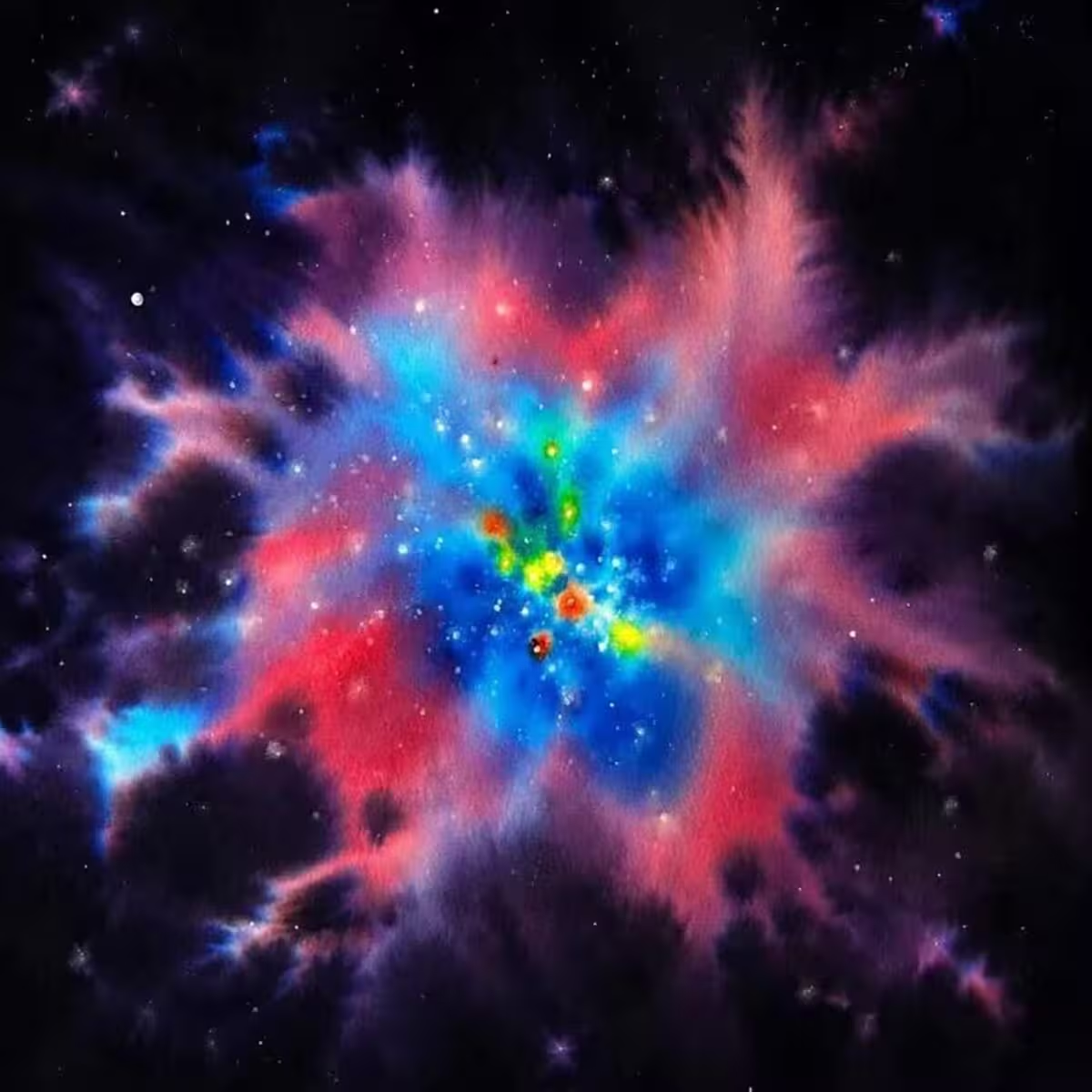
This painting shows massive stars emitting ionizing radiation, but gas swept up by supernova-driven galactic winds can prevent that radiation from escaping the galaxy.
When the expected clearing wind turns into a curtain
For years, theorists have leaned on a simple picture: massive stars explode as supernovae, their blasts drive fast galactic winds, and those winds punch holes in a galaxy’s gas. Ultraviolet photons then stream out through these channels and ionize the intergalactic medium. Elegant. Plausible. But observations led by Cody Carr, formerly at Zhejiang University and now at the University of Michigan, suggest reality is messier.
Using the Hubble Space Telescope to study nearby starburst galaxies—compact systems producing stars at furious rates that resemble early galaxies—the team measured how much ionizing radiation escapes and how fast gas is moving in the outflows. They did this by splitting galaxy light into spectra and reading the fingerprints that moving gas leaves: absorption dips shift and widen depending on speed and turbulence.
The surprising trend is clear. Galaxies with the fastest, most energetic winds tend to let the smallest fraction of ionizing photons escape. Faster winds, less leaked light. That runs counter to the idea that supernova-driven outflows primarily act as evacuation tools that clear pathways for radiation.
"Energy from exploding stars appears to stir up and redistribute gas and dust in ways that increase the covering of opaque material," says Stephan McCandliss of Johns Hopkins University, a senior author on the study. The implication is blunt: supernova winds can thicken the curtain rather than tear it down.
Young stars, small-scale winds, and a different exit strategy
If supernovae are not the main escape artists, then what is? The data point toward a more local, earlier mechanism. Radiation pressure and modest winds from newborn massive stars carve channels on small scales in their immediate neighborhoods. Those channels form before the first supernovae detonate. In other words, photons may slip out early, riding pathways created by stellar radiation and gentle outflows rather than by the later, violent feedback of supernova explosions.
That conclusion matters beyond tidy theorizing. Simulations of cosmic reionization rely heavily on assumptions about how feedback from stars and supernovae sculpts galactic gas. If supernovae actually increase the coverage of neutral gas and dust, then models must re-evaluate the timing and balance of feedback processes. Renyue Cen of Zhejiang University, another lead author, notes that the findings push modelers to examine how radiation and early stellar winds reshape gas before supernovae appear.
The study appears in Nature Astronomy and combines careful spectroscopy with a strategic choice of nearby analogues to ancient galaxies. Observing local starbursts gives astronomers a laboratory where they can measure processes in detail, then apply those lessons to the distant universe where direct observations are far harder.
Expert Insight
"What surprised me was how clearly the data point away from the simple supernova-clearance scenario," says Dr. Lena Ortiz, an astrophysicist at the University of Cambridge who was not involved in the study. "It suggests that timing is everything. The first phases of stellar life set the stage for photon escape, and the later, noisier supernova era can actually bury those early openings under swept-up gas and dust."
Ortiz adds that the result will likely change how people set up feedback prescriptions in large-scale cosmological simulations. "We will need to resolve smaller scales around young star clusters to see if models can reproduce this early leakage of ionizing photons," she says.
What this means for the cosmic story and future observations
The big-picture takeaway is modest but significant. We still lack a complete census of the objects that reionized the universe or a full timeline for how reionization unfolded. Yet these Hubble measurements provide a concrete constraint: supernova-driven winds do not automatically guarantee higher escape fractions of ionizing radiation, and in some cases the opposite is true.
The team plans to request additional Hubble time to expand the sample of local starbursts and refine measurements of wind speed and escape fraction. Meanwhile, next-generation observatories that can probe the faint galaxies of the early universe directly will test whether the nearby analogues truly reflect conditions at high redshift.
Hubble remains central to this work. The telescope, a NASA mission with contributions from the European Space Agency and supported through grants administered by the Space Telescope Science Institute, still provides the ultraviolet sensitivity and spectral detail required to trace ionizing-photon escape in the local universe.
Conclusion
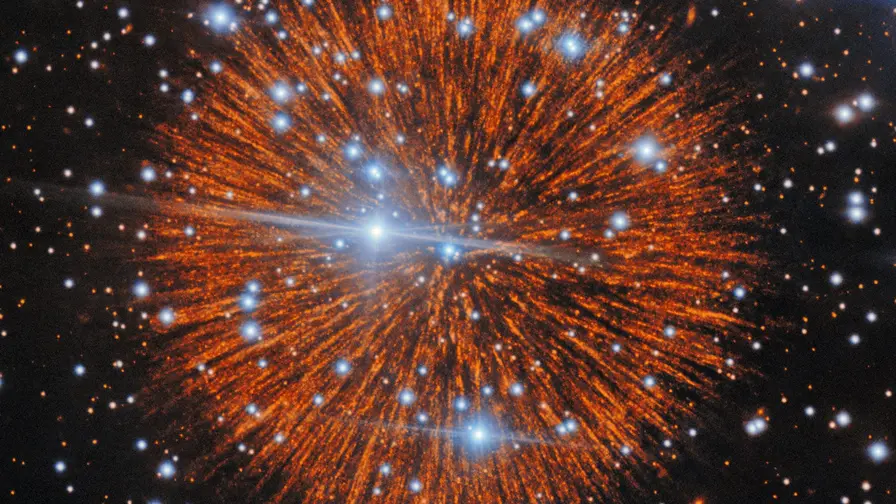
The cosmic fog did lift, but the mechanics of that clearing are more nuanced than previously thought. Rather than being widened by the brute force of supernova-driven winds, the routes that allowed ionizing photons to leave their birthplaces may have been forged earlier by young stars and gentler outflows. That subtle shift in perspective matters for both observation and simulation as astronomers piece together how the first billion years of cosmic history unfolded.

“The cosmos has always fascinated me. I write about space missions, astronomy, and the technologies pushing humanity beyond Earth.”

Discussion
Leave a Comment
Comments
No comments yet. Be the first.