

Cold does something strange to living tissues. It does more than slow chemistry; it flips switches inside cells that can push organisms toward longer, healthier lives.
Researchers publishing in Nature have traced one of those switches to a small metabolite produced and released by muscle. The molecule, dihydrobiopterin (BH2), appears to be a systemic messenger: made in muscle, ferrying information to distant tissues, and nudging protein quality control systems toward greater resilience as animals age.
How a muscle signal ripples across the body
Scientists have observed for more than a century that colder conditions extend lifespan in species from worms to mice. For years the assumption was passive: lower temperatures slow metabolism, so damage accumulates more slowly. But recent work argues for active biological programs. The new study adds a vivid piece to that puzzle.
In the nematode Caenorhabditis elegans, a moderate drop in temperature — from the usual lab warm to about 15 °C — increases production of an enzyme called CAT-4, predominantly in muscle tissue. CAT-4 drives synthesis of BH2. Once released into the body, BH2 is converted into the bioactive cofactor tetrahydrobiopterin (BH4). BH4 then enables an enzyme, PAH-1, to make the amino acid tyrosine. That metabolic relay ultimately improves protein homeostasis, helping cells clear misfolded or aggregated proteins.
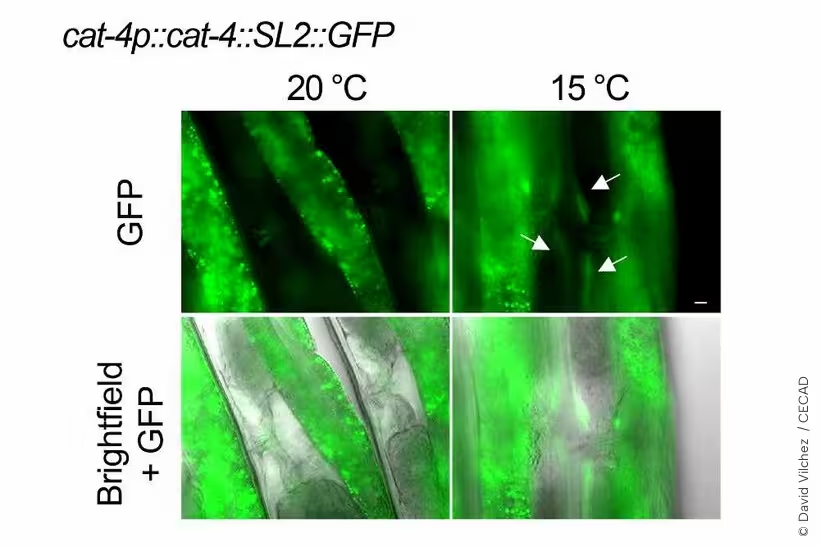
Increased production of the enzyme CAT-4 (green) in worms exposed to colder temperatures.
Why does that matter? Proteostasis — the maintenance of correctly folded, functional proteins — falters as organisms age. Aggregated proteins lie at the heart of many neurodegenerative diseases. By linking a muscle-derived metabolite to organism-wide proteostasis, the study maps a concrete route by which an environmental cue (temperature) can remodel cellular quality control.
From worms to human cells: promise and limits
The team used genetic tools to interrupt parts of this pathway in worms; doing so reduced the lifespan gain normally seen at colder temperatures. Conversely, raising CAT-4 levels in muscle extended lifespan even when worms were kept at normal or warmer temperatures. That implies the muscle-to-body signal is sufficient to reproduce at least some benefits of cold without lowering temperature itself.
Moving beyond worms, the researchers tested human cells engineered to form proteins typical of Huntington's disease and amyotrophic lateral sclerosis. Adding BH2 to those cultures reduced the accumulation of misfolded proteins. In motor neurons carrying an ALS-linked mutation, BH2 and tyrosine supplementation decreased markers of programmed cell death. These cellular results hint that aspects of the pathway are conserved across species, though the experiments stop short of demonstrating effects in whole mammals.
There is still a long road from cell culture and worms to safe, effective therapies for people. The authors and independent experts caution that many steps remain: confirming the pathway in mammals, understanding dosage and delivery, and ruling out unintended consequences of altering biopterin metabolism. But the discovery reframes cold as more than a sterile environmental variable; it can act as a trigger for organized, protective physiology.
Therapeutic possibilities and scientific context
Therapies inspired by this work could take several forms. One route is pharmacological: develop small molecules that boost CAT-4 activity or mimic BH2/BH4 function in target tissues. Another is tissue-directed strategies that stimulate muscle to produce beneficial metabolites. Both approaches would aim to harness the protective cascade without forcing patients to endure lower body temperatures.
From an evolutionary angle, the finding makes sense. Muscle is abundant, metabolically active, and well placed to sense and signal environmental stress. A muscle-originating protect-and-share strategy would allow a single tissue to coordinate organism-wide resilience during cold stress, when survival depends on maintaining critical functions.
Expert Insight
"This study gives us a mechanistic foothold in a phenomenon we've long observed but not fully understood," says Dr. Elena Maris, an aging biologist at the Institute for Molecular Gerontology. "The muscle-to-system signaling model is elegant because it leverages an organ that already monitors metabolic state. Translating that into therapies will require careful work, but the path is clear: identify safe ways to amplify the same molecular cues the cold naturally produces."
Conclusion

The Nature report does not claim a ready-made antiaging pill. It does something more valuable: it identifies a concrete, testable pathway linking environmental temperature, muscle metabolism, and organismal proteostasis. For researchers interested in aging, neurodegeneration, or metabolic signaling, the study opens practical lines of inquiry. For the public, it offers a simple lesson: the body responds to cold not just by shivering and saving heat, but by activating biochemical programs that, in some species, promote longevity. Whether those programs can be safely and selectively engaged in humans remains an open and important question.

“My work centers on sustainability, energy, and environmental science — examining how innovation can lead to a greener future.”

Discussion
Leave a Comment
Comments (1)
wow, muscle sending a longevity signal? wild. if BH2 works in humans tho, that's huge. cautious but hyped