

You sip from a can. The fizz, the sugar, the habit. Invisible to the eye, a thin epoxy lining may be shedding molecules into your drink. That lining often contains bisphenol A, or BPA, a chemical threaded through modern packaging since the 1960s. It is everywhere: in the plastics and the can linings that make food storage convenient. It is also in most people's urine, according to past surveys.
Small dose, measurable change
New human trial data have put a spotlight on an uncomfortable possibility: even what regulators call a "safe" dose of BPA can nudge the body's handling of glucose in an unfavorable direction. In a randomized, double-blind clinical trial, researchers gave 40 healthy, young adults either a low oral dose of BPA—equal to the US Environmental Protection Agency's lifetime reference dose of 0.05 milligrams per kilogram of body weight per day—or a placebo for five days. At the end of that window, participants who received BPA showed a roughly 9 percent drop in peripheral insulin sensitivity, while the placebo group showed a small increase.
Why does this matter? Insulin sensitivity describes how readily cells, especially those in muscle and fat, take up glucose from the blood when stimulated by insulin. Lower sensitivity is a hallmark of insulin resistance, a metabolic shift that precedes type 2 diabetes and correlates with elevated cardiovascular risk. A 9 percent change in a controlled, short-term experiment is not by itself proof of long-term disease. Yet it is a signal. It hints that routine exposure to common chemicals may alter fundamental metabolic pathways.
These findings were presented at the American Diabetes Association Scientific Sessions in 2024 and later published in The Journal of Clinical Endocrinology & Metabolism. The study team included researchers from California Polytechnic State University and Rutgers University. Lead voices on the paper pointed to public health implications: if even brief exposure at doses regulators consider acceptable can impair glucose metabolism, perhaps the reference dose deserves a fresh look.

Plastic bottles can contain BPA.
How the trial worked and what it revealed
The experiment built on prior, smaller trials and on observational studies that repeatedly linked higher BPA levels to metabolic problems. This time, the investigators improved measurement precision. Participants followed the same diet. Half received a daily BPA dose; half, a placebo. Urinary BPA concentrations rose as expected in the BPA group, confirming intake.
Researchers used gold-standard clamp techniques to estimate insulin sensitivity in participants. Those methods can distinguish peripheral tissue response from hepatic, or liver, insulin sensitivity, although the trial could not fully separate the two. The main signal pointed to peripheral tissues: skeletal muscle appeared less responsive to insulin-stimulated glucose uptake after BPA exposure. Common indices of liver insulin function remained similar between groups, suggesting the effect was localized outside the liver.

Observers noted that estrogen-like activity, a well-known property of BPA, did not seem to fully explain the observed change. That is notable, because BPA can mimic estrogenic signaling in cells, which has long been central to concerns about its biological impact. The present trial adds detail: the chemical may disrupt insulin-stimulated glucose metabolism in skeletal muscle via pathways that are not simply the same as classical estrogen receptor activation.
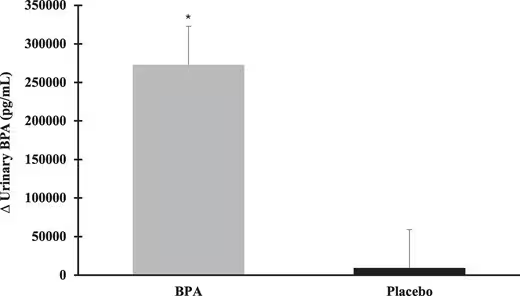
Change in urinary BPA concentrations in the BPA group versus the placebo.
Context: decades of suspicions
The EPA's reference dose for BPA dates back to 1988. Since then, decades of laboratory and epidemiological research have complicated the risk picture. Animal experiments going back to the 1990s showed that low-dose BPA exposure can create subtle but lasting changes in development and reproductive systems. Population studies have repeatedly associated higher BPA biomarkers with reproductive issues, altered neurodevelopment, cardiovascular disease, and metabolic disorders, including type 2 diabetes and insulin resistance.
Correlation is not causation. Epidemiology points to patterns. Animal work reveals mechanisms in controlled systems. What was missing until now was clearer experimental evidence in humans that oral BPA, at doses within regulatory limits, can change insulin responsiveness in the short term. That gap is what this randomized, placebo-controlled trial begins to fill.
Policy has sometimes moved faster in Europe than in the United States. Many food and beverage products sold in Europe now avoid BPA in their packaging. In the US, regulatory reevaluation has lagged, even as lawmakers have introduced legislation such as the No Toxics in Food Packaging Act to ban BPA from food packaging. Past versions of similar bills have failed to pass, and the federal reference dose remains the same. The new human data add pressure to reassess those benchmarks.
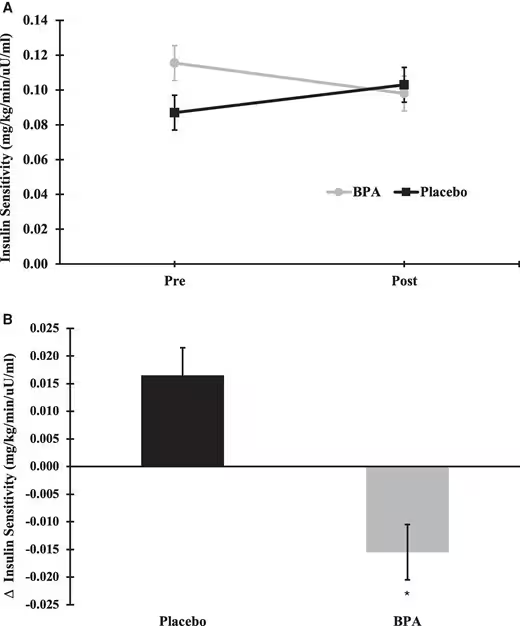
(A) Insulin sensitivity in BPA-50 and PL between baseline and post-treatment clamps; (B) change in insulin sensitivity in PL and BPA-50.
What it does not yet tell us

Important limits apply. Participants were young, healthy adults. How would BPA interact with the physiology of someone living with obesity, prediabetes, or established type 2 diabetes? Would repeated low-dose exposure over months or years produce cumulative changes? The trial ran for five days. It measured short-term shifts, not chronic disease outcomes. Larger, longer, and more diverse studies are needed to know whether the acute change in insulin sensitivity translates to clinically meaningful risk in a real-world population.
Still, the experiment was rigorous. Double-blinding, random assignment, and precise metabolic clamp measures move the evidence closer to causal inference than previous associative studies. That matters to clinicians and regulators alike. If a ubiquitous chemical nudges metabolism even modestly, the population-level consequences could be substantial.
Expert Insight
"Seeing a measurable decline in peripheral insulin sensitivity after only five days of exposure is striking," said Dr. Maria Alvarez, a fictional endocrinologist consulted for context. "Short-term trials cannot prove long-term harm, but they do tell us a chemical is biologically active at doses we thought were harmless. That should prompt both further study and precautionary thinking in public health policy."
Broader implications and next steps
What comes next is a mix of science and policy. Researchers will want to repeat the trial in larger, older, and more metabolically diverse populations. They will also seek mechanistic insight: which signaling pathways in muscle cells are affected? Are epigenetic changes involved? Do cumulative exposures from multiple sources amplify effects?
For regulators, the conversation is difficult but familiar. Risk assessment balances exposure, hazard, and uncertainty. New human experimental data sharpen the hazard profile and reduce uncertainty. They do not automatically dictate a specific regulatory action, but they do provide a stronger basis for reexamining the long-standing reference dose.
Consumers often look for simple fixes. Reducing exposure is straightforward in many cases: use glass or stainless steel containers, choose fresh or unpackaged foods when possible, and favor products that explicitly avoid BPA in their linings. Those steps are practical and low-cost, and they may reduce one source of chemical load while scientists and regulators sort out the larger picture.
Conclusion
The trial does not claim that short, low-dose BPA exposure causes diabetes. It does indicate that a common plasticizer, at levels regulators have previously treated as safe, can impair how muscle tissue responds to insulin over days. Given the high prevalence of diabetes and metabolic disorders worldwide, even a modest effect from a ubiquitous chemical is worth attention. Science advances by piling evidence: when mechanistic studies, animal models, population data, and now human experiments point in the same direction, policy and public awareness should follow.


“The cosmos has always fascinated me. I write about space missions, astronomy, and the technologies pushing humanity beyond Earth.”

Discussion
Leave a Comment
Comments (1)
Wow didnt expect a measurable drop in 5 days, thats wild. Switching to glass and avoiding canned stuff. Regulators wake up!