
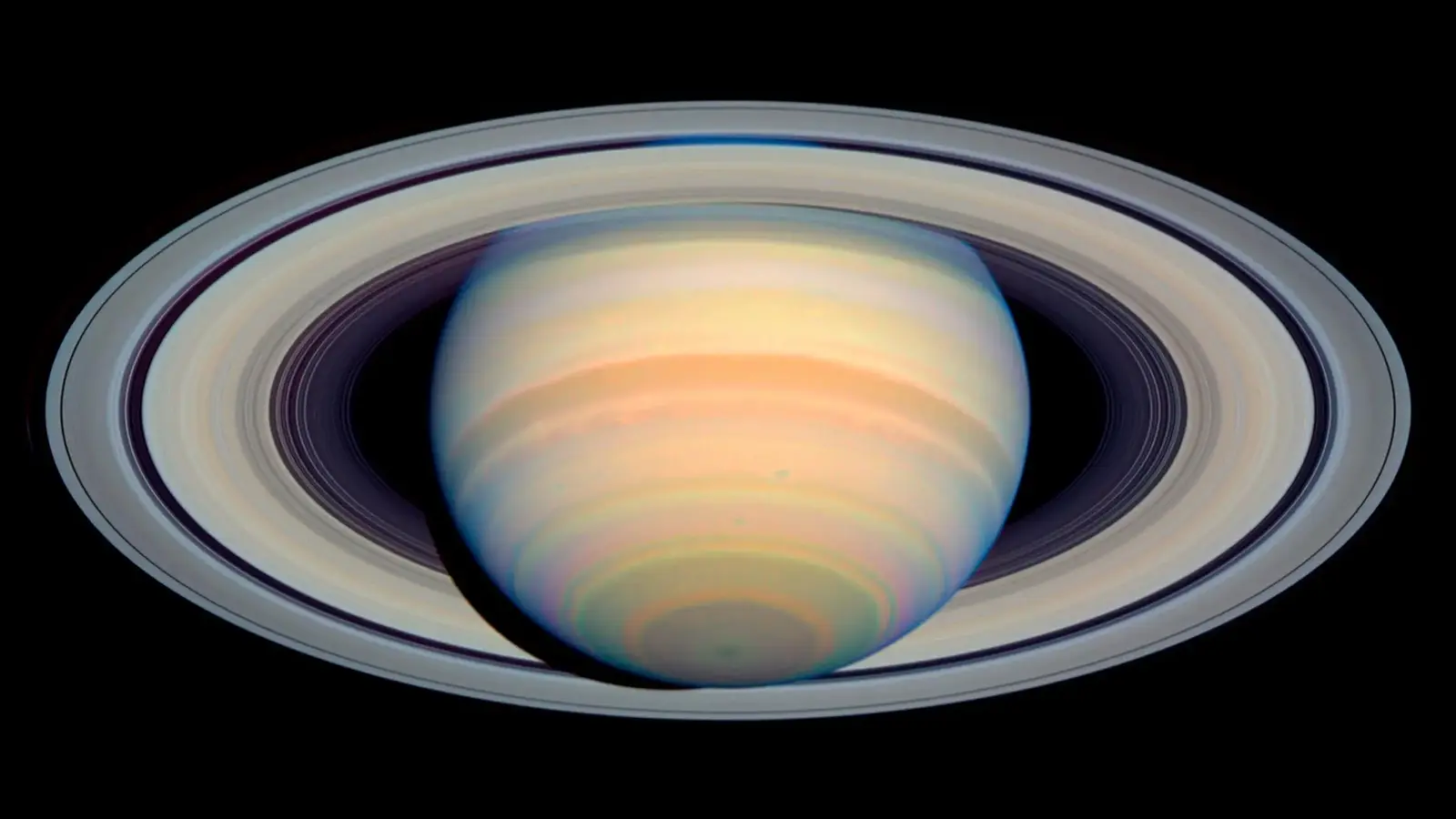
Imagine a planet writing geometry into its weather. That is what astronomers are watching unfold at Saturn’s south pole: a decagon-shaped wave, ten distinct sides stitched into a jet stream hundreds of kilometers across.
Recent images from the Hubble Space Telescope reveal a large, evolving atmospheric wave wrapped around Saturn’s southern polar region. For the first time scientists have recorded a regular, many-sided jet pattern in the planet’s southern hemisphere, a phenomenon that both echoes and diverges from Saturn’s famed northern hexagon.
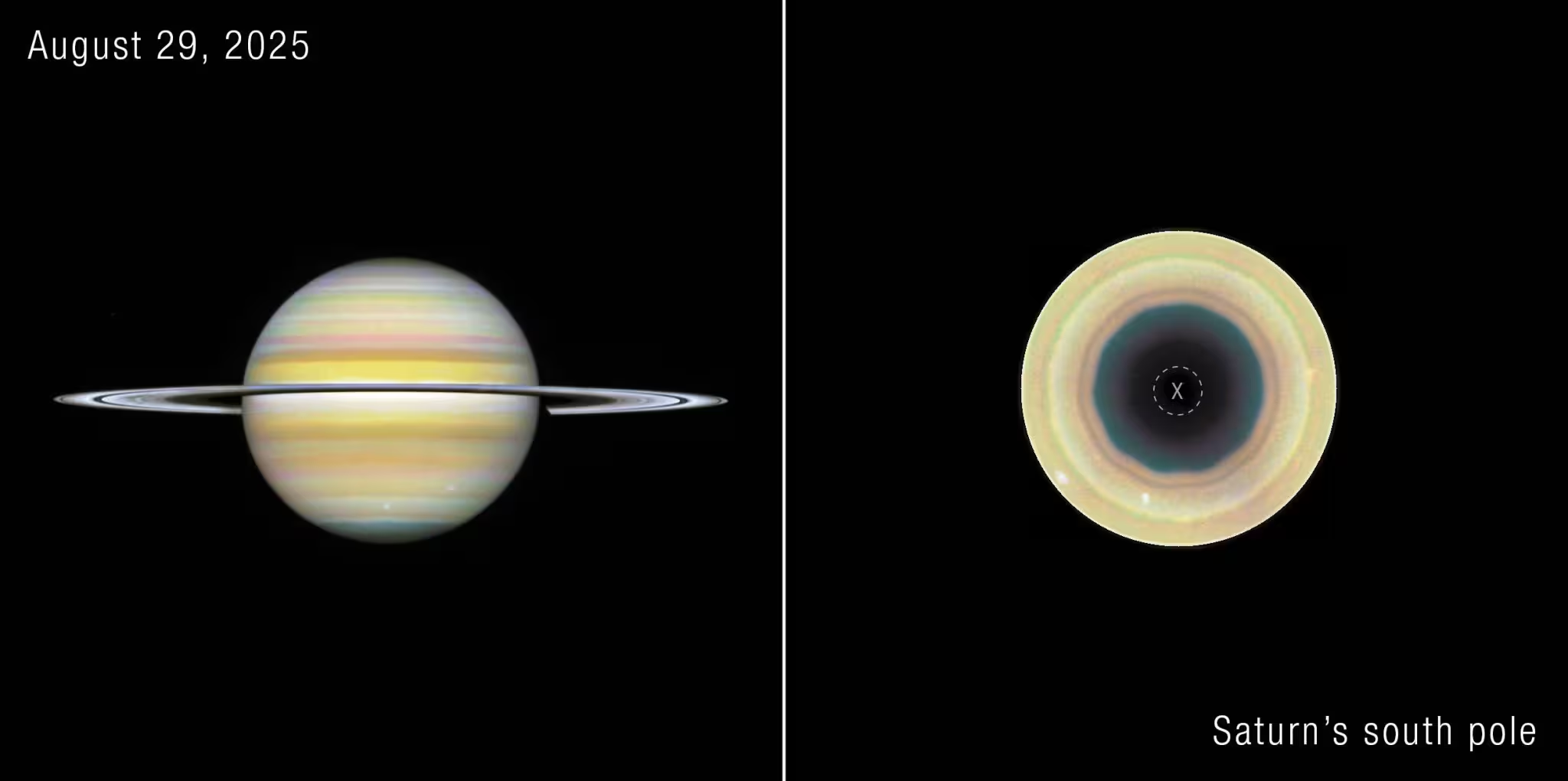
Recent NASA Hubble Space Telescope images show the gas giant Saturn and its southern pole, where astronomers have discovered a 10-sided atmospheric wave. Observations show the decagon extends through multiple layers of Saturn’s atmosphere.
A geometric surprise in Saturn’s southern sky
The feature is not a static decoration. It appears embedded in a powerful jet stream and reaches through multiple atmospheric layers, visible in different wavelengths that probe different heights. As Hubble’s multi-year record shows, the decagon strengthened noticeably between faint hints in 2023 and clearer structure in subsequent seasons.
Scientists reconstructed the pattern using years of Hubble imagery collected by the Outer Planet Atmospheres Legacy program, known as OPAL. OPAL’s annual portraits of the outer planets give researchers the rare ability to watch slow, planetary-scale changes instead of relying on isolated snapshots.
“We’ve never seen anything quite like this in Saturn’s southern hemisphere,” said Amy Simon, the OPAL principal investigator at NASA’s Goddard Space Flight Center. “The northern hexagon has been there every time we’ve looked for more than 40 years. This feature is different — it appears to be strengthening, giving us the rare opportunity to watch a giant atmospheric pattern develop.”
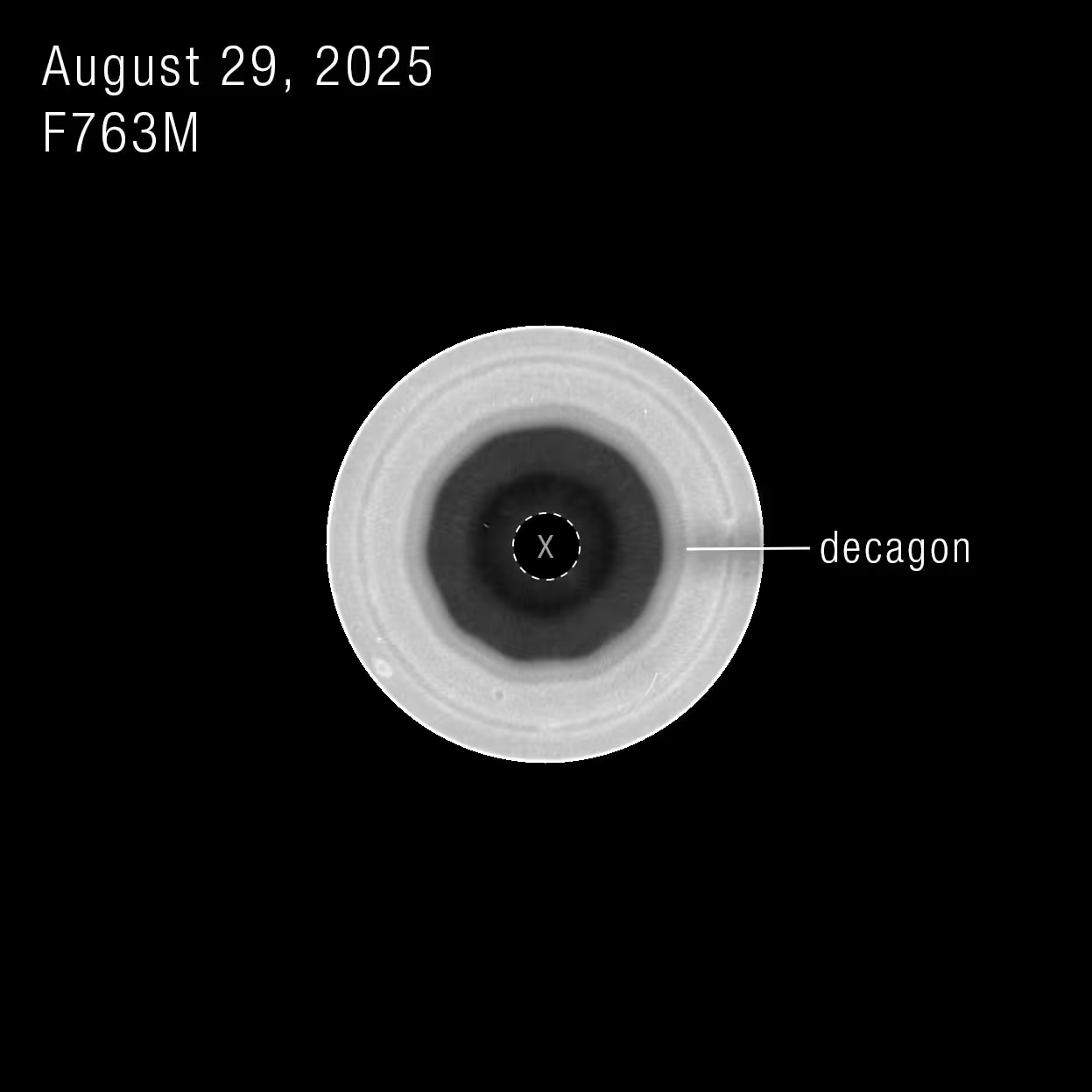
A single filter from NASA’s Hubble Space Telescope distinctly shows a 10-sided wave encircling Saturn’s south pole, labeled “decagon”. An “X” denotes where data was not captured.
How amateur eyes and space telescopes teamed up
This discovery began not in a flagship mission control room but on a distributed, crowd-sourced stage. Ground-based observers and amateur astronomers first noticed a faint, wavy band near Saturn’s south pole in 2024 images collected through the Planetary Virtual Observatory Laboratory, run by the University of the Basque Country.
Lead author Agustín Sánchez-Lavega and contributors including Trevor Barry and Jean-Paul Oger tracked the feature across 2024 and 2025 ground-based observations, where it became more convincing. Hubble’s vantage removed atmospheric blurring and allowed researchers to see the pattern with clarity across whole rotations of the planet.
Images from NASA’s Cassini mission, which orbited Saturn from 2004 to 2017, showed no long-lived southern counterpart to the northern hexagon. Hubble data pushed the timeline back to 2023, indicating the decagon is a recent development rather than a persistent, long-standing formation.

What kind of wave is this?
Planetary scientists describe such features as Rossby-like or standing waves in a jet—structures that can become locked into a planet’s rotation and wind pattern to create polygonal shapes. The northern hexagon has been studied for decades and appears deeply rooted in Saturn’s atmospheric dynamics. The southern decagon, however, raises new questions because of its recent appearance and its tenfold symmetry.
This is the first large, regular-sided jet pattern observed in Saturn’s southern hemisphere.
Different wavelengths reveal that the wave shifts position slightly with height, implying that the phenomenon is not just a cloud-top illusion. Instead, it likely involves dynamics that span vertical layers of Saturn’s atmosphere. That vertical reach hints at energy and momentum exchanges between layers—processes that planetary scientists model to understand weather on giant planets.
Why this matters beyond a curious shape
Patterns like the decagon serve as natural laboratories for fluid dynamics on the largest scales. They tell us how jet streams behave under rapid rotation, how vortices form and persist, and how seasonal changes influence atmospheric stability. These insights feed back into models used to interpret atmospheres across the solar system and in exoplanet studies.
Hubble’s long baseline of observations matters because slow changes—seasonal shifts, the gradual emergence of waves, the decay of storms—can only be detected with regular monitoring. Mike Wong of UC Berkeley, a co-author on the study, emphasized that OPAL’s repeated observations are enabling new findings precisely because the data span years, not single visits.
Instruments and next steps
Hubble will continue to monitor the evolving decagon. Meanwhile, astronomers plan complementary observations with the James Webb Space Telescope, which offers different infrared capabilities that probe atmospheric composition and deeper layers.
Computer modeling will be essential. Simulations that reproduce a ten-sided standing wave under Saturn-like conditions could reveal the necessary ingredients: wind shear patterns, thermal contrasts tied to Saturn’s seasonal tilt, and the role of internal heat flux from the planet itself. Researchers will also test whether the decagon could settle into a long-lived fixture like the northern hexagon or whether it will dissipate or morph into a new pattern.
Expert Insight
Dr. Elena Marquez, planetary dynamicist at the Institute for Planetary Physics, offered a grounded take: “What makes the southern decagon fascinating is its timing. Saturn’s seasons and subtle shifts in radiative balance can nudge an atmosphere across a threshold where stable standing waves appear. If models can reproduce a tenfold symmetry under realistic conditions, we learn not just about Saturn but about the physics that shape atmospheres on rotating worlds.”
Her comment underscores a practical point: the decagon is not just pretty geometry. It is a diagnostic of the forces and instabilities operating on a gas giant.
Conclusion

The new ten-sided wave at Saturn’s south pole is a rare real-time glimpse of planetary-scale weather taking form. It connects decades of telescopic work, from Cassini’s intimate mapping to OPAL’s long-term stewardship, and now to coordinated efforts between professionals and skilled amateurs. Continued monitoring with Hubble and Webb, paired with focused modeling, promises to reveal whether this decagon is a passing curiosity or the birth of a lasting engine of Saturnian weather.

“My work centers on sustainability, energy, and environmental science — examining how innovation can lead to a greener future.”

Discussion
Leave a Comment
Comments (1)
wow Saturn's writing geometry into its weather? decagon! mind blown, but also curious how long it'll last, seasons vs internal heat... can't wait for Webb pics