

Imagine printing a shelter out of Martian dirt mixed with living yeast, then leaving it to the cold to do the rest. Sounds like science fiction. It is not. Researchers at Hong Kong University of Science and Technology and The Hong Kong Polytechnic University have sketched a low-energy route to habitat construction on Mars that leans on biology as much as engineering.
Could a microorganism become part of a construction crew? The idea began with a familiar trick from food processing: freeze-drying. Remove the water and the remaining structure becomes lighter and porous, yet surprisingly rigid. The team adapted that concept to a composite made from a gelatin hydrogel, a genetically modified yeast strain that secretes sticky proteins, and simulated Martian regolith.
From gel to strong foam
The working material starts as a viscous paste suitable for extrusion-based 3D printing. The gelatin hydrogel acts as a scaffold and growth medium for the yeast, which has been engineered to glue mineral particles together. Once printed into the desired shape, the paste is exposed to very cold, dry conditions similar to Mars, where internal ice sublimates directly into vapor. The result is a foamy, porous solid with tiny cavities where the water used to be, much like a freeze-dried fruit but on an architectural scale.
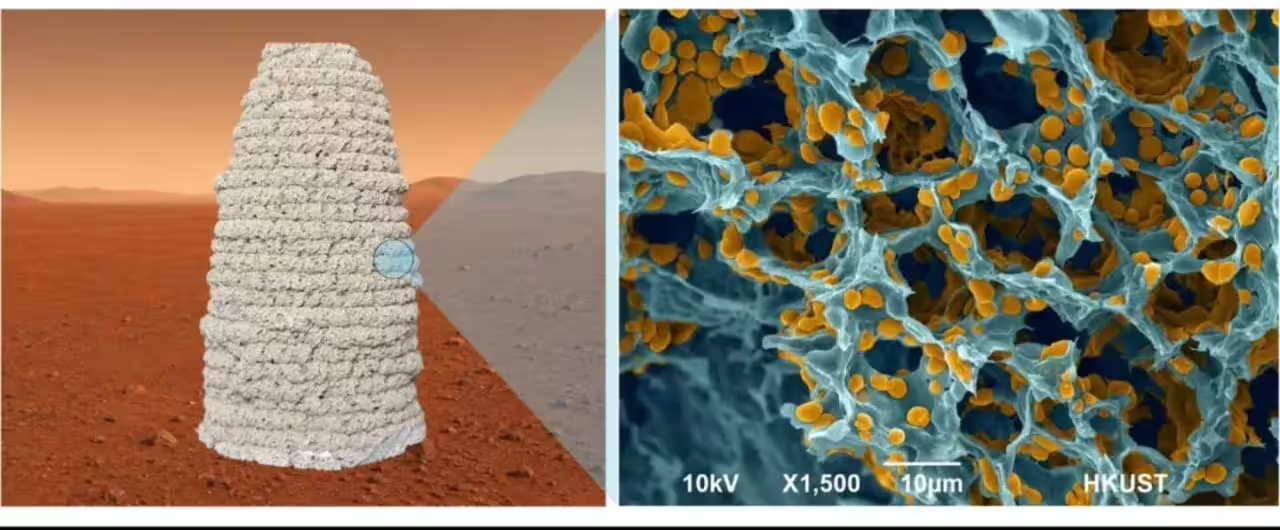
Mechanical tests in the lab reported compressive strengths near 12 megapascals and flexural strengths around 6 megapascals. To put that in perspective, those values overlap with the lower range of conventional concretes used on Earth. The process also offers a major energy advantage: it consumes roughly 10 to 100 times less energy than heating or melting regolith to form blocks or sinter structures, a critical saving when every watt matters on an interplanetary mission.
There are additional perks. The material is potentially recyclable. If at least a few yeast cells survive the desiccating cold, they could be revived and used to rebind powdered material into new parts. Current test specimens are small, roughly 45 millimeters tall, but the investigators see no fundamental barrier to scaling up. Still, several engineering hurdles remain.
Air-tight integrity for human habitation has not yet been demonstrated. Radiation shielding, thermal stability through Martian day and night cycles, and long-term durability all demand hybrid architectural solutions that combine biological foams with engineered membranes and structural frames. In-situ resource utilization is the guiding principle here: use what is already on Mars to lower payload mass and mission cost.
Conclusion
This research reframes building on Mars as a partnership between microbes and machines. It does not promise ready-made homes tomorrow. Rather, it points to a future where biofabrication, 3D printing and planetary materials science meet to cut energy needs and expand options for habitat design. More testing under true Martian pressures and radiation will be needed, but the concept moves us one step closer to living off the land on the Red Planet.
.webp "Earth's Magnetic Field Funnels Atmosphere to the Moon")

“My work centers on sustainability, energy, and environmental science — examining how innovation can lead to a greener future.”

Discussion
Leave a Comment
Comments (1)
No way, printing Mars homes from dirt + yeast? Mind blown. Energy savings sound huge, but air leaks, radiation and night temps worry me. If a few cells survive tho… game changer!