
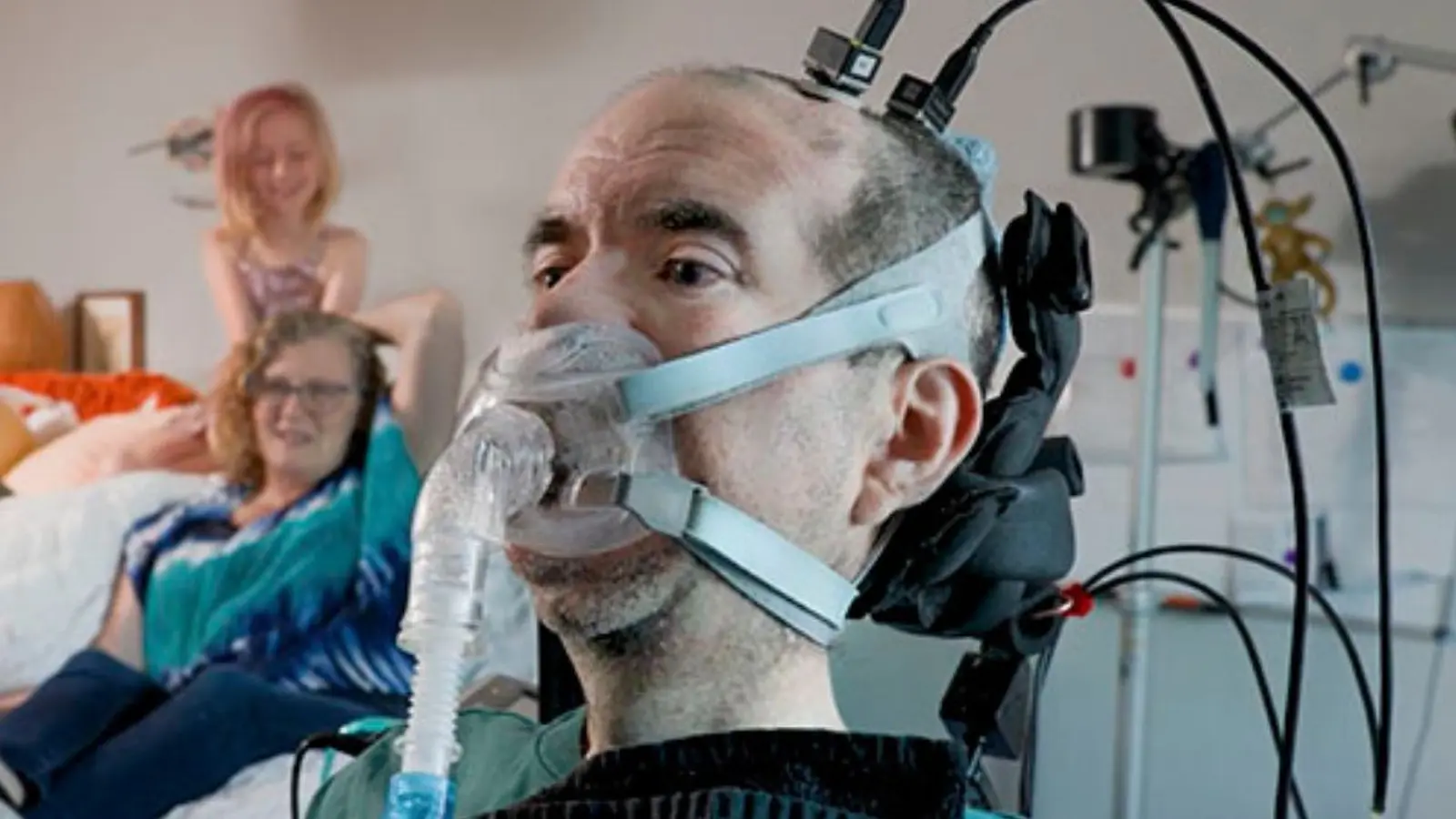
She listened with tears in her eyes as a familiar cadence returned. Not the worn recordings on a phone that failed to capture the warmth, but a voice shaped to resemble the man's own, reading his sentences aloud while he sat in his living room. For Casey Harrell, who lives with advanced amyotrophic lateral sclerosis, the sound was less about novelty and more about being recognized again.
From thought to words: how the system works
The system begins inside the brain. Small electrode arrays are surgically placed in regions that control speech planning and articulation. When Harrell intends to speak, even though his vocal muscles barely move, the arrays pick up the electrical patterns associated with that attempt. Those patterns travel to an external speech decoder that translates neural activity into text in real time.
The interface combines two control channels. Eye tracking provides a visual pointer on a screen; a white circular cursor marks where Harrell is looking. He selects words, edit buttons, or confirmation keys with pure intention. Meanwhile, the continuous decoder converts attempted utterances into candidate phrases that appear on screen. The result is a hybrid system—neural decoding plus eye-gaze selection—that lets a user compose, correct, and then vocalize messages through a digital voice modeled to sound like their pre-illness speech.

An illustration of the brain-computer interface, which decodes neural activity (b) into words on a screen that users can rate or correct (c) before the text is verbalized. The system has eye-gaze tracking to enable the participant to select on-screen buttons.
The practical details matter. Each morning a caregiver helps connect the implant to the mobile decoder mounted on a cart. After that, Harrell can take the system with him through his day and use it at home independently. He composes emails, messages, and even works full time. Over roughly 400 days of recorded use, he has produced more than 183,000 sentences and nearly 2 million words while practicing for over 3,800 hours. His average communication speed now sits around 56 words per minute, a dramatic improvement from his first attempts in 2023.
Why this matters beyond a single user

ALS robs people of muscle control but not necessarily of thought. Conventional assistive technologies like text-to-speech matched to typing or switch devices help some, but they require reliable hand movement or slow scanning. Brain-computer interfaces bypass those motor bottlenecks. They tap into intended speech signals upstream, before muscles would normally act.
What makes this trial notable is continuity. For years, BCI demonstrations were short, lab-bound experiments. Harrell's case is different: the device runs continuously for daily life. According to the UCD-led team and collaborating groups at Brown University and Mass General Brigham Neuroscience Institute, this trial shows it is possible to move from proof of concept to sustained, home-based use. Co-principal investigator and neurosurgeon David Brandman notes that the field may have crossed an important threshold by empowering a person with paralysis to speak on his own terms.
Accuracy and privacy are also key. When Harrell uses the system, the decoded text is reported as correct or nearly correct about 92 percent of the time. He controls when the system records. A privacy mode ensures that sessions he wishes to keep private are not saved or used for model training. Only non-private sessions feed data that improve the decoder for future users.

Trial participant Casey Harrell has been using the brain-computer interface at his home for two years.
Impact on daily life and relationships
Words reconnect people. Harrell describes the moment his wife hears his digital voice as something that conjures a memory. He uses the system to explain things to his daughter, who does not remember him speaking naturally. He says it lets him stay "tethered to my life as a human being" and gives him a fuller social presence with friends, family, and colleagues.
That human dimension is what researchers emphasize when they discuss feasibility. This trial, called BrainGate 2, is an early clinical study focused on safety and usability in people with severe speech impairment or inability to use their hands. Harrell is one of 27 participants enrolled in ongoing work designed to refine hardware, software, and training protocols so the technology can one day serve a broader population.

Expert Insight
"This is not just a speed improvement or a new gadget," says Dr. Maya Singh, a neuroengineer who has worked on adaptive decoding algorithms. "It changes the unit of social exchange. When someone can speak in their own style and timing, you rebuild conversational rhythms. That matters for cognition, mood, and relationships."
Dr. Singh adds that continued progress will depend on three things: improving long-term implant biocompatibility, reducing setup overhead so users can be independent from day one, and investing in robust privacy protections. "We also need to make sure these systems are affordable and scalable," she says, "so access does not become the next bottleneck."
Context and next steps
The technology reported in Nature Medicine in 2026 grew from decades of basic neuroscience, signal processing advances, and iterative clinical work. Teams combined intracortical electrode arrays, machine learning decoders trained on large datasets, and human-centered interface design to achieve continuous, daily use. The collaboration across UCD, Brown, and Mass General Brigham highlights how multi-institutional efforts accelerate translation from lab to home.
Looking forward, researchers plan to test the approach with more participants, extend deployment times, and explore ways to make synthetic voices even more personalized without compromising privacy. The dataset accumulated from Harrell alone is the largest in the trial so far and will inform next-generation models that can generalize better across users and speaking styles.
Conclusion
For people who have lost the power to speak, restoring a voice is more than technical success. It restores identity, agency, and social ties. The case of Casey Harrell shows that continuous brain-computer interfaces can move from experimental demonstrations to meaningful, everyday tools. There are still engineering and ethical challenges ahead, but the direction is clear: interfaces that read intended speech are becoming viable assistive technologies capable of returning something deeply human to those who have lost it.

“My work centers on sustainability, energy, and environmental science — examining how innovation can lead to a greener future.”

Discussion
Leave a Comment
Comments (3)
Feels a bit overhyped, like a single-case win. Impressive tech, sure, but scaling, cost and ethics are the real mountain to climb. setup seems fiddly
Is this even real? 56 wpm from implants sounds insane — how long do they last, and who pays for this care, honestly?
Wow, tears here too. Hearing someone’s old voice again hits hard... tech that brings back a person, not just words. privacy pls.