
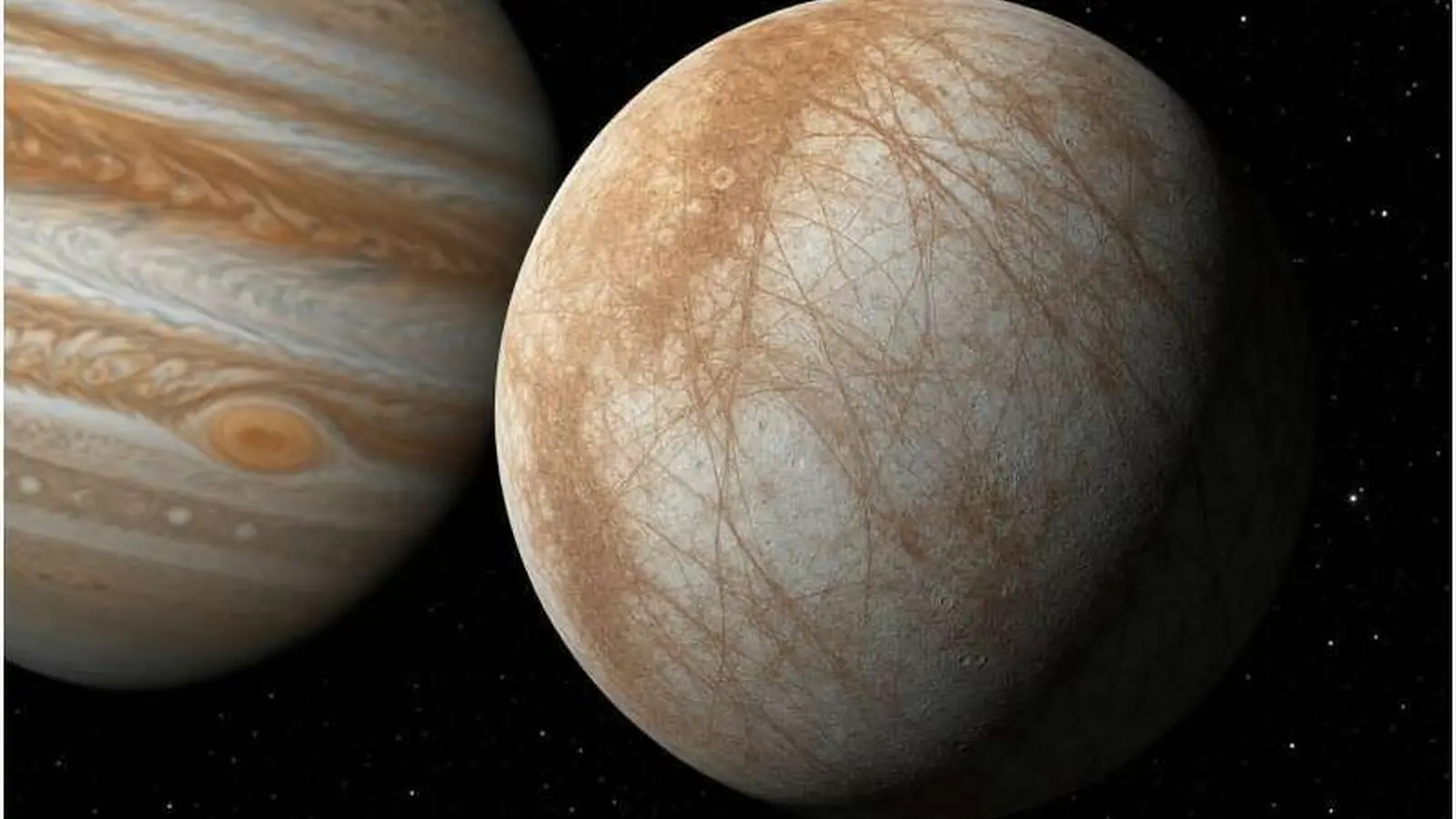
Imagine a moon the size of Jupiter circling an object that itself orbits a distant star. Strange. Compelling. And a little unsettling to the tidy boxes astronomers use to classify worlds.
Giant companion discovered around a brown dwarf
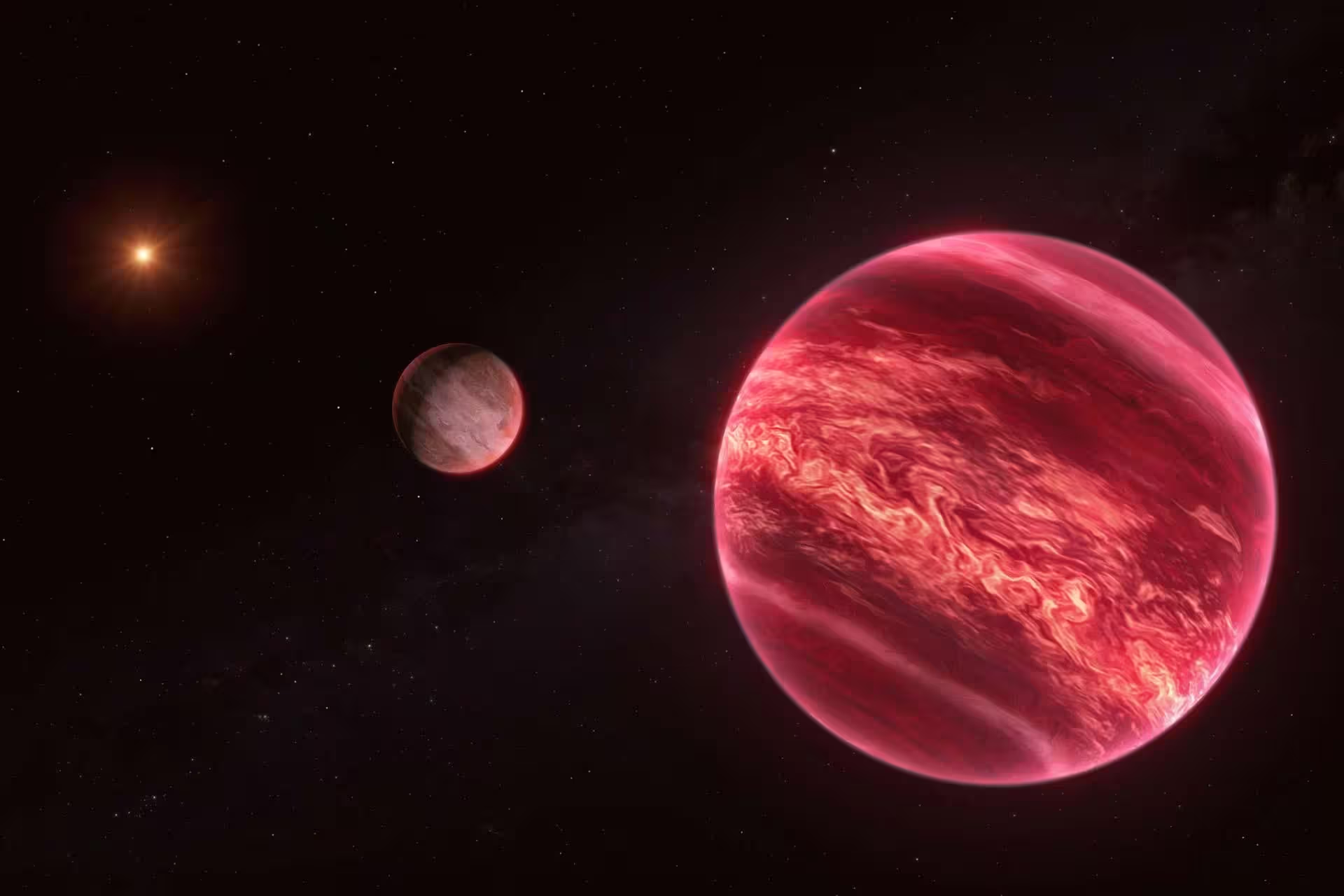
Astronomers have found a massive companion orbiting the brown dwarf known as CD-35 2722 B, a system roughly 73 light years from Earth. The brown dwarf has a mass of about 30 times that of Jupiter, yet it does not ignite like a true star. What caught researchers’ attention is the secondary body: an invisible, gravitationally tugging object whose mass is estimated at least 90 percent that of Jupiter. It completes an orbit around the brown dwarf every 170 days.
At first blush the system fits an elegant three-tier architecture: star, brown dwarf, and a moon-sized companion. But that simplicity dissolves when we ask the key question: is this object a moon, a planet, or something in between? The discovery forces astronomers to revisit the boundaries that separate planets, moons, and binary companions.
Earlier indications of a companion around CD-35 2722 B had emerged from observations with the Keck Observatory in Hawaii. Those signals were suggestive but not definitive. To test the hypothesis, a team led by Kevin Hoy, a PhD student based in Santiago, Chile, turned to the European Southern Observatory’s Very Large Telescope and the high-resolution infrared spectrograph CRIRES+ installed in the Atacama Desert. Their analysis, spanning about two and a half years and published in Nature, reveals a clear radial-velocity wobble in the brown dwarf’s spectrum consistent with a massive orbiting object.
How the measurement was made and why it matters
CRIRES+ breaks incoming light into a detailed spectrum. Tiny shifts in that spectrum act like a Doppler fingerprint: when an object moves toward us its light shifts toward shorter wavelengths, and when it moves away the light shifts to longer wavelengths. A companion’s gravity makes the brown dwarf wobble, producing a repeating pattern of spectral shifts. Tracked regularly over months, those shifts trace the unseen companion’s orbit and yield its minimum mass.
The team monitored CD-35 2722 B periodically through February 2026. The radial-velocity signal they detected is robust: a periodic oscillation that repeats every 170 days, and an amplitude that implies an object with at least 0.9 times Jupiter’s mass. Given that the object probably contains a large fraction of gas, its composition would be similar to a gas giant rather than an icy or rocky moon.
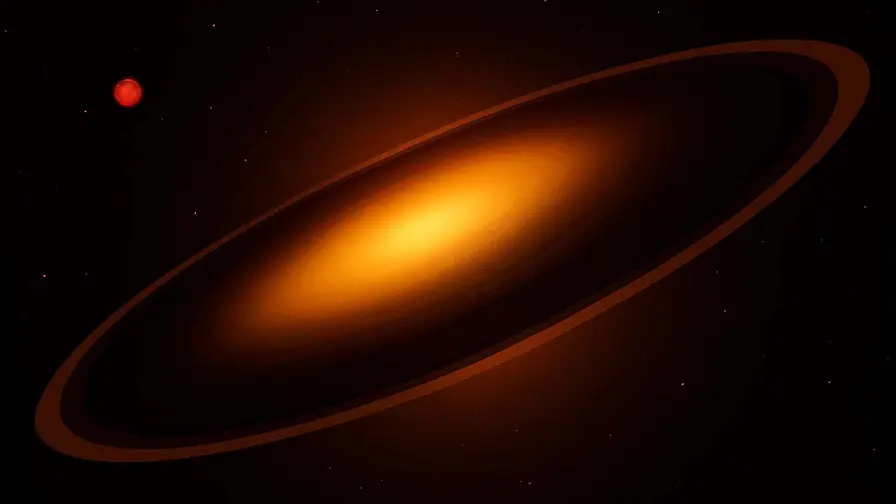
That composition matters for classification. If this body orbited a star directly, most astronomers would call it a giant exoplanet. Because it orbits a brown dwarf, which sits on the fuzzy border between planets and stars, the name becomes contentious. Should labels be determined by the mass of the primary object, by formation history, or by orbital hierarchy? Different criteria point to different answers.
One nearby analogue is HD 206893 b, a candidate system with a massive companion and suspected moonlike oscillations. That case remains ambiguous because the signal could have other explanations. By contrast, the CD-35 2722 B signal appears cleaner and harder to reconcile with alternative scenarios, which is why many researchers find it persuasive even though the secondary body remains technically a candidate.
What this reopens about definitions and formation
Brown dwarfs occupy an awkward niche. They are often described as failed stars because they can be tens of times more massive than Jupiter but lack the mass to sustain hydrogen fusion in their cores. They can nevertheless host companions with planetary properties. Finding a near-Jupiter-mass object orbiting a brown dwarf highlights how formation pathways can blur the lines between what we call moons and planets.
One useful distinction is formation history. Planets are thought to form in disks around stars, building up from dust and gas. Moons can form out of disks around planets, or be captured by larger bodies. But if the companion formed in a disk around the brown dwarf, was it a planet by origin or a moon by context? Observationally, disentangling formation channels is difficult. Location and dynamics provide clues, but often not a definitive answer.
Kevin Hoy and his colleagues suggest using a neutral term such as exosatellite while the community debates stricter definitions. That pragmatic label buys scientists time to gather more examples and to refine models of how these systems form and evolve. With better instruments and more long-term monitoring, we can expect more borderline systems to appear. Each one will push us to sharpen or perhaps revise the taxonomy of substellar companions.
Expert Insight
"This is precisely the kind of system that forces a rethink," says Dr. Maya Alvarez, an exoplanet scientist at the University of Lisbon. "When a companion’s mass approaches that of Jupiter but it orbits a non-stellar primary, the question is no longer merely academic. It affects how we model formation, migration, and tidal evolution. Calling it a moon or a planet without understanding its past is premature."

David Kipping, an exomoon specialist at Columbia University who was not part of the study, offered a cautious endorsement. He noted that previous candidate systems produced signals that later found alternative explanations, but that the current dataset for CD-35 2722 B is unusually convincing. "Technically it remains a candidate, but the evidence here is stronger than in many prior cases," Kipping commented.
Implications and the road ahead
Beyond taxonomy, this system has practical observational value. A massive companion orbiting a relatively nearby brown dwarf provides a laboratory for studying atmospheric properties and orbital dynamics in regimes not available in typical star-planet systems. Follow-up work could target direct imaging, transit searches, or spectroscopy aimed at detecting the companion’s own thermal emission. Each new piece of data would refine mass estimates and could constrain its composition more tightly.
On the theoretical side, models must account for the formation of massive companions around substellar objects. Did the companion form like a planet in a circum-brown-dwarf disk? Was it captured during a close encounter in the young cluster where the system formed? Or did both objects form together through fragmentation, making them a very low-mass binary?
Answers will come slowly. Patience is part of astronomy. But the payoff is conceptual. Systems such as CD-35 2722 force us to acknowledge that nature rarely fits into human-made categories. Instead of squeezing discoveries into existing labels, astronomers are increasingly comfortable describing objects along a spectrum of properties and origins.
Conclusion
The CD-35 2722 system does more than present an intriguing candidate for a moon-sized companion. It challenges how we define worlds. As instruments like CRIRES+ push sensitivity and time baseline, we will find more objects that sit on the fence. Each one is not merely another data point. Each is a prompt to refine our language and our models.
For now, the best description may be humble and provisional: a massive exosatellite circling a brown dwarf, itself circling a faint star, in a system that makes astronomers rethink what a moon really is.


“My work centers on sustainability, energy, and environmental science — examining how innovation can lead to a greener future.”

Discussion
Leave a Comment
Comments (3)
Feels a bit overhyped. Cool discovery but calling it a moon before formation is known seems premature. Meh, wait for more followup
Is this even true? RV signals can be tricky, could be stellar activity or data quirks. Hope they keep monitoring, curious but skeptical.
Whoa, a moon the size of Jupiter?! Mind blown. Feels like sci fi but real. Naming it is messy tho, planet? moon? exosatellite? love the mystery