
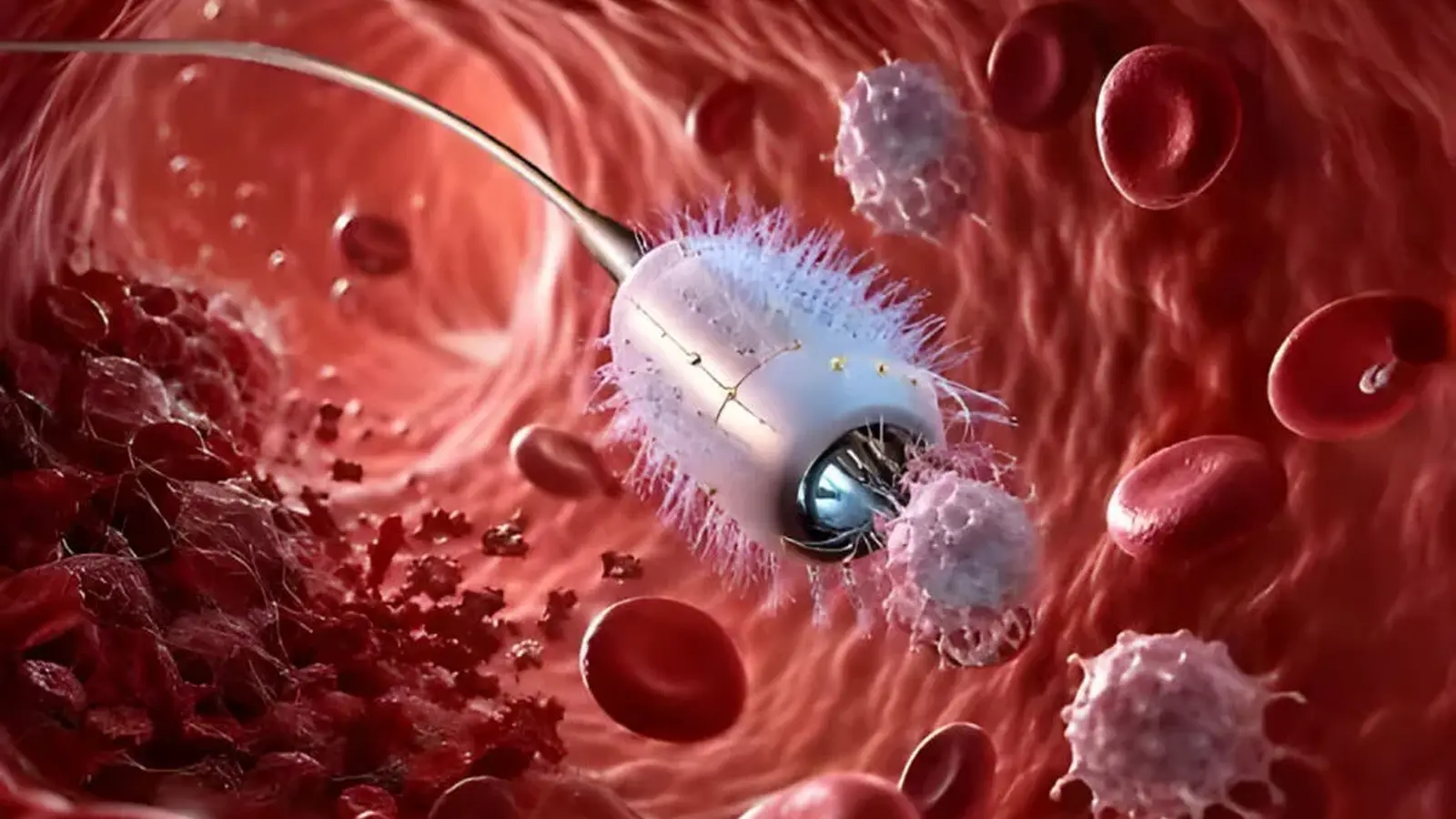
A hairlike robot enters a blood vessel and moves like a living brush. It bends. It sweeps. It nudges blood flow. And in early trials it has trapped circulating cancer cells and helped clear small clots.
Inside the CiliaVine: what it is and how it moves
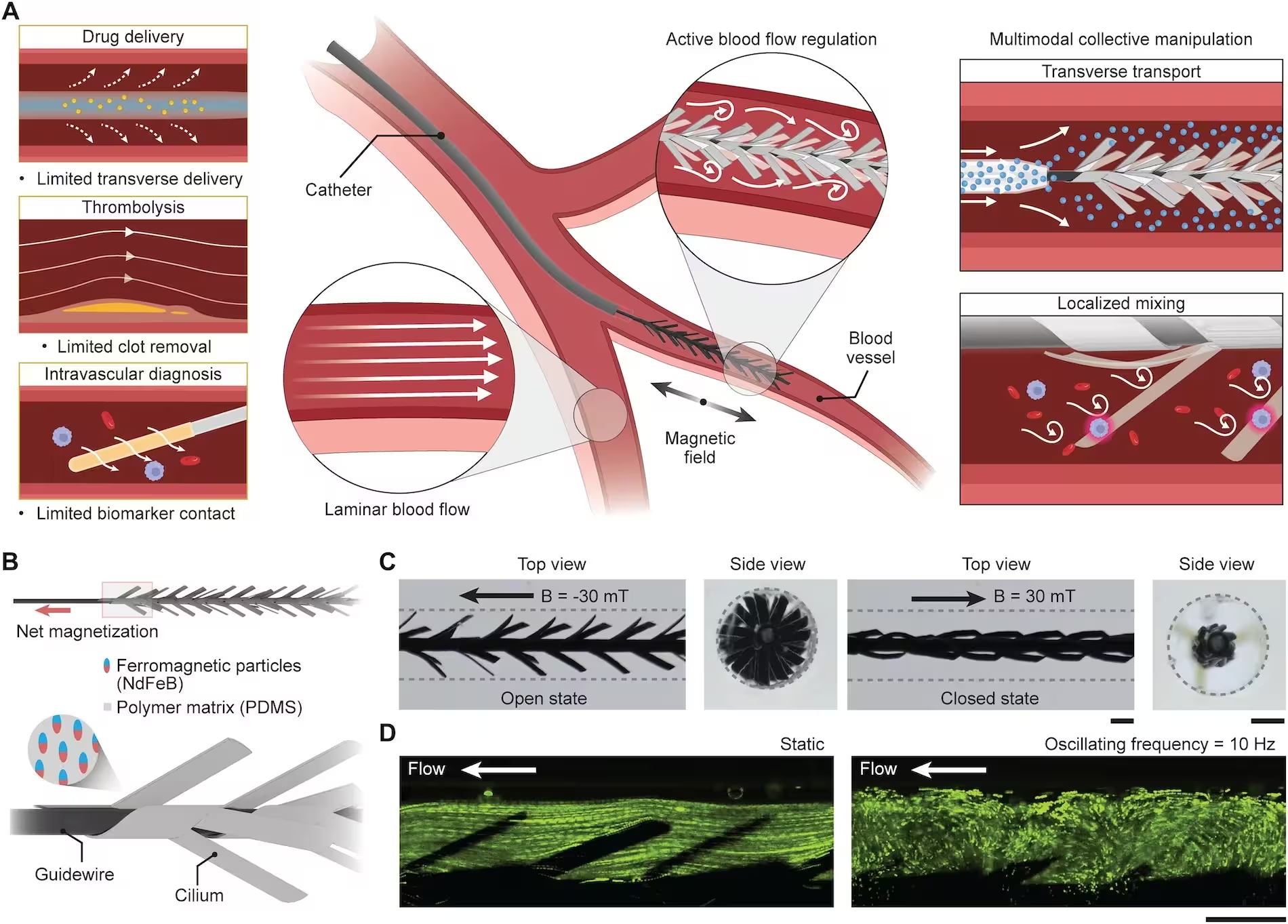
Researchers at the Shenzhen Institute of Artificial Intelligence and Robotics, in collaboration with the University of Hong Kong and China General Hospital, built a microscopic device called CiliaVine. The design borrows from nature: flexible, filamentous arms that behave like cilia on a cell. The robot is tethered to a thin guide wire and driven by programmable magnetic fields along that wire. Change the field and the robot curls, sways, or creates coordinated beating patterns to alter local blood flow.
Why does that matter? Because the motion does more than steer. It increases mixing near vessel walls, pushes therapeutic agents into tissue, and physically captures unwanted material. The arms can mechanically disrupt or retrieve clots and ensnare circulating tumor cells, offering a mechanical complement to biochemical approaches.
What the experiments showed and why it matters
Tests began in animal models, including rabbits with liver tumors, and then moved into early human trials. In laboratory and bedside tests the device performed several striking feats. When used to release drugs from within a vessel, tissue-level drug distribution rose by about 146 percent compared with passive infusion. Measured penetration of the drug beyond the vessel wall improved by roughly 75 percent at distances up to one millimeter. For small blood clots, average removal time fell from 70 minutes to about 40 minutes.
In a small clinical set of 23 patients the robot also trapped circulating liver cancer cells within the bloodstream. Teams report that transient insertion into tumor masses or main feeding vessels for up to 20 minutes produced no detectable inflammation or tissue damage under the study conditions. Magnetic control allowed precise steering throughout each procedure.
Those numbers are concrete. They suggest targeted drug delivery could become far more efficient, lowering required doses and concentrating treatment where it helps most. They also point to a minimally invasive mechanical option for early clot retrieval and liquid biopsy enrichment.

Still, the path to routine clinical use will be long. Regulatory testing, sterilization protocols, device durability inside pulsatile blood, and reproducible control systems all need rigorous study. Scaling the technology from short, supervised procedures to broad hospital adoption will require engineering, clinical trials, and safety data across larger patient groups.
For now, CiliaVine is a promising proof of concept. It blends soft robotics, magnetic control, and a clear clinical aim: deliver drugs more precisely, catch cancer cells before they seed, and clear dangerous clots faster. Whether it becomes a common tool in interventional suites depends on the next wave of trials and the practical questions engineers and clinicians must still answer.

“The cosmos has always fascinated me. I write about space missions, astronomy, and the technologies pushing humanity beyond Earth.”

Discussion
Leave a Comment
Comments (2)
If that's real then cool, but how do they handle pulsatile flow, device durability and sterlization? Control systems, long runs, hmm
Wow, a hairlike robot in vessels? Mind blown. If CiliaVine really boosts drug penetration 146% that's huge, but hope longterm safety checks catch everything...