
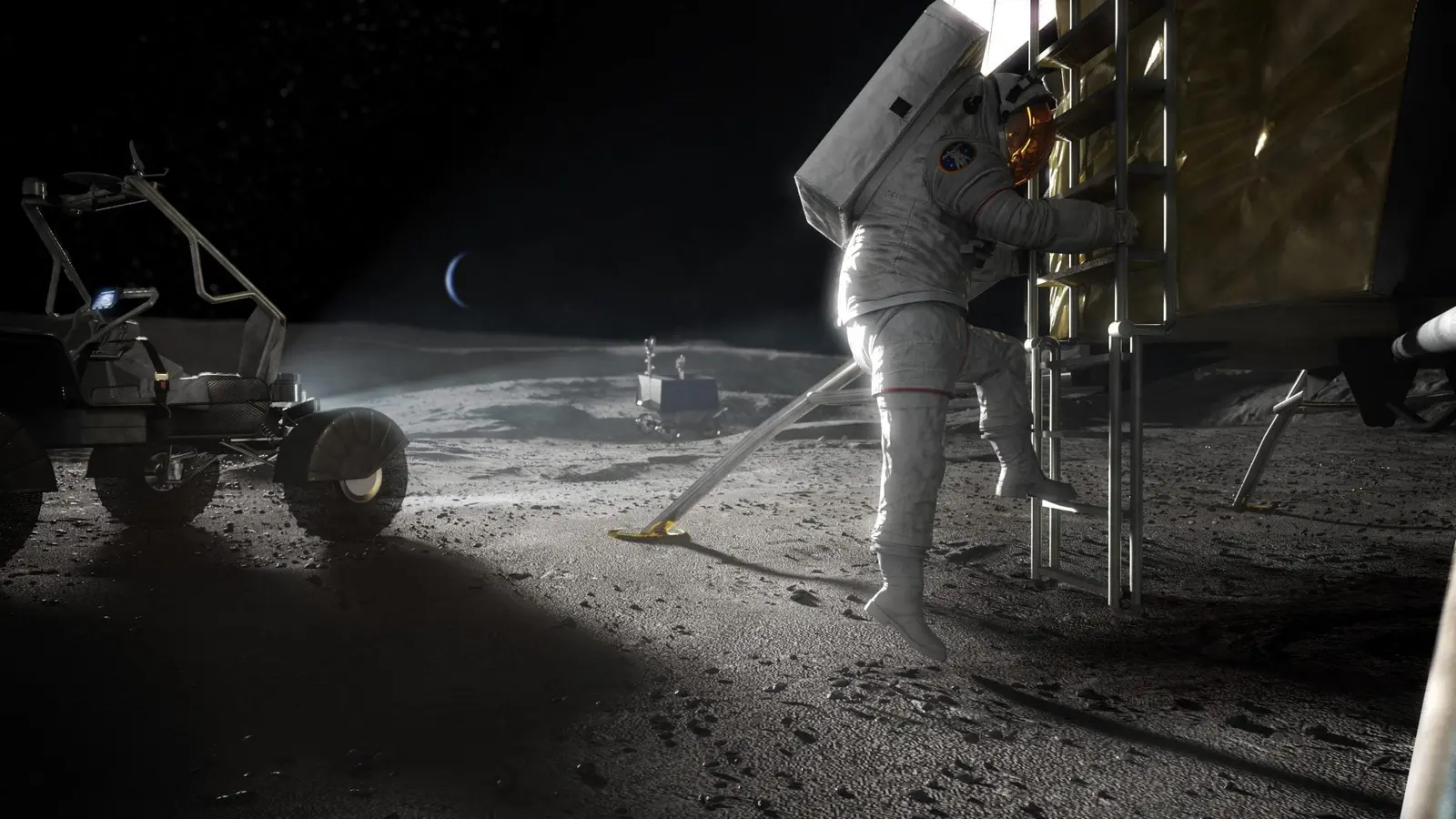
Dust kicks up in slow, ghostly arcs. A robotic footpad settles on basalt older than most continents. No flag yet, no human footprints, but a network is being assembled piece by piece. That quiet choreography of machines, tests, and repeatable deliveries is NASA's chosen way to make a Moon Base real.
A stepwise plan rather than a single leap
NASA's vision for a durable outpost near the lunar South Pole has become less a headline promise and more a staged engineering program. Instead of trying to erect an entire base all at once, the agency is orchestrating a series of robotic deliveries, technology demonstrations, and commercial partnerships that will collectively assemble the essential pieces of a future human-tended settlement. More than twenty robotic landings are planned through 2029 under Phase I of the architecture. Each flight is meant to prove a capability: precision landing, long-duration power, in-situ science, and reliable cargo transfer.
Why this piecemeal approach? Because the Moon is unforgiving. Thermal swings, abrasive regolith, unpredictable terrain, and the long lunar night require systems that are proven in situ. Rather than simulate everything on Earth, NASA and its commercial partners are building a ladder of missions: each one validates hardware, refines operations, and lowers risk for the missions that follow.
Commercial landers doing the heavy lifting
Private companies now supply the majority of cargo delivery options NASA depends on. Blue Origin, Firefly Aerospace, Intuitive Machines, and Voyager Lunar Systems are moving from prototypes into flight-ready landers capable of carrying science instruments, rovers, power systems, and other infrastructure elements. These vehicles are not one-off testbeds. They are designed to be repeatable, scalable, and versatile, giving NASA a commercial supply chain that mirrors orbital logistics on Earth.

Blue Moon Mark 1 (MK1) is a single-launch, lunar cargo lander that remains on the surface and provides safe, reliable, and affordable access to the lunar environment. MK1 will provide cargo transport, leveraging the 7-meter fairing of the New Glenn launch vehicle, to deliver up to three metric tons anywhere on the lunar surface.
Blue Origin is advancing its Blue Moon MK1 lander through integrated environmental testing. Thermal vacuum checks at NASA’s Johnson Space Center confirmed the vehicle can survive the hard thermal conditions expected on descent and after touchdown. Communications tests have linked MK1 with NASA’s Tracking and Data Relay Satellite System and the Deep Space Network. The next major milestones include final integration of propulsion systems, loading of cryogenic propellants, and a full mission dress rehearsal ahead of the Endurance demonstration flight. Endurance will test precision landing, autonomous operations, and payload delivery at scale.
Breaking new ground on the far side

Firefly Aerospace is approaching its Blue Ghost Mission 2 with a different objective: the lunar far side. That hemisphere is scientifically compelling because it is shielded from Earth's radio noise, which makes it an attractive location for radio-astronomy projects probing the cosmic Dark Ages and for experiments sensitive to electromagnetic interference.

Upon launching, Firefly’s dual spacecraft - with Blue Ghost stacked on Elytra - will orbit Earth 3.5 times at varying altitudes prior to performing a trans lunar injection and entering lunar orbit.
Blue Ghost Mission 2 uses a stacked architecture: Elytra, an orbital vehicle, carries Blue Ghost, a lander. This configuration lets Firefly deploy payloads both into lunar orbit and onto the surface, increasing operational flexibility for science and logistics. Having successfully landed once before, Firefly is applying lessons learned from earlier autonomous landing sequences and reusing proven subsystems to speed development and reduce risk. The mission will place instruments inside permanently shadowed or remote regions that have been hard to reach until now.
Small landers with big ambitions
Intuitive Machines' Nova C family exemplifies how smaller spacecraft can deliver significant science. The IM-3 mission will fly Trinity, a Nova C lander, alongside Altus 1, the company's first lunar data relay satellite. Altus 1 will remain in lunar orbit to support communications for surface assets and to serve as a prototype for orbital logistics that may be standard in future Moon Base operations.

Illustration of Intuitive Machines Nova-C lander for the IM-3 mission taking four NASA investigations to Reiner Gamma.
IM-3 will target Reiner Gamma, a distinctive lunar swirl associated with a magnetic anomaly. No mission has directly sampled the surface of a lunar swirl before, so instruments delivered by Trinity could answer longstanding questions about how localized magnetic fields interact with space weather and the regolith. Intuitive Machines has run extended thermal vacuum testing on sensors, aligned Trinity's top deck, and is completing final wiring and engine integration before hot-fire tests.
Infrastructure-class deliveries: the next scale up
Voyager Technologies is preparing Griffin 1, an infrastructure-class lander that aims to carry the largest commercial payload ever delivered to the Moon. Tested inside NASA JPL’s Environmental Test Laboratory, Griffin 1 has undergone mass-properties testing and other environmental trials to validate its guidance, navigation, and control functions. The lander will deploy the Astrolab FLIP rover, which carries five NASA payloads and will demonstrate extended surface mobility and new technologies for long-duration operations.

Artist’s rendering of Astrobotic’s Griffin Mission One lunar lander on the surface of the Moon. Griffin-1 is part of NASA’s Commercial Lunar Payload Services (CLPS) initiative and is designed to deliver science and technology payloads to the lunar surface.
Infrastructure-class missions like Griffin 1 are crucial because the Moon Base concept moves beyond short-lived science drops to continuous capability upgrades. Power systems, communication relays, cargo caches, and mobility platforms all need mass and volume that small landers cannot always accommodate. Griffin 1 and similar vehicles bridge that gap.
Repurposing orbital tech for the surface
Northrop Grumman is adapting avionics and power systems originally intended for the Gateway program’s HALO habitation module to ground demonstrations. The shift reflects NASA's evolving strategy, which now favors surface operations more heavily than a purely orbital approach. These demonstrations will test survive-the-night technologies that can keep instruments alive through days-long lunar nights, and they will evaluate shared surface power concepts that could one day feed habitats, rovers, and science stations.

An illustration of the Gateway PPE-HALO in lunar orbit.
Shared power on the surface is a non-trivial problem. Solar panels work well when sunlight is available, but the lunar South Pole’s terrain casts long shadows and hides potentially useful ice deposits in cold traps. Systems must be tolerant, modular, and capable of operating intermittently for long durations. Demonstrations with repurposed HALO hardware will test those modes and inform standards for interoperable surface infrastructure.
How robotics builds confidence for crews

Repeated robotic missions give mission planners real-world data on terrain, dust behavior, communications latency, and thermal cycling. Those lessons translate directly into better crewed missions. Precision landing reduces risk for astronauts by ensuring supplies and infrastructure are placed where they are needed. Reliable data relays let controllers send commands and receive telemetry without long blackouts. Long-duration surface power experiments inform habitat thermal control and life support planning.
Can commercial systems be trusted to support people on the Moon? That is the central operational question. The answer hinges on repeatability, demonstrated robustness, and the industry’s ability to iterate quickly. In practice, the combination of government oversight, NASA flight heritage, and commercial agility could deliver a resilient supply chain between Earth and the lunar surface.
Expert Insight
Dr. Elena Márquez, a lunar systems engineer who has worked with both mission design teams and habitat concept groups, offered a practical assessment: "What we are seeing is industrialization in miniature. These early landers are testing the bricks and mortar of lunar logistics. If they succeed, the next decade will be about linking those pieces into an architecture that supports sustained human presence. The technical challenges are significant, but they are well understood. The variable now is simply execution at scale."
Scientific payoffs and wider implications
The science aboard these missions is not an afterthought. Instruments sent to Reiner Gamma, permanently shadowed regions, and quiet far-side plains will probe lunar geology, volatile deposits, radiation shielding, and space weather effects. Some payloads target cosmology questions by exploiting radio-quiet zones on the far side to listen for faint signals from the universe’s earliest epochs. Others will study the distribution and accessibility of water ice and other volatiles critical for in-situ resource utilization, which would reduce the need to haul consumables from Earth.
Operational advances will enable more ambitious science. A stable power network, for example, allows longer surface missions and higher-power instruments. Reliable sample return or caching could let laboratories on Earth analyze material that landed probes can only characterize roughly. In that sense, the commercial landers are both delivery trucks and testbeds: they transport instruments and teach us how to operate a human presence economically.
What comes next
The immediate horizon is the next cluster of CLPS missions and several commercial launches slated for the late 2020s. If those flights demonstrate repeatable success, expect a shift from experimental drops to coordinated logistics: pre-positioned power units, repeatable cargo runs, and modular habitats assembled over multiple deliveries. International partners and private ventures may then add their own infrastructure modules, turning a handful of landing sites into a resilient, distributed surface system.
There are still hard choices. Where exactly to place a long-term outpost? How to standardize interfaces so landers from different companies can share power and docking points? What governance frameworks will manage resource extraction and operations on the Moon? Technical progress will answer only part of these questions; policy and international cooperation will decide the rest.

Conclusion
NASA's Moon Base is becoming tangible not through a single flagship module, but through a series of purpose-built landers and demonstrations that together form a logistical backbone. Blue Origin, Firefly, Intuitive Machines, Voyager, and established contractors like Northrop Grumman are proving that commercial capabilities can shoulder much of the work. Each successful landing, each cryogenic propellant test, each surviving lunar night, nudges the program from concept toward reality. The path is incremental and deliberate, but the destination—a sustainable human presence on the Moon—feels nearer with every mission.

“My work centers on sustainability, energy, and environmental science — examining how innovation can lead to a greener future.”

Discussion
Leave a Comment
Comments
No comments yet. Be the first.