
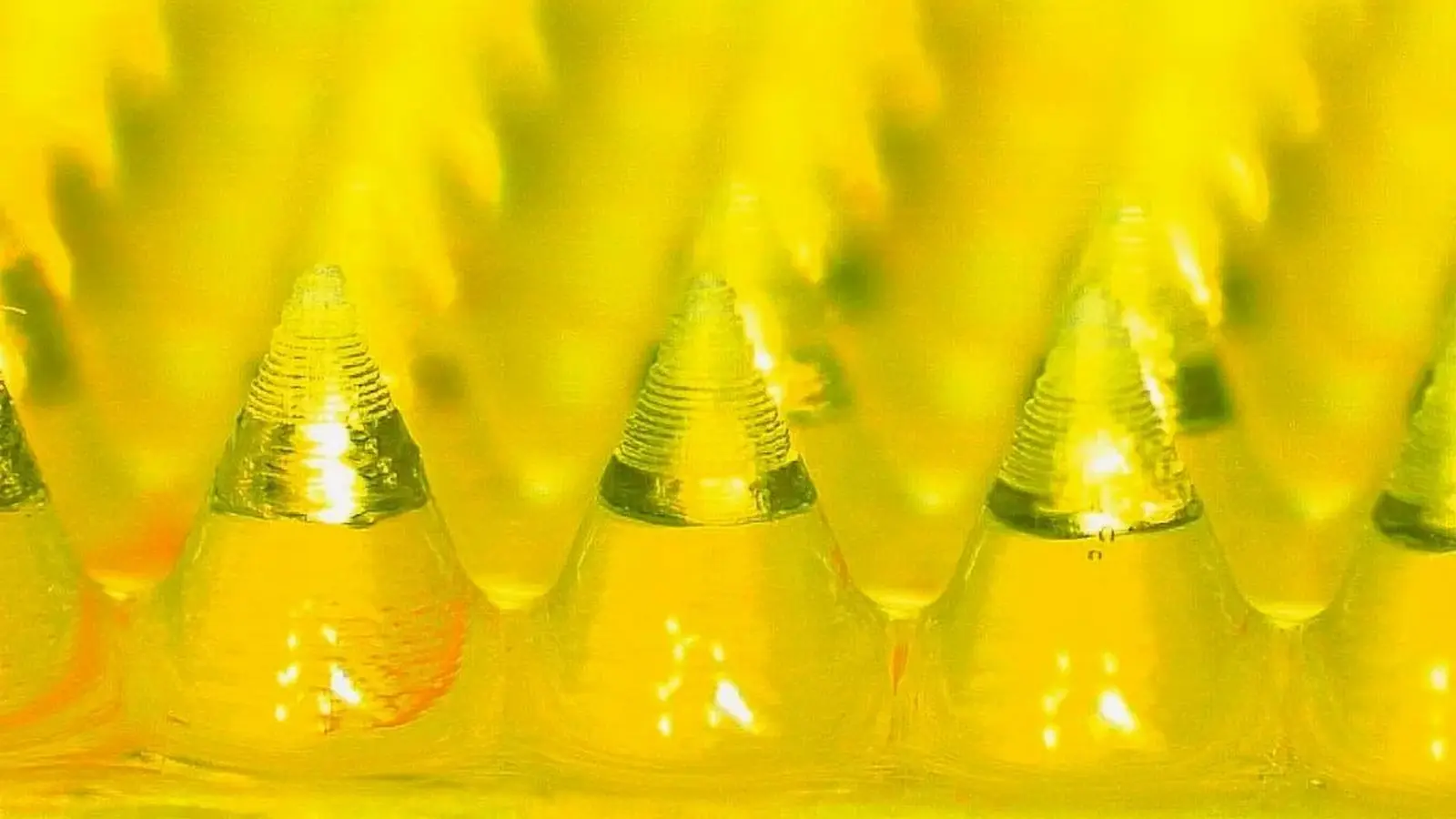
Imagine a treatment that slips under the skin like a whisper and then simply vanishes. Tiny needles, no bleeding, and a focused dose of cancer drugs delivered exactly where they are needed. That is the promise emerging from researchers at Queen's University Belfast.
How a disappearing patch delivers two cancer drugs
Scientists led by Rutuja N. Meshram and Professor Dimitrios A. Lamprou have created a 3D-printed, dissolving microneedle patch designed for localized skin cancer therapy. The patch is studded with microscopic needles that penetrate the outer skin layer without causing bleeding. Once inserted, these microneedles dissolve, releasing two anticancer agents: curcumin and 5-fluorouracil.
Why combine these two compounds? Curcumin has anti-inflammatory and potential anticancer properties, while 5-fluorouracil is a well-established topical chemotherapeutic. Together they aim to increase local efficacy while reducing exposure of the rest of the body to toxic drugs. The patch’s design allows for staged release, meaning a portion of drug payload is delivered quickly and the remainder releases more slowly over time. That controlled delivery can reduce the frequency of reapplications and the need for injections.

One-step printing, cleaner supply chains
What sets this work apart is the manufacturing technique. The team developed a single-step 3D printing approach that mixes both drugs directly into a printable resin before forming the microneedles. The result is a one-shot fabrication method that embeds medication inside each needle during production, rather than loading drugs afterwards. The technique improves drug integration, promotes better skin penetration, and enables programmable release profiles.
Professor Lamprou notes that dissolving microneedles could offer a less painful and more user-friendly route to chemotherapy for superficial skin lesions. 'Many patients avoid injections or struggle with repeated topical regimens,' he says. 'A dissolving patch simplifies delivery and can cut down on sharps waste and accidental needle injuries.'
Meshram adds that advanced manufacturing methods like 3D printing allow for more precise, patient-tailored dosing. 'We can imagine patches adjusted for lesion size, drug mixture, or release schedule—moving toward personalized topical therapies,' she says.
Clinical promise and next steps
The study, published in Advanced Healthcare Materials, is an early but important proof of concept. Laboratory results indicate improved local drug transfer and the potential for reduced systemic side effects. Still, rigorous clinical trials will be needed to confirm safety, effectiveness, and optimal dosing in patients.
Beyond skin cancer, the technology could be extended to vaccines or emergency medicines that benefit from fast, targeted delivery without cold chains or trained personnel. For dermatology clinics and home-based care alike, a dissolving microneedle patch represents a quieter, less invasive future for treating conditions that today often require painful injections or repeated topical therapies.
Targeted drug delivery, additive manufacturing, and biocompatible dissolving polymers are converging. The result is small in size but large in potential: a tiny patch that delivers therapy where it counts, then disappears.

“My work centers on sustainability, energy, and environmental science — examining how innovation can lead to a greener future.”

Discussion
Leave a Comment
Comments (2)
Is this even true? Mixing drugs into a resin for 3D printing sounds clever, but what about stability, dose variability and skin irritation… will they show safety data?
Wow this reads like sci fi but actually plausible. Tiny needles that vanish? If trials back it, home chemo patches could be a lifesaver. kinda hyped