
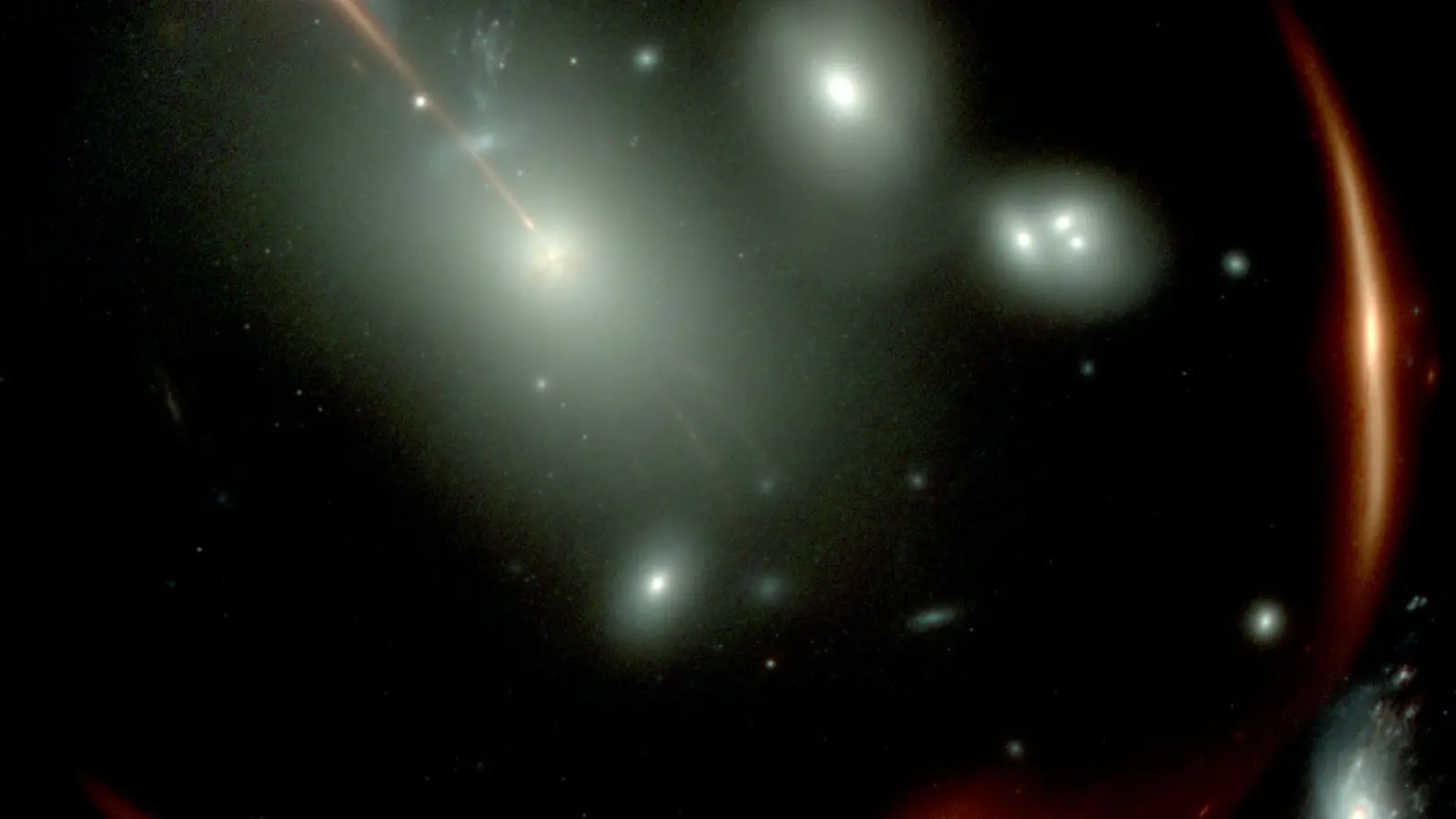
It is quiet now. Once, this object may have blazed as a quasar, outshining its entire galaxy. Today, it is a sleeping giant: an enormous black hole weighing roughly six billion times the mass of the Sun, seen at a time when the universe was barely three billion years old.
How astronomers found a hidden heavyweight
Astronomers usually spot the early universe by hunting for light: bright quasars signal supermassive black holes actively devouring gas. But not every massive black hole leaves a glowing trail. Some go dormant when their fuel runs out or when feedback heats and expels surrounding gas. Those quiet behemoths are far harder to detect. So how do you weigh what you cannot see?
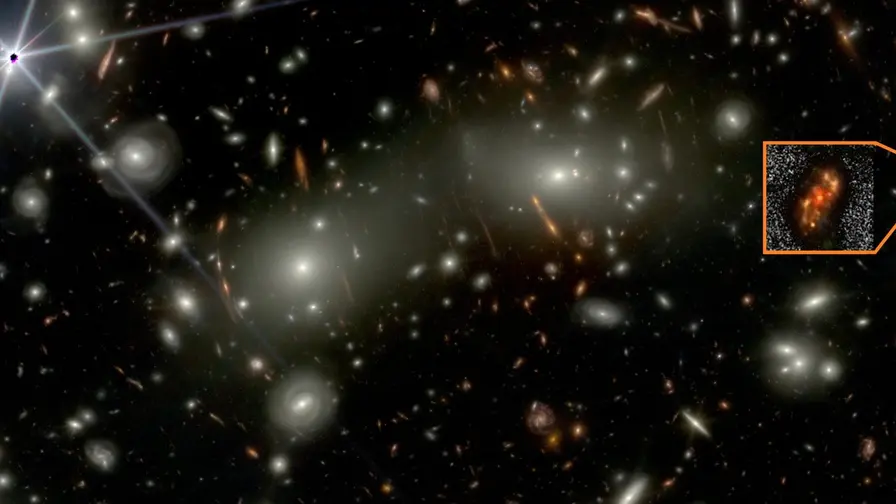
This team used two cosmic tools at once: the sharp infrared eyes of NASA's James Webb Space Telescope and the magnifying power of gravitational lensing. A nearer galaxy sits directly along the line of sight to MRG-M0138, bending and amplifying the background galaxy’s light by about a factor of 30. That natural telescope stretched the image, letting JWST resolve details that would otherwise be blurred into faint smudges.
With that boosted view, researchers tracked the motions of stars across the galaxy’s core. Stars feel the gravity of everything inside their orbits. If a very massive, compact object lurks at the center, stars close in will move faster than those further out. By mapping velocity patterns and constructing dynamical models, the team inferred the presence of a supermassive black hole and pinned its mass near six billion solar masses. The measurement used stellar dynamics, a method familiar from studies of the Milky Way and nearby galaxies, but applied now at an unprecedented cosmological distance.
Why this measurement matters
Finding a dormant black hole this far away is a big shift in perspective. Previously, the farthest dormant black hole measured by stellar motions lay within about 700 million light-years. MRG-M0138 sits more than 10 billion light-years away, pushing the technique deeper into cosmic history and shattering the distance record by roughly a factor of 15.
That reach changes what astronomers can test about how galaxies and black holes grew up together. Nearby galaxies show a tight correlation: bigger bulges tend to host heavier black holes. But we do not know if that relationship was already in place early on, or whether black holes and galaxies evolved along divergent paths before settling into the pattern we see today.
The new result provides a rare data point from the era when star formation and black hole growth were both more vigorous on average. Crucially, both the black hole and its host galaxy appear quiescent. The galaxy shows little ongoing star formation, implying that some process shut down stellar birth long before the present day. One plausible explanation is that the black hole once grew rapidly, and the energy released during that phase heated or expelled the gas needed to form stars, a process known as quenching. That scenario links black hole physics to galaxy evolution in a causal way.
Technique and technology
Stellar dynamics is straightforward in concept but demanding in practice. Observers need high spatial resolution and sensitive spectroscopy to measure how stellar velocities change with radius. JWST provides the sensitivity and the infrared coverage necessary to study distant, red galaxies. Gravitational lensing supplies the spatial magnification. Together, they allowed the team, led by Andrew Newman of Carnegie Science with collaboration from University College London and other institutions, to peer into the black hole's sphere of influence at a time when the universe was less than one quarter of its current age.
Accurate dynamical modeling also requires careful accounting for the galaxy’s mass distribution, including stars and dark matter, plus an understanding of orbital anisotropies. The researchers ran a suite of models to separate the central point mass — the black hole — from the extended mass of the stellar population. The result held up: a supermassive, but currently inactive, black hole dominates the core.

JWST and gravitational lensing enabled an international team of astronomers led by Carnegie Science’s Andrew Newman to measure the mass of a dormant black hole from the early universe for the first time.
Implications for future surveys and theory
This finding opens a new observational channel. If JWST plus lensing can reveal dormant black holes at cosmological distances, surveys targeting massive, lensed galaxies could assemble a statistical sample across cosmic time. That would let theorists test whether black holes consistently outpaced stellar growth in the early universe, or whether the two components grew in step.
There are broader consequences for models of feedback, quenching, and the lifecycle of active galactic nuclei. Understanding when and why black holes switch off is critical to predicting the evolution of galaxy populations. If dormant giants are common at high redshift, then episodes of intense accretion followed by extended quiescence may be an ordinary phase in a galaxy’s life. Alternatively, these objects might be rarer relics of exceptional growth events.
Future observations can also probe whether dormant black holes can reignite. A fresh influx of cold gas, for example through a merger, could reactivate the engine and turn a silent nucleus back into a quasar. Monitoring environments and merger histories for lensed galaxies will be part of the strategy going forward.
Expert Insight
"This measurement demonstrates that the combination of JWST and gravitational lensing is not just a novelty but a practical way to extend classical dynamical techniques to the early universe," says a fictional but representative expert, Dr. Elena Marquez, an astrophysicist who studies galaxy formation. "It gives us a direct handle on black hole masses where previously we had only indirect guesses based on brightness. That will force theorists to refine how they model the coevolution of galaxies and their central black holes."
Dr. Marquez adds, "The next step is to turn single discoveries into samples. With a handful of well-measured systems across a range of epochs, we can start to map the tempo of black hole growth relative to star formation."
Conclusion
The discovery of a dormant, six-billion-solar-mass black hole in MRG-M0138 reorients part of the black hole census. It proves that heavyweights existed and had already quieted down when the universe was young. More importantly, it shows that combining JWST’s sensitivity with nature’s gravitational lenses allows astronomers to weigh invisible giants far beyond the reach of past instruments. As surveys expand and models adjust, these sleeping giants will help explain how the brightest and darkest parts of galaxies shaped one another over cosmic time.

“The cosmos has always fascinated me. I write about space missions, astronomy, and the technologies pushing humanity beyond Earth.”

Discussion
Leave a Comment
Comments (3)
Feels a bit overhyped but ok, one data point can't rewrite coevolution models. If that's real then... we need a full survey, not just singles. Quick thought, but still cool tech
is the mass estimate robust? Stellar dynamics at z~3 sounds tricky, systematics and lens modeling could bias it. I'd like to see repeated obs and more models. curious
Wow, a 6-billion-sun black hole asleep? Mind blown. Love JWST + lensing combo, but also kinda eerie that such giants go quiet... what triggered the shutdown? so mysterious