
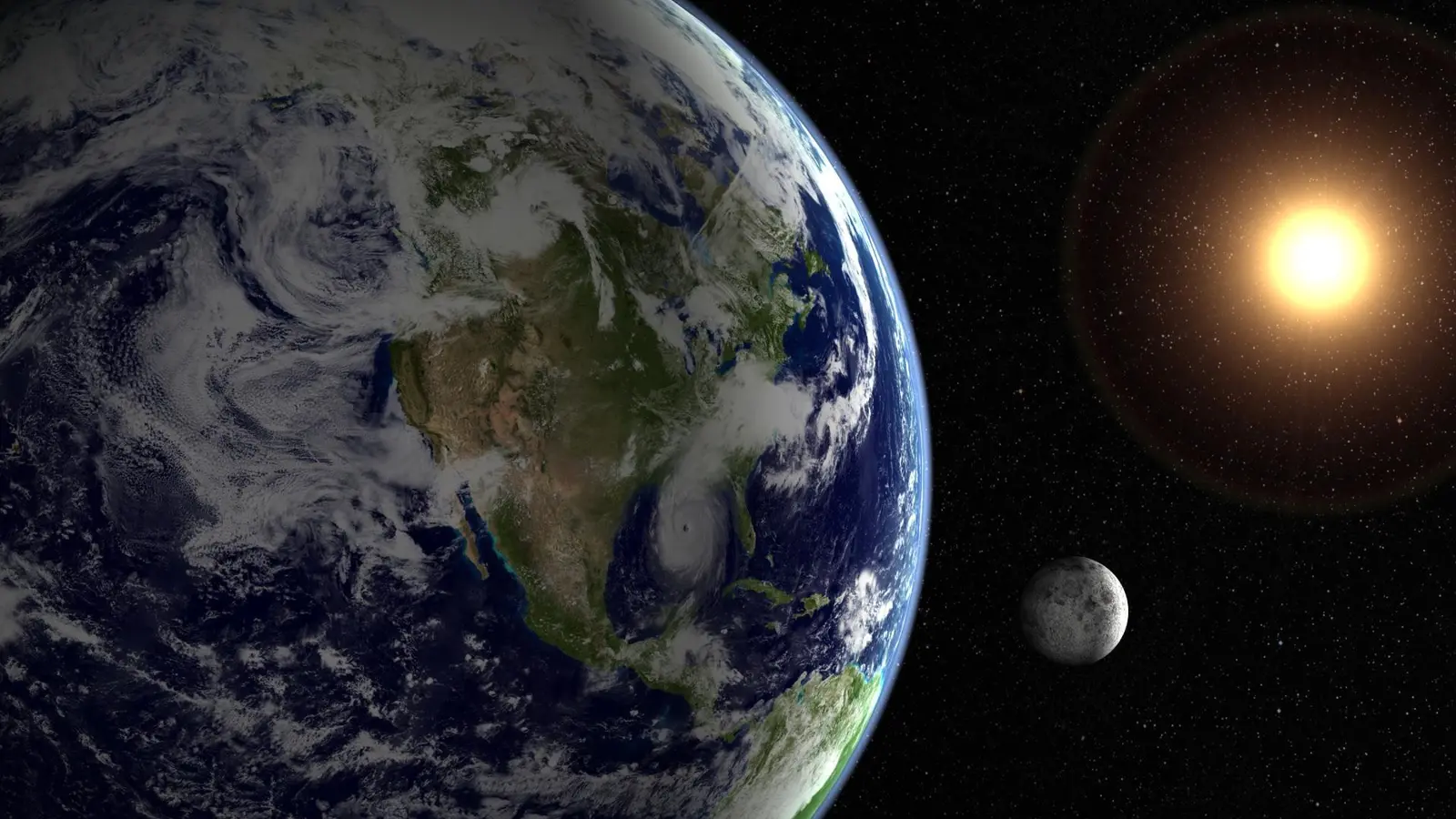
Imagine standing on a shoreline while the sun swells to fill the sky. The horizon brightens. The air stutters. A star that has been steady for billions of years turns into a bloated red giant, and everything inside its growing sphere seems doomed. For decades that image shaped our view of the solar system's far future: Mercury, Venus and perhaps even Earth, swallowed whole.
New modeling, however, paints a subtler picture. A team of astronomers has revisited the endgame of our star using updated stellar-evolution and stellar-wind calculations. Their result: Earth may not be an automatic casualty. Instead, our planet’s fate hinges on a tug-of-war between two competing processes — tidal forces that pull planets inward and the Sun’s gradual loss of mass, which weakens its grip and pushes orbits outward.
The physics in plain language
Tidal forces are familiar on a small scale: the Moon raises tides on Earth. On stellar scales, tides act like a brake. As the Sun expands and its outer layers become convective and turbulent, gravitational interactions drain orbital energy from nearby planets. If tides dominate, orbits decay. Planets sink. They burn.
Opposing that inward drag is mass loss. Late in its life the Sun will shed large amounts of material through powerful stellar winds. Every kilogram lost is a bit less gravity. Orbits respond by moving outward, sometimes by a lot. The key question is which effect wins for Earth.

Earlier studies reached mixed conclusions because they used simplified prescriptions for stellar structure or crude wind models. The new research integrates more refined calculations of how an aging star’s interior changes and how its winds carry away mass. The team then tested a range of plausible mass-loss scenarios to bracket outcomes.
The headline is straightforward. Mercury and Venus are almost certainly doomed; tides and direct engulfment will end them as the Sun balloons. Earth and Mars live in a gray zone. Under many realistic models, our planet drifts outward enough to avoid direct engulfment and ultimately orbits a white dwarf, the dense remnant left after the Sun sheds its envelope. But in scenarios where tidal torques are stronger than expected, Earth could still spiral inward.
Why the uncertainty matters
It comes down to numbers: how much mass will the Sun lose, and how efficiently will tides sap orbital energy? Stellar-wind physics remains complex. Small changes in the assumed wind strength alter the balance decisively. The researchers point out that the Sun might lose something on the order of half of its current mass during the red-giant and asymptotic-giant phases, but that figure carries uncertainty.
To make the problem less hypothetical, the team examined an analogue star, HD 56096, roughly 183 light-years away. This star shares mass and broad characteristics with the Sun, and its observed properties support the new models: the pace of expansion and wind-driven mass loss could be sufficient to push an Earth-like orbit outward before tides have the final word.
Even if Earth escapes physical engulfment, escape is not the same as survival for life. The Sun will grow brighter long before its red-giant phase. In about one billion years solar luminosity will likely heat Earth enough to strip oceans and sterilize the surface. So the question of Earth’s orbital fate is largely about the solar system’s architecture after stellar death, not about humans living there at that late time.
Expert Insight
"If tidal forces dominate, Earth will be swallowed; but if mass loss wins out, Earth could be pushed outward and survive," says Mats Seldors, lead author and researcher at the Institute of Astronomy, Catholic University of Leuven, Belgium. "Our models improve on prior work by coupling internal stellar changes with more realistic wind prescriptions, yet the final outcome remains sensitive to the Sun's exact mass-loss history."
The implication is twofold. First, detailed stellar physics matters for predicting long-term planetary dynamics. Second, observations of Sun-like giants such as HD 56096 help narrow the plausible pathways for the solar system’s future. Combining observation and refined models reduces the uncertainty, even if it does not eliminate it.
What this means for planetary science
This study reframes questions about planetary migration and survival during late stellar evolution. It suggests that rocky worlds can survive dramatic changes in their parent stars and end up in distant orbits around white dwarfs. Those remnant systems are now prime targets for searches that probe planetary bodies orbiting dead stars, including the fate of atmospheres and volatile reservoirs.
Technologically, new telescopes and long-term surveys will be essential. Precise measurements of stellar winds, more extensive catalogs of evolved Sun-like stars, and better limits on how convective envelopes affect tidal dissipation will all sharpen predictions. Ultimately, connecting stellar astrophysics with planetary dynamics yields a clearer picture of cosmic demographics: which planets survive stellar death and where we might look for them.
Conclusion
The romantic image of the Sun swallowing Earth remains possible, but it is not inevitable. Improved models show a realistic pathway for Earth to be nudged outward and avoid incineration, concluding its long orbit around a white dwarf. The caveat is large: uncertainties in stellar mass loss and tidal physics still allow both outcomes. In other words, the planet may escape the Sun’s red giant embrace, but the exact ending depends on stellar details we are still uncovering.

“My work centers on sustainability, energy, and environmental science — examining how innovation can lead to a greener future.”

Discussion
Leave a Comment
Comments (2)
wow, imagining the sun bloating like that gives me chills... but also kinda cool Earth might survive? strange mix of hope and doom
Wait so Earth might actually dodge being eaten? Sounds hopeful but it hinges on tiny wind numbers, kinda weird, is this even settled tho