
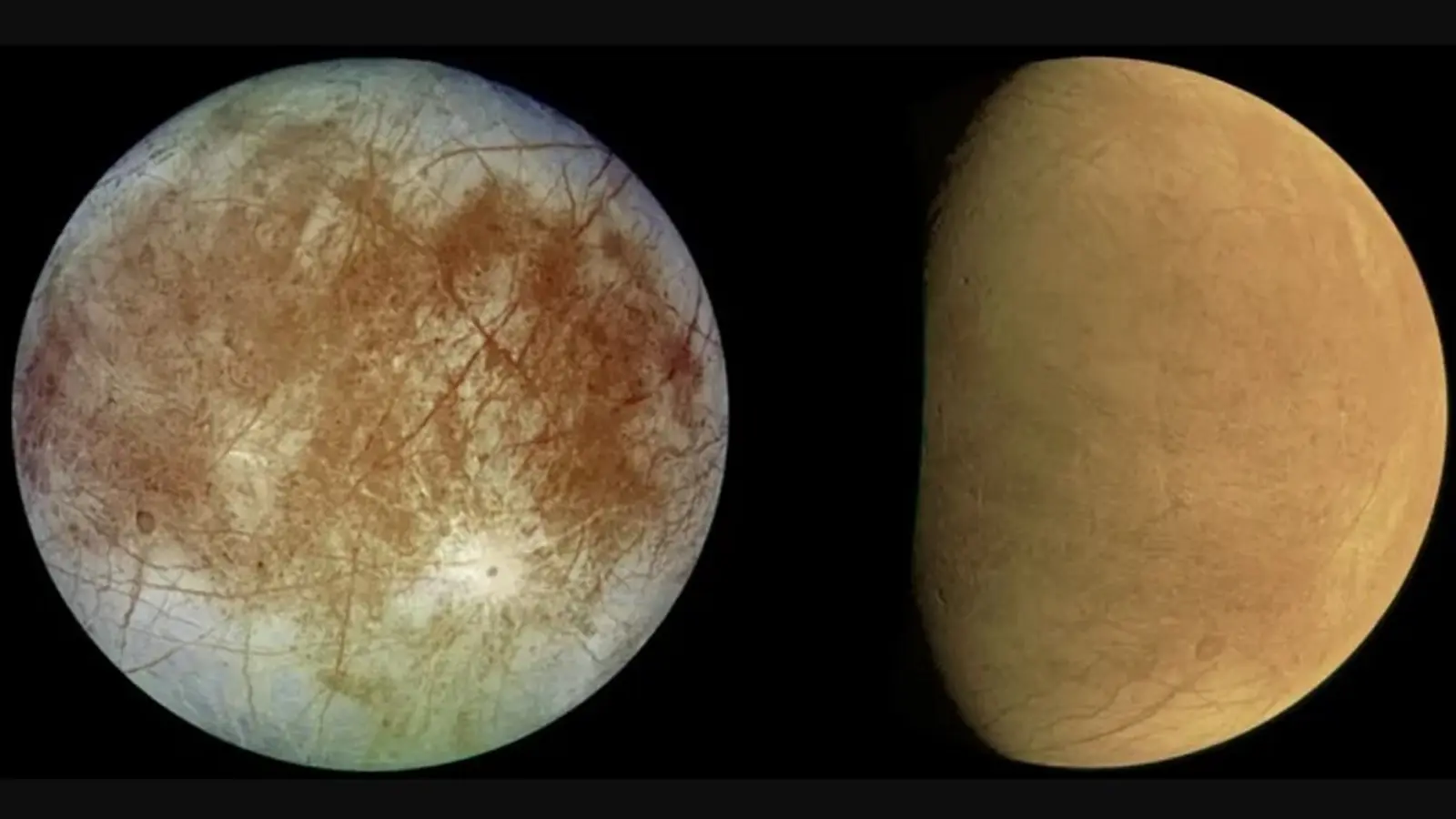
Imagine standing at the rim of a frozen ocean, wind howling, but the sea you seek is buried miles below and refuses to answer. That is the dilemma scientists now face with Europa, Jupiter's bright, fractured moon. New simulations suggest the moon's icy shell is not a porous gate but a near-impermeable barrier that freezes any water trying to climb through it.

Europa, one of Jupiter’s icy moons, has drawn scientific interest because its frozen surface may hide a global ocean with conditions that could support life.
A harder path than we hoped
For years planetary researchers entertained a tantalizing shortcut. What if pockets of ocean water could travel upward through cracks in the ice and appear close to the surface? Such shallow reservoirs would be easier to detect and possibly sample with spacecraft, offering a quick route to probe the chemistry of Europa's hidden sea. The new work led by Rutgers scientist Lujendra Ojha reframes that hope. His team modeled fluid dynamics inside narrow ice fractures and found a brutal physical reality: moving water loses heat far faster than prior models allowed, and that rapid cooling can choke a pathway shut in hours.
The simulations include turbulence, a messy, energetic form of fluid motion. On Earth, fluid models sometimes smooth over turbulence for simplicity. Ojha's group deliberately put the chaos back in. The result was a picture of water surging and swirling against cold ice walls, mixing continuously and shedding heat at high rates. Where earlier calculations allowed for long, steady ascents, these new runs show flows that cool, nucleate crystals, and stall.
What the physics actually says
Think of a narrow crack filled with warm ocean water punching upward into a frigid shell. At first glance the scenario resembles magma driving through rock on Earth, but the analogy collapses under scrutiny. Lava is viscous, hot, and often insulated by a surrounding solid that still conducts poorly compared with ice contacting liquid water. Water in ice fractures behaves differently in two crucial ways: it mixes violently, and ice forms rapidly when the temperature drops.
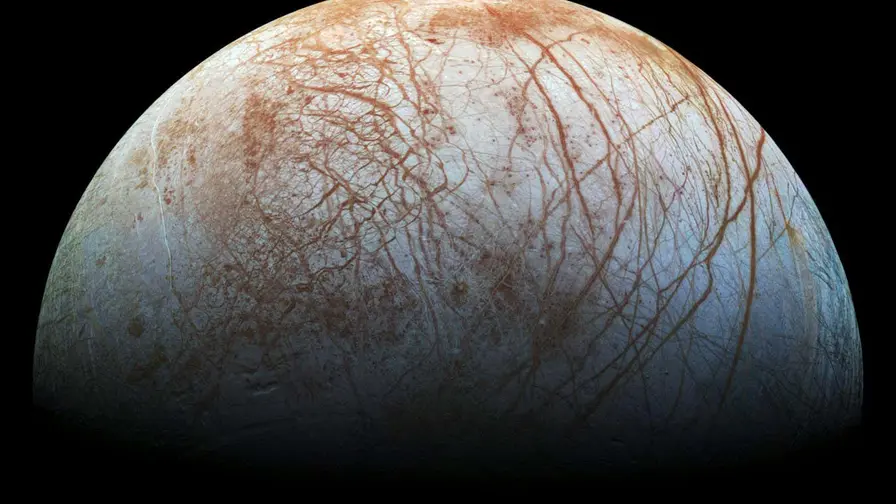
Turbulence increases the contact between the liquid and the cold walls. That amplifies heat loss. When water becomes supercooled, tiny frazil ice crystals begin to form throughout the flow. These are not orderly sheets but suspended shards that accumulate along the fracture. Over time they reduce the cross section available for flow, slow the current, and then plug the fracture completely. In the simulated cases, narrow fractures could freeze shut within hours. Even wider conduits fared poorly once turbulent mixing was allowed for.
That sequence matters because it redefines what we should expect to find on Europa's surface. If shallow liquid pockets exist, they might be the result of local melting inside the ice shell rather than direct upwellings from the global ocean. Localized heating can come from tidal flexing, frictional heating along faults, or decay of heat-producing elements. Liquids created this way would record the chemistry of the ice and near-surface environment, not necessarily the chemistry of Europa's deep ocean.
Implications for life detection and missions
Europa remains one of the solar system's top candidates for astrobiology. A salty ocean in contact with a silicate seafloor could supply both liquid water and chemical energy, two of the key ingredients for life. But the discovery that the ice shell can act like a one-way frozen valve complicates mission planning. Finding liquid a few meters below the surface will not automatically mean you have access to the ocean's composition. A pocket of water created by local melting could lack the salts, minerals, or organic molecules transported from the deep interior.
That makes a difference for how we interpret radar echoes, surface chemistry, and plume-like features. Instruments that detect shallow liquid will need to be combined with compositional measurements and geological context to decide whether a sample is representative of the ocean or merely of the shell. In short, proximity to liquid is not the same as a direct line to the deep sea.
Two major missions will test these ideas. NASA's Europa Clipper launched in October 2024 and is scheduled to begin close flybys of Europa after its arrival at Jupiter. The spacecraft carries ice-penetrating radar, spectrometers, and cameras designed to map the surface and probe the interior. The European Space Agency's JUICE mission, launched in April 2023, will also study Jupiter's icy moons before ultimately orbiting Ganymede. Both missions will provide higher-resolution data on ice thickness, subsurface structure, and locations where liquid might be present.
Expert Insight
"These results force us to be precise about targets," said Dr. Mara Hines, a planetary geophysicist who studies icy worlds at a research institute in California. "A radar reflection that looks like liquid does not automatically equate to a conduit to the deep ocean. We must combine subsurface imaging with chemistry and geologic mapping. Otherwise we risk mistaking a transient melt for the global ocean."
Hines added that the new simulations are a healthy corrective. "When we build exploration strategies, we need to account for the messy physics. Turbulence and frazil ice are not exotic footnotes; they dictate whether a pathway remains open long enough to transport meaningful material."
How the models were built and tested
Ojha's team published their results after developing numerical simulations that incorporate fluid turbulence, heat exchange, and ice crystallization kinetics in narrow conduits. Previous models often treated rising water as laminar or smoothed the flow for computational simplicity. The new approach resolves the chaotic eddies and mixing scales that control heat transfer between the liquid and surrounding ice. By tracking the formation and accumulation of frazil ice, the simulations estimate how quickly and under what conditions a fracture will clog.
The models explored a range of fracture widths, ascent rates, and thermal contrasts. In many realistic parameter regimes, heat loss outpaced the ability of flowing water to keep channels open. Only in extreme and unlikely scenarios did the simulated flows transport enough liquid to sustain a connection between the deep ocean and near-surface regions. In practical terms, that means either the fractures would need to be unusually wide, uncommonly numerous, or supported by sustained, localized heating to remain open.
What to look for on Europa
- Signs of localized melting: thermal anomalies, disrupted ice fabrics, or features associated with tidal heating.
- Chemical fingerprints: salts, organics, or mineral patterns that suggest transport from the deep ocean rather than formation within ice.
- Temporal behavior: transient plumes or rapidly forming surface features that could indicate episodic melting events.
Europa Clipper's radar will be critical for distinguishing steep-walled reservoirs from thin, ephemeral films. Spectrometers will help determine whether surface materials contain the signatures of ocean-derived salts or instead point to near-surface alteration. Together these measurements will let scientists assign probabilities to competing formation scenarios.
Conclusion
The idea of an easily reachable subsurface ocean on Europa is compelling, but the physics is less forgiving than we hoped. Turbulent flows, rapid heat loss, and frazil ice formation mean that fractures in the shell may be short-lived conduits rather than steady pipelines. Shallow liquid on Europa could be common, but its origin matters. Is it ocean water that rose intact, carrying with it chemical cues from the seafloor, or is it meltwater born in the shell itself? The answer will shape how we search for habitability and interpret the first high-resolution data from Europa Clipper and JUICE.
This study does not close the door on ocean access. Instead it clarifies where we should aim our instruments and how carefully we must read their signals. The ice that conceals Europa's global sea proves a formidable opponent. But with targeted observations and a keen understanding of the underlying physics, we can separate the shallow illusions from genuine links to the moon's hidden ocean.

“My work centers on sustainability, energy, and environmental science — examining how innovation can lead to a greener future.”

Discussion
Leave a Comment
Comments
No comments yet. Be the first.