
.webp)
A Paris arrival with little more than a headache turned into a public-health ripple that stretched from an Air France jet to international laboratories. On Tuesday a doctor returning from the Democratic Republic of Congo was confirmed as France's first domestically identified case of Ebola in the current outbreak, a development that has focused urgent attention on travel screening, contact tracing, and the limits of our vaccines.
A flight, a headache, and immediate containment
French health authorities say the patient boarded a commercial flight from Kinshasa almost asymptomatic, reporting only headaches. During the journey the person's condition "slightly deteriorated during the flight," prompting crew and medical teams to isolate the patient on arrival in Paris and begin care before laboratory confirmation arrived. The health ministry called it "a first positive case of Ebola virus disease on national territory." Viral-load tests show a very low level, and officials describe the patient's state as stable.
Air France confirmed the passenger travelled on one of its flights and that it provided passenger manifests to authorities. "Contact with these passengers is being handled by the health authorities," the airline said. French Health Minister Stephanie Rist later noted that five other passengers have been identified as possible contacts and placed in precautionary isolation. The prime minister's office said he was monitoring the situation closely.
Outbreak context and scientific implications
This case marks the first detection of the current outbreak outside Africa. The flare in the DRC was declared on May 15 in Ituri province, a remote, conflict-affected region that complicates surveillance and care. Official tallies list over 1,000 cases with 267 deaths so far, a fatality rate near 25 percent. Many experts warn those figures likely undercount the true scale because of limited access in affected areas.
Virologically, this outbreak is caused by the Bundibugyo strain. That matters. The Ebola vaccines licensed after 2018 target the Zaire strain and offer little if any protection against Bundibugyo. At present there is no approved vaccine or specific antiviral treatment for the strain driving the DRC epidemic, although experimental therapies are being trialled in the region.
How contagious is Ebola in practice? The virus spreads through direct contact with the bodily fluids of a symptomatic person or contaminated materials. It is not airborne in the way influenza or measles can be. Still, risk increases sharply in close-contact settings, especially where protective equipment and rapid isolation are unavailable. For humanitarian staff, standard protocols often include a three-week quarantine after exposure to confirmed cases.
.webp "Why France's €30M AI Pledge Sparked Global Backlash")
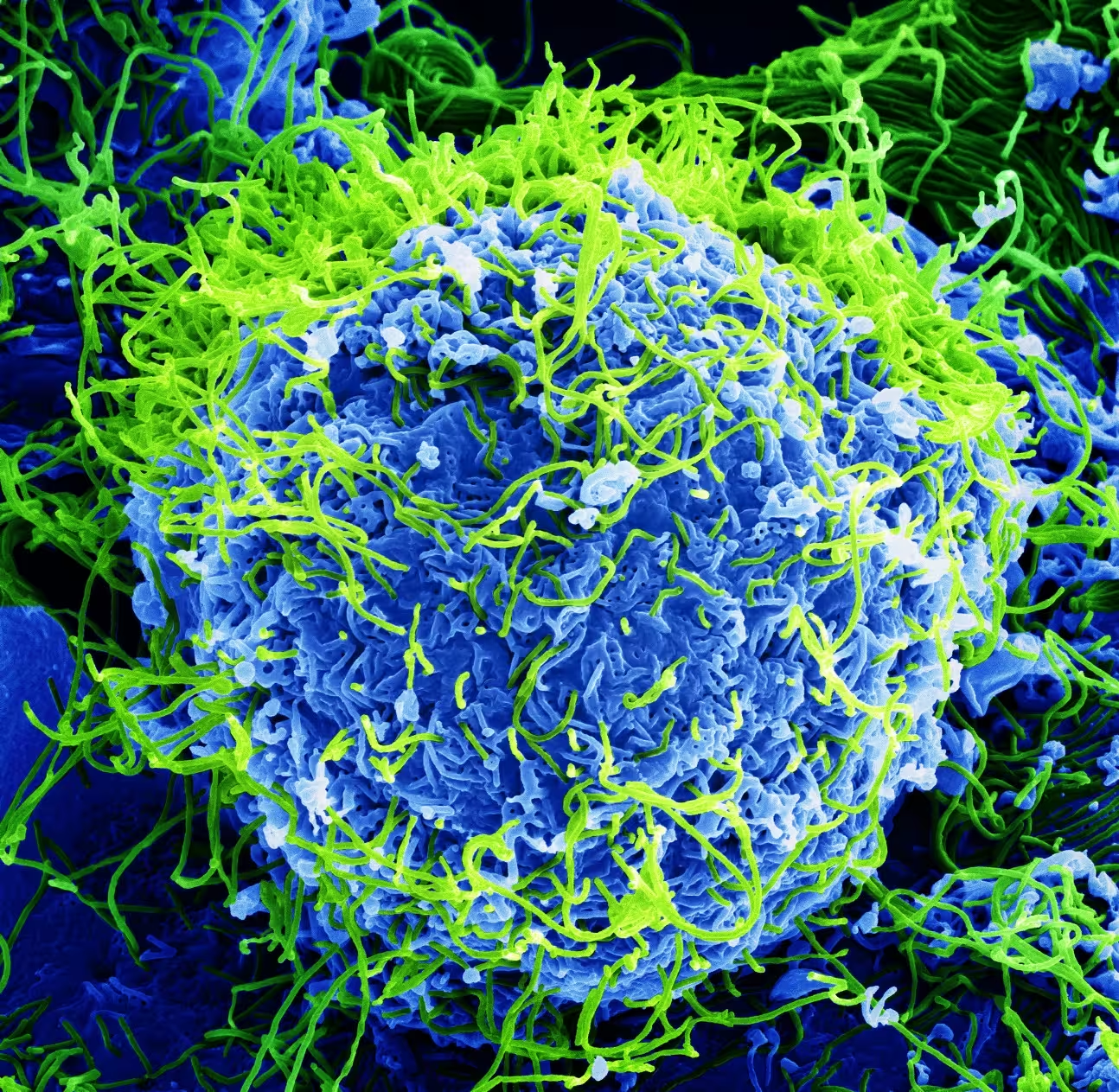
A colorized scanning electron micrograph of Ebola virus particles (green) budding from an infected cell.
The practical response to a single imported case is familiar: identify, isolate, and trace. French authorities quickly isolated the patient, tested contacts, and coordinated with international partners such as the World Health Organization. WHO Director-General Tedros Adhanom Ghebreyesus said the global risk from the outbreak "remains low," while underlining the need for sustained vigilance where cases arise.
What the Bundibugyo strain means for response
- Vaccination campaigns based on Zaire-targeted vaccines will not reliably prevent Bundibugyo infections.
- Clinical care relies on supportive treatment; some patients have received experimental agents under compassionate or trial protocols.
- Contact tracing and rapid isolation remain the most effective tools to limit spread, especially at air transit hubs.
International NGOs are closely involved. ALIMA, the medical humanitarian organization, confirmed the patient worked with its teams and said it is investigating how the infection occurred. In May, a U.S. surgeon who contracted Ebola in the DRC was flown to Germany for advanced care and later discharged after 17 days; his treatment included experimental therapies that remain under study.
Expert Insight
"Imported cases are never zero-risk, but they are manageable when systems work," says Dr. Anne Moreau, an infectious-disease epidemiologist at the Pasteur Institute. "Early detection on arrival, transparent passenger lists, and rapid isolation are the three elements that convert a potential chain of transmission into a contained event. The remaining challenge is ensuring those elements function in places where health systems are under strain. That determines whether an outbreak stays local or becomes international."
The Paris detection underlines two realities: first, global travel can move pathogens quickly; second, strong public-health routines at points of entry and within hospitals blunt that movement. For now, officials judge the risk to the wider public as low. But the presence of a Bundibugyo outbreak in a mineral-rich, conflict-affected region of the DRC continues to pose significant challenges for containment and surveillance. As investigations proceed, health authorities will watch passenger contacts, viral sequencing data, and whether any secondary cases emerge in France or elsewhere.


“The cosmos has always fascinated me. I write about space missions, astronomy, and the technologies pushing humanity beyond Earth.”

Discussion
Leave a Comment
Comments (2)
Phew, lucky they isolated quickly! Still kinda freaked out, airports gotta step up screening... travel isnt the same anymore :(
Wait, Bundibugyo not covered by usual vaccines? That can't be good. How did they get on the plane almost symptomless, tests miss something??