
A speck of mineral smaller than a poppy seed is forcing planetary scientists to rethink what Mars might once have been capable of doing deep beneath its surface.
A grain that refuses to behave
The meteorite NWA 8171 is unassuming at first glance: a basaltic breccia, a jumble of once-molten rock and embedded fragments, now curated at the Royal Ontario Museum. Yet when researchers split one tiny fragment and probed it with high-resolution chemistry, they uncovered a few grains of garnet, a mineral never before confirmed in a Martian sample.
Garnet on Earth often signals intense conditions — high temperatures, crushing pressures, or pervasive fluid alteration. Finding garnet in a meteorite derived from Mars raises immediate questions: did that garnet crystallize on Mars, or was it an interloper incorporated into Martian crustal rubble long before the meteorite launched toward Earth?
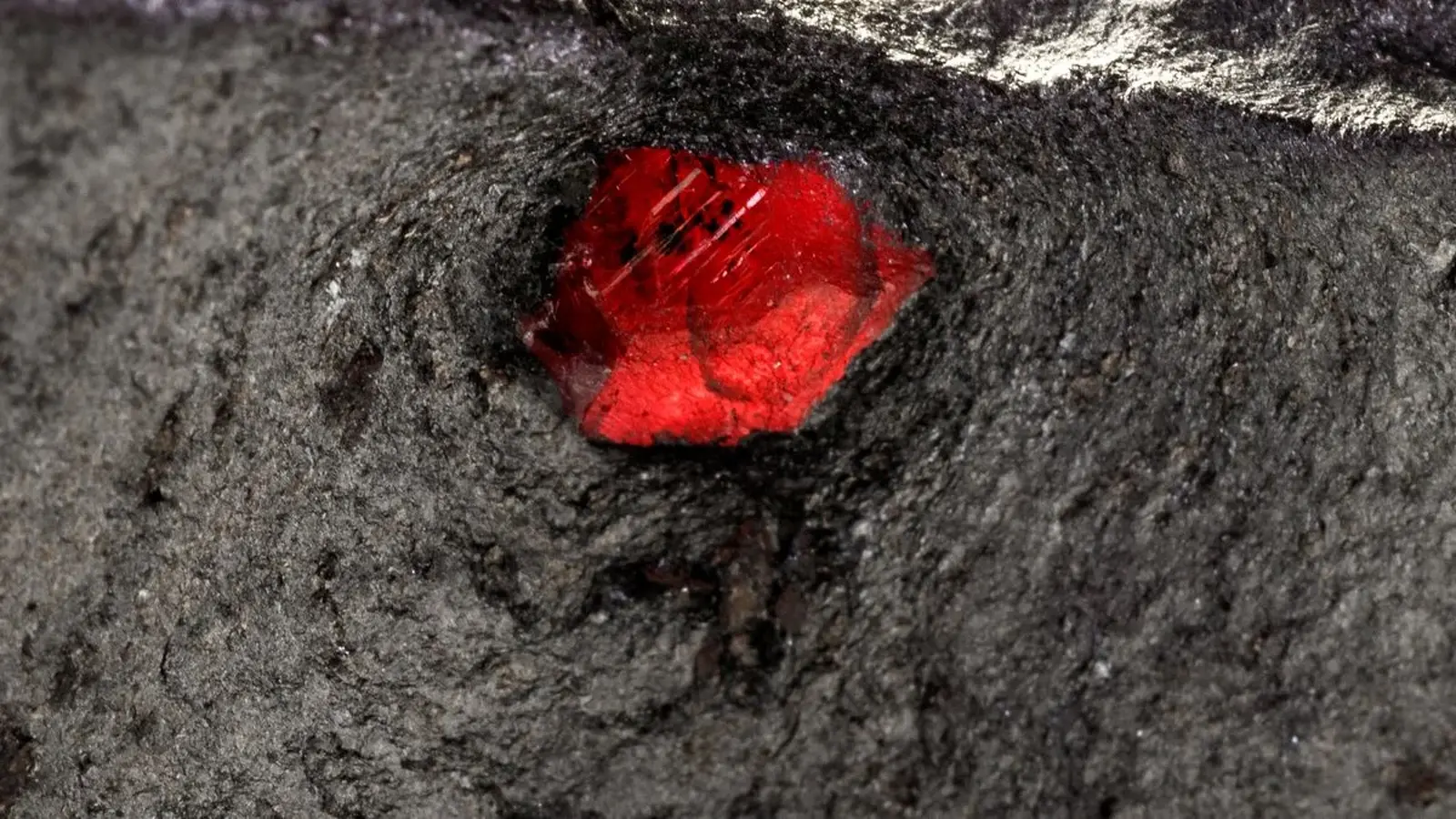
At first glance the crystals did not look like the garnets most people picture. Andradite, an iron-rich variety of garnet, can carry an olive or yellow-green tint that blends into the typical fabric of meteorite minerals. That camouflage nearly let the find slip by.

Andradite can have an olive hue.
"This little section of the meteorite looked really interesting, and the chemistry was a bit odd," says planetary geologist Tanya Kizovski of Brock University. "At first, we assumed it was a mineral called pyroxene, which is very common, but then we decided to take a second look." Subsequent analyses confirmed the mineral as andradite.
Why this matters for Martian geology
Garnet is more than ornamentation. It acts like a geological recorder. Its crystal chemistry and internal trace elements lock in the pressure-temperature conditions and fluid chemistries present when it formed. On Earth, garnet frequently forms during metamorphism, when rocks are transformed by heat, pressure, or chemically active fluids. If the andradite in NWA 8171 formed on Mars, it would imply that processes capable of producing metamorphic minerals occurred in that region of the planet.
The basaltic breccia nature of NWA 8171 complicates the interpretation. Breccias are composites: clasts of different origins stuck together by cooling magma or impact melt. That means the garnet-bearing clast could be local Martian crust or a piece of foreign material that arrived on Mars long before the impact that eventually ejected this meteorite into space.
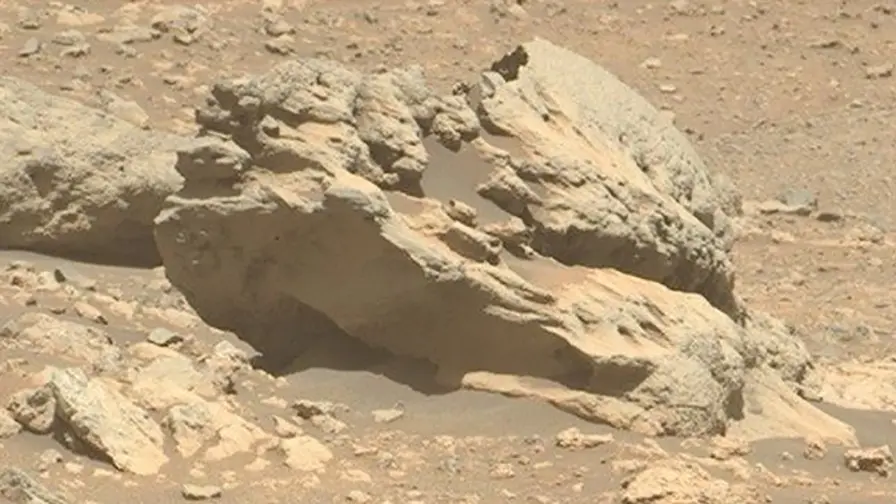

Chemical maps of the garnet-bearing fragment.
If isotopic ratios of elements such as oxygen and chromium within the garnet match those measured in known Martian materials, the case for an in situ Martian origin would strengthen. If they differ, the garnet might trace back to a different parent body and simply became part of the Martian crust before being entrained in NWA 8171.
Either result would matter. A Martian origin would expand the palette of known rock types on Mars and imply episodes of heating or fluid activity capable of producing metamorphic minerals. A non-Martian origin would highlight the complexity of material exchange within the inner solar system and the role impacts play in mixing planetary crusts.
Possible formation scenarios
- Impact metamorphism: a meteorite impact could have generated transient high pressures and temperatures, producing garnet in altered host rocks.
- Magma-related processes: uncommon magma compositions or localized contact metamorphism where magma intruded into older crustal rocks.
- Hydrothermal alteration: hot fluids percolating through rock may alter mineralogy and stabilize garnet in certain chemical environments.
"This discovery is going to expand our knowledge of the geologic processes that are possible on this planet," Kizovski adds. "This new garnet-bearing rock type could give us clues to how Mars has changed throughout its history and new insights into the ancient environments that could have formed the garnet and related minerals."
Planetary scientist James Darling of the University of Portsmouth notes the broader implications: "The findings add a striking new dimension to our understanding of the geology of Mars, and open an exciting new window into the evolution of our planetary neighbor."
Expert Insight
Dr. Elena Martín, a planetary geochemist at a major university, offers a practical vantage point: "Isotopic work is the key. Garnet traps small amounts of accessory elements and isotopes when it forms, and those signatures are robust. If the oxygen and chromium isotopes line up with Martian basalts, we've got direct evidence of metamorphic or hydrothermal episodes on Mars. If they don't, we learn how much material is being exchanged across planetary bodies over time. Either way, it's a rare chance to read a hidden chapter of solar system history."
The methodology ahead will rely on careful, minimally destructive isotope ratio measurements and further microstructural imaging to determine whether the garnet crystals grew in place or were incorporated as foreign fragments. Instruments such as secondary ion mass spectrometers and electron microprobes will play central roles.
Conclusion
Tiny, unassuming, andradite grains inside NWA 8171 have reopened questions about Mars' capacity for producing metamorphic minerals and about how planetary crusts can be mosaicked by impacts. The next steps are clear: pin down isotopic fingerprints, chart the crystal histories, and see whether these garnets narrate a homegrown Martian episode or a longer story of interplanetary exchange. Either outcome promises new chapters in our picture of Mars.

“My work centers on sustainability, energy, and environmental science — examining how innovation can lead to a greener future.”

Discussion
Leave a Comment
Comments (2)
Is this even true? could be a foreign clast or contamination, not convinced yet. isotopes will make or break the story, fingers crossed
wow didnt expect garnet on Mars. if those grains are Martian, subsurface was way more active than we thought... gotta see the isotope data asap