
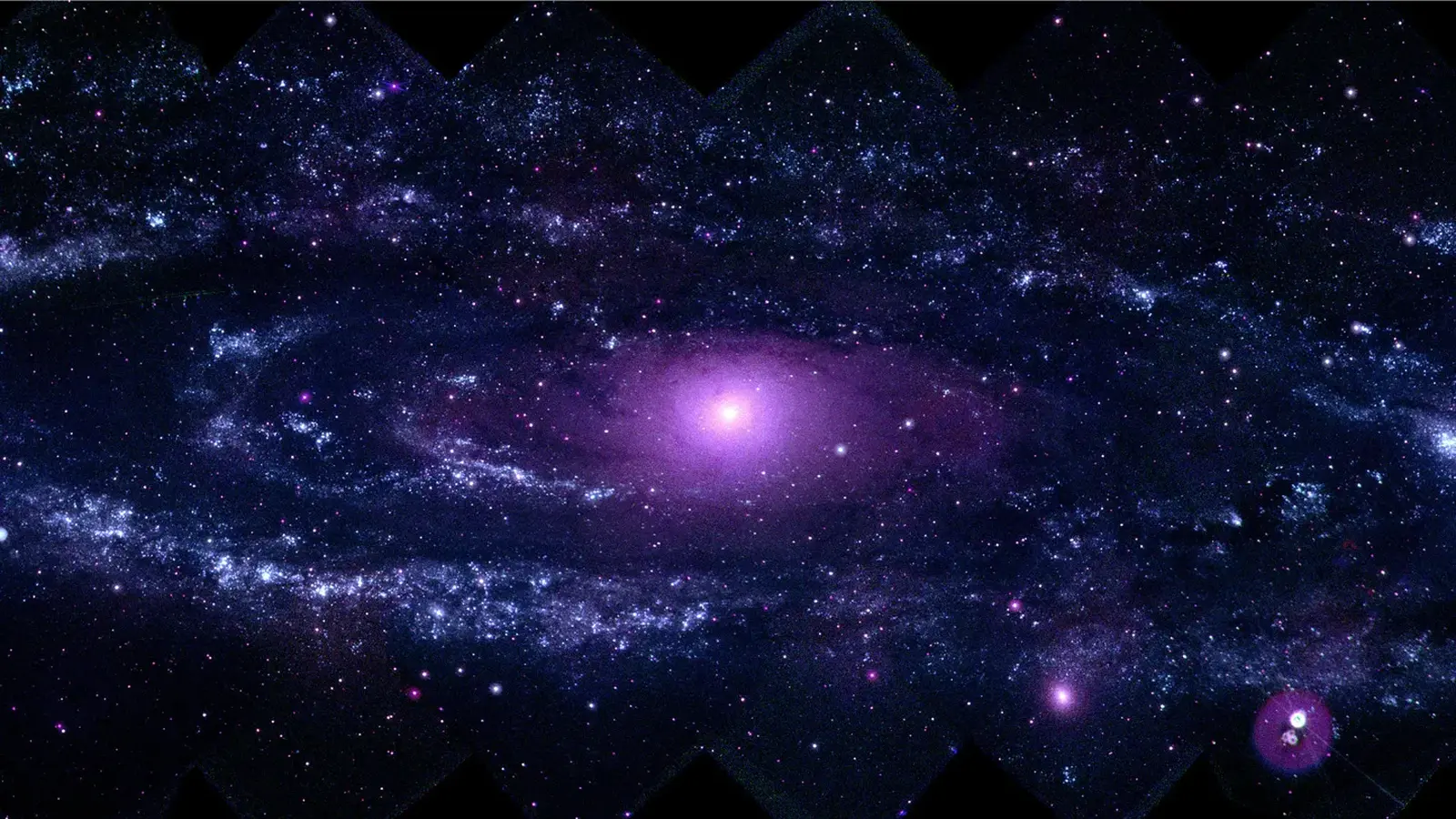
Look toward the galaxy’s heart and you find a glow that refuses to be explained. It is faint, spherical, and spread across thousands of light years. For more than a decade astronomers have argued about what produces it: an exotic signal from dark matter, or a swarm of ordinary objects we simply cannot see.
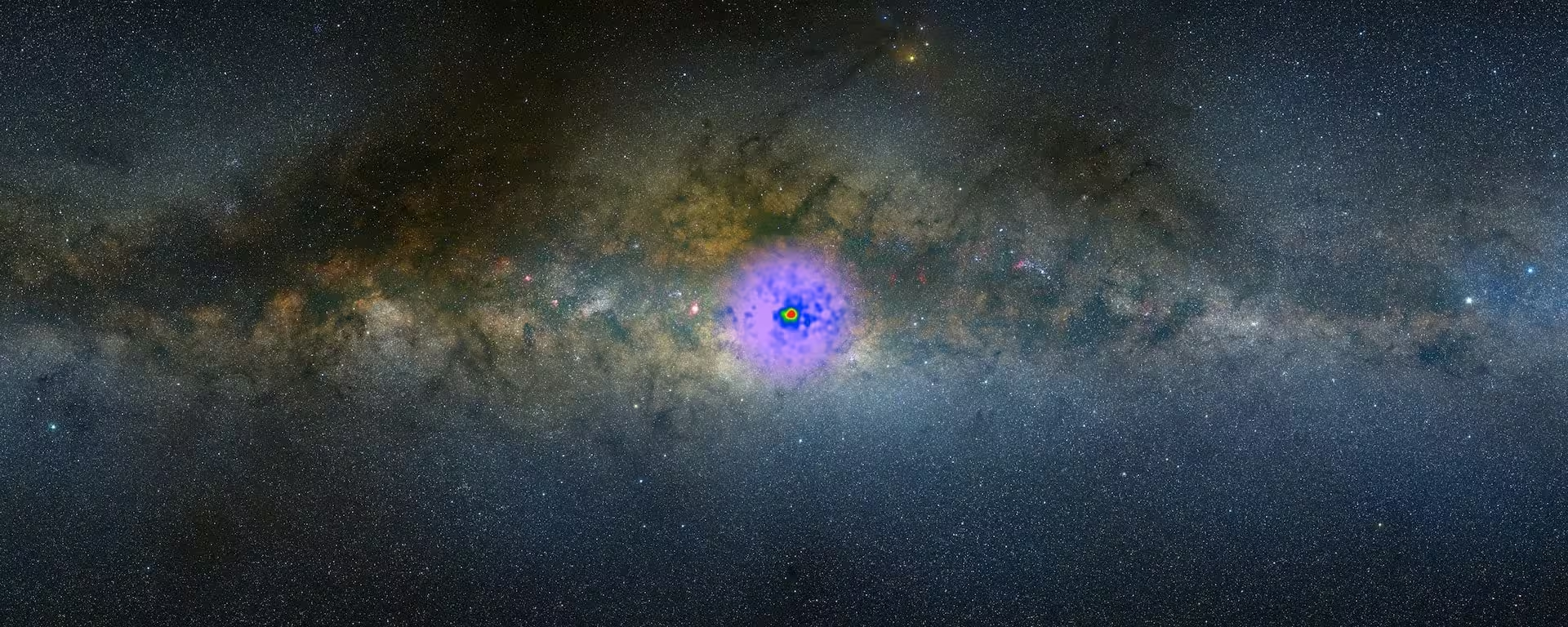
An image of the gamma-ray excess observed at the center of the Milky Way, overlaid on an optical image of the galaxy. Scientists have debated the origin of this excess, and whether it could be caused by dark matter, for more than a decade.
The new study, led by teams at the University of Vienna and Lawrence Berkeley National Laboratory and published in Physical Review Letters, does not close the book. It reopens questions by changing how we look at the data. Instead of treating each detected gamma-ray as a speck on a map, the researchers taught a machine-learning model to read each photon’s energy as well as its position. The result shifts the balance of plausible explanations.
A sharper look at the Galactic Center
The feature is known as the Galactic Center Excess. It appears as extra gamma-ray emission centered on the Milky Way’s nucleus. Two explanations have dominated: self-annihilating dark matter, a theoretical particle-based process that would produce gamma rays when dark matter particles collide, or a hidden population of millisecond pulsars, tiny neutron stars that spin hundreds of times per second and emit high-energy light.
Which is it? The region is messy. The galactic center is bright in many wavelengths, with gas, stars, and other sources crammed into a small patch of sky. Past statistical tests tended to favor the pulsar scenario, finding that the excess looked like many unresolved point sources. Those analyses, however, largely ignored a crucial piece of information — the energy carried by each gamma-ray photon.
To fix that, the team trained a neural network on over one million simulated gamma-ray observations. The model learned to weigh both where photons arrived and how energetic they were. That combination matters. Energy spectra carry fingerprints of physical processes. When the researchers folded photon energies into their model, the picture changed: if the emission comes from pulsars, those pulsars would have to be far dimmer than earlier studies assumed. Dimmer pulsars are harder to distinguish from a smooth glow, the sort expected from annihilating dark matter.
One stark implication: the pulsar option now requires an enormous population—on the order of 35,000 millisecond pulsars clustered near the galactic center. That count far exceeds previous estimates of a few hundred to a few thousand. Producing so many pulsars in that compact region raises astrophysical questions about formation and survival that current models struggle to answer.
Expert Insight
"This is a careful, methodical step forward," says a fictional astrophysicist, Dr. Lena Ortiz, who works on high-energy surveys. "What changed is not just a new algorithm, but the willingness to let the photons speak more fully. Energy is a fundamental property of each detection. Once you include it, the separation between point-like sources and a smooth component blurs. That keeps dark matter squarely in play as an explanation."
The study’s authors—among them Florian List from the University of Vienna and Nick Rodd from Lawrence Berkeley—are explicit about limits. Their work does not prove that dark matter causes the excess. Rather, it removes one of the strongest practical arguments that had been marshaled against the dark matter hypothesis. In essence, a previous line of inference has been weakened.
That matters because the Galactic Center Excess has long been one of the most promising indirect signs of dark matter. If annihilating dark matter were responsible, it would be a window into particle physics beyond the standard model. But extraordinary claims demand extraordinary evidence. The new analysis moves the debate back into the realm of open possibility.
Conclusion
The lesson is both technical and philosophical. Better models, smarter use of data, and cross-disciplinary methods can overturn confident-seeming conclusions. Machine learning does not conjure discoveries; it amplifies subtleties already present in the photons. The galactic center will not yield its secrets overnight. Follow-up work is needed: deeper radio and X-ray surveys to hunt for faint pulsars, improved gamma-ray instruments, and independent analyses that test the same signals with different assumptions.
For now, the gamma-ray glow at our galaxy’s core remains an open clue. Dark matter has not been proven. It has, however, earned another round at the table.


“My work centers on sustainability, energy, and environmental science — examining how innovation can lead to a greener future.”

Discussion
Leave a Comment
Comments (2)
Wow, love that they let the photons talk! Energy cracks open new angles. still wanna see those radio/X-ray hunts, hurry up telescopes ;)
Wait, so ML says we cant rule out dark matter yet? 35k pulsars near the core sounds insane... how would they even form, survive? feels off