
Imagine a loop of galaxies so vast that it strains the rules astronomers use to describe the cosmos. In 2024, a team led by Alexia Lopez at the University of Central Lancashire reported just such an object: the Big Ring, an almost perfect ring of galaxies roughly 1.3 billion light-years across. The light we see left that region about 6.9 billion years ago, and its geometry does not match any familiar formation process.
Discovery and the odd geometry
The Big Ring landed in the literature after a presentation at the 243rd meeting of the American Astronomical Society and a follow-up paper in the Journal of Cosmology and Astroparticle Physics. What makes the find arresting is both its sheer scale and its location: it sits near another puzzling system, the Giant Arc, which Lopez and collaborators reported in 2021. Two enormous neighbors in the same sector of sky, at comparable distances, is not what cosmologists expected to see.
The ring spans an estimated 1.3 billion light-years—yes, billion—and initial scrutiny suggests it is not a simple circular structure produced by known physical processes. Instead of the roughly spherical shells associated with baryon acoustic oscillations, the Big Ring appears more like a corkscrew when viewed in three dimensions, oriented such that its projection onto our sky resembles a ring.

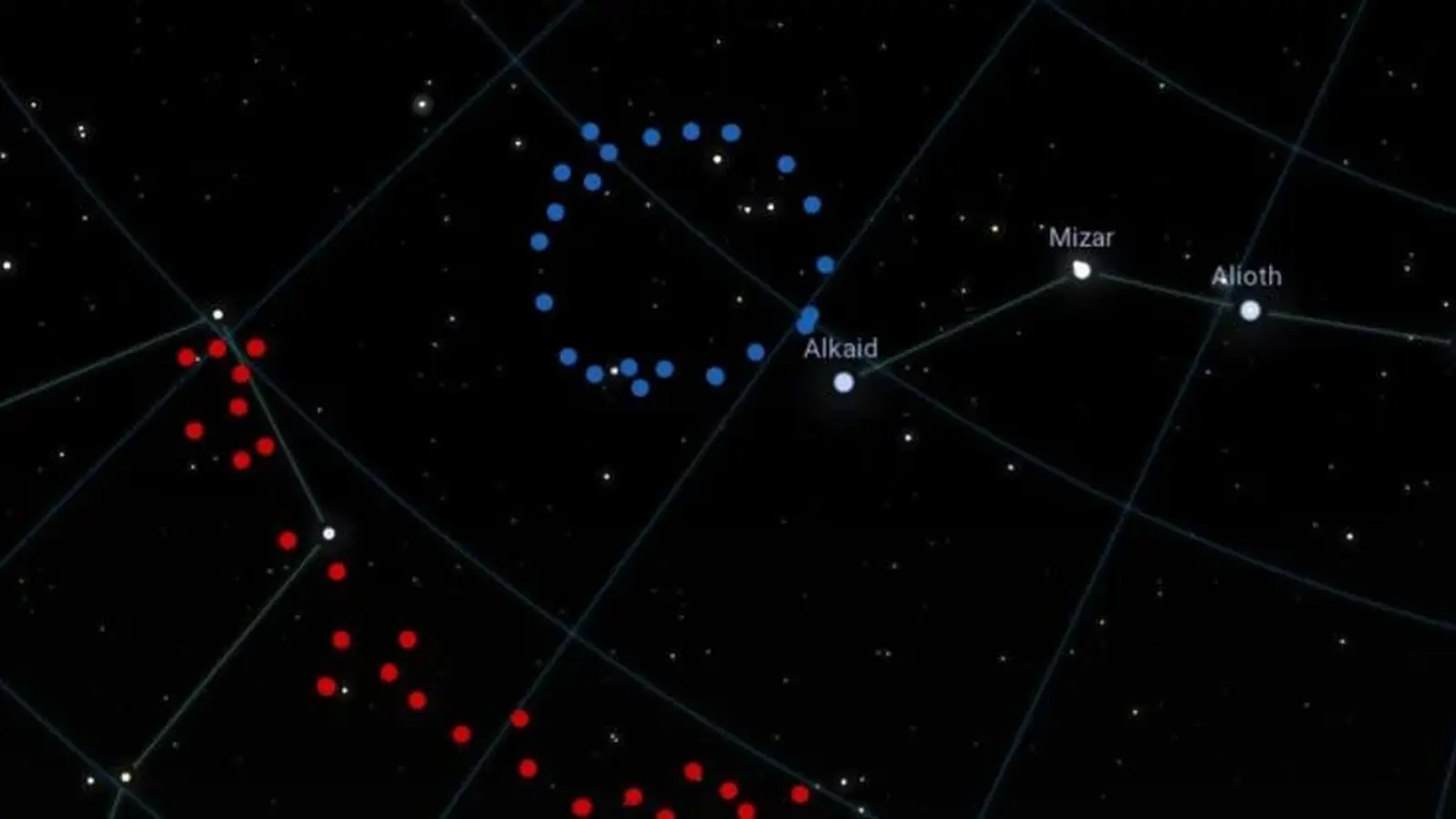
The Big Ring (blue) and Giant Arc (red).
That projection is key. Observers must untangle whether the apparent shape is an intrinsic property of the structure or a consequence of perspective. Either option has consequences. If intrinsic, current models of structure formation struggle to explain how matter could clump at these scales. If the ring is a projection of a more complex filamentary arrangement, then we still face an uncomfortable coincidence: two ultra-large features, adjacent and similarly distant.
Why this matters for cosmology
Cosmology rests on statistical homogeneity and isotropy—the Cosmological Principle—which says that at sufficiently large scales the Universe should look roughly the same in every direction. Theoretical work places an upper bound on coherent structure sizes at about 1.2 billion light-years. The Giant Arc stretches to almost three times that scale and the Big Ring's circumference rivals the Arc's length. These discrepancies are more than curiosities; they force cosmologists to ask whether our statistical expectations are incomplete or whether rare, extreme formations can occasionally appear in a universe otherwise well described by the standard model.
Some alternatives have been floated. Baryon acoustic oscillations are ruled unlikely: BAOs have a characteristic scale near one billion light-years and present as spherical shells, not corkscrews. Roger Penrose's conformal cyclic cosmology anticipates ring-like imprints as vestiges of a previous aeon, but that framework has competing challenges and is not widely accepted as a replacement. Another speculative idea is that the ring and arc are signatures of cosmic strings—narrow, high-energy defects in space-time generated during early-universe phase transitions. Theoretical interest in strings remains high, but direct observational evidence has been elusive.


A plot of galaxies, showing the Big Ring, roughly centered on 0 on the x-axis.
Or, less exotically, both features could be statistical flukes: unlikely alignments of filaments and clusters that only appear extraordinary because they coincide in the same patch of sky. That possibility cannot be dismissed outright, but the probability drops sharply when two such exceptional structures cluster within a cosmological neighborhood.
What happens next is practical work: expand the search. Upcoming and ongoing wide-field surveys—such as the Dark Energy Spectroscopic Instrument, ESA's Euclid mission, and data from the Rubin Observatory—will map galaxy distributions across enormous volumes. Those data sets will either find more oversized structures, forcing a deeper theoretical reckoning, or show the Big Ring and Giant Arc to be rare anomalies in an otherwise well-behaved cosmos.
Expert Insight
"Extraordinary claims require extraordinary evidence," says Dr. Elena Morales, an observational cosmologist not involved in the discovery. "If additional, independent data reveal similar patterns elsewhere, we will need to revise how we model large-scale clustering. If not, these features will still teach us about the tail of cosmic statistics—how rare events can masquerade as new physics."
Dr. Morales underscores a pragmatic point: better three-dimensional reconstructions and redshift confirmations are the immediate priorities. Improved modeling of selection effects and survey geometry will also help determine whether the ring's appearance is physical or an observational artifact.
Conclusion
The Big Ring and the Giant Arc are reminders that nature can surprise us. They sit at the boundary between data and theory, where observation compels re-examination. Whether they herald new physics, ephemeral statistical flukes, or unfamiliar manifestations of known processes, the onus is now on the observational community to map, test, and either generalize or consign these giants to cosmic trivia.
Finding more structures like these—or proving their uniqueness—will sharpen our picture of how the Universe arranges itself on the grandest scales.


“My work centers on sustainability, energy, and environmental science — examining how innovation can lead to a greener future.”

Discussion
Leave a Comment
Comments (2)
Is this even real or just a fluke in the data? Two giant things next to each other feels too coincidental... or am I missing sth?
Whoa, a billion-light-year ring?? Mind blown. If real this could shake cosmology, but maybe it's just a weird projection, more redshifts needed