

When a faint whisper of helium was detected leaking from a distant rocky world, astronomers listened closely. That whisper turned into a signal with profound consequences: for the first time, researchers have strong evidence that a planet with Earth-like mass and temperature, orbiting in its star's habitable zone, still carries an atmosphere.
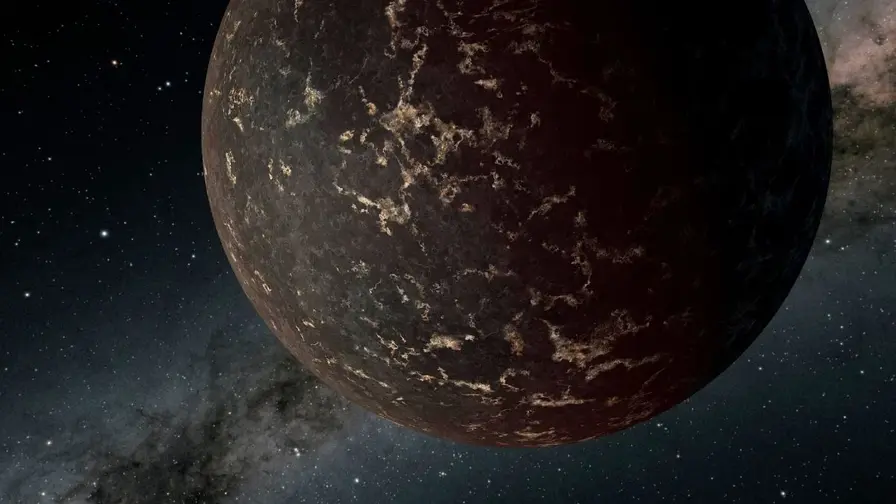
In this artist’s concept, the exoplanet LHS 1140 b is shown in the foreground, surrounded by a helium-rich atmosphere. Another nearby rocky planet orbits the same cool red dwarf star in the distance. A new study provides the strongest evidence yet that LHS 1140 b has retained an atmosphere, representing a milestone step toward the discovery of Earth-like rocky planets beyond our solar system. Credit: Melissa Weiss/CfA
The planet is LHS 1140 b, a rocky world about 48 light-years away circling a cool red dwarf. The team behind the detection, led by Collin Cherubim while he completed his Ph.D. at Harvard, used a clever combination of theory and opportunistic observing to tease out a spectral signature of helium escaping from the planet’s upper atmosphere. Ground-based spectroscopy did the heavy lifting.
How helium gave the atmosphere away
Helium is a subtle tracer. It does not betray itself in visible light the way sodium or oxygen might. Instead it shows up in the near-infrared as a thin absorption feature produced by atoms in a planet’s upper atmosphere that are energized and drifting away. Cherubim and colleagues built a model predicting that LHS 1140 b should host a helium-rich exosphere slowly leaking into space. Then they tested that forecast with real data.
The team used the WINERED spectrograph on the Magellan Clay telescope at Las Campanas Observatory in Chile. Timing helped: an unusual alignment put LHS 1140 b and a neighboring planet in front of their star on the same night, offering a natural control. One planet produced no atmospheric signal. LHS 1140 b produced helium absorption that stood out in the data, statistically robust and repeatable.
The detection method matters because it brings a new tool to the study of rocky exoplanets. Until now, confirming atmospheres on small, cool worlds has been difficult. Space telescopes can probe many targets, but they face time and sensitivity limits. Ground-based searches for escaping gases, especially helium in the near-infrared, give astronomers an additional, complementary pathway to identify atmospheres on terrestrial planets.

The lead study researchers, from left to right: Robin Wordsworth, Gordon McKay Professor of Environmental Science and Engineering and Professor of Earth and Planetary Sciences; Collin Cherubim, who recently earned his Ph.D. in Earth and Planetary Sciences from Harvard University and is affiliated with the Center for Astro; and David Charbonneau, head of the Harvard Department of Astronomy and astronomer in the Center for Astrophysics | Harvard & Smithsonian. Charbonneau and Wordsworth are Cherubim’s dissertation advisors. Cherubim will be joining the University of Chicago as a post-doctoral researcher in the fall.
Why this detection changes the search for habitable worlds
Finding an atmosphere is a crucial step toward assessing habitability. Atmospheres moderate surface temperatures, allow liquid water to persist, and provide chemical cycles that can support life. A few sentences capture the point: atmosphere present. Atmosphere long-lived. That elevates LHS 1140 b from an intriguing candidate to a primary target for follow-up.
Estimations suggest the atmosphere has survived for more than three billion years. That longevity matters. It says the planet has resisted atmospheric stripping from stellar activity and retained volatile components across geological timescales. For planets around red dwarfs, which can be active and hostile, that’s notable. It raises the question: how common are such survivors?
David Charbonneau, head of Harvard’s Department of Astronomy and one of the study’s senior authors, was initially skeptical. The predicted helium signal came from mathematical modeling and had not been seen previously on a rocky world. The observations changed his mind; the signal was real and convincing.
Instrumental edge: WINERED and opportunistic timing
WINERED is a high-resolution, warm near-infrared echelle spectrograph optimized for precisely this kind of work: teasing out weak absorption lines from faint sources. Combined with the favorable double-transit event, the instrument provided a clear path to separate stellar and telluric noise from a genuine planetary signal. It’s a reminder that smart targeting and the right toolset can yield discoveries even without the largest telescopes or space-based platforms.
What comes next is straightforward and ambitious. The team will try to measure the atmosphere’s complete chemical composition, search for signs of water vapor or heavier molecules, and apply their model to other promising rocky planets. If helium can act as a beacon for atmospheres, surveys can scale up.

Expert Insight
"This detection is a turning point for ground-based studies of small planets," says Dr. Maya Singh, an observational astrophysicist not involved in the study. "Helium is a fragile but telling tracer. When you find it escaping, you get a window into the upper atmosphere's physics and a hint that the lower atmosphere might be stable. That opens doors for follow-up spectroscopy and, ultimately, assessments of habitability."
Singh adds a caution: "Detection of helium does not by itself confirm surface oceans or life-friendly chemistry. But it does shorten the list of unknowns. It tells us where to aim the next observations."
Implications for exoplanet science and future prospects
Beyond LHS 1140 b, the broader implication is methodological. Spectroscopic searches for escaping gases can expand the roster of small exoplanets known to host atmospheres. That will guide expensive follow-ups with facilities such as the James Webb Space Telescope and next-generation ground arrays. It will also inform theoretical models about atmospheric loss, magnetic protection, and stellar-planet interactions.
In the end, the result feels like a small but decisive triumph. A theory predicted a faint helium signature. Observers found it. The detection validates a model and hands astronomers a practical tool in the hunt for Earth-like worlds. And for anyone who wonders whether planets like ours persist beyond the solar system, this discovery provides the clearest answer so far: yes, at least one does.
Conclusion
LHS 1140 b is now a leading laboratory for studying rocky-planet atmospheres. The helium detection is not a final verdict on habitability, but it is a major step toward answering whether Earth analogs with stable atmospheres exist in the galaxy. Expect a steady cadence of follow-up studies as astronomers use this approach to catalogue atmospheres around other small, temperate planets.


“My work centers on sustainability, energy, and environmental science — examining how innovation can lead to a greener future.”

Discussion
Leave a Comment
Comments (3)
Quick comment: neat method, but feels a bit hyped. Helium escape hints an atmosphere, ok, but surface habitability is still a big jump. we'll see
Is this even true? Could stellar flares or instrument noise fake the helium line, or did they actually nail it? More nights pls
wow, helium whisper turning into proof? chills. If LHS 1140 b kept its air 3+ billion yrs, that's huge. curious what JWST will find…