

It began as a modest flash. A 53-second burst of gamma rays blinked on a space telescope screen on March 10, 2026, and for a moment it looked routine. Then the afterglow refused to behave.
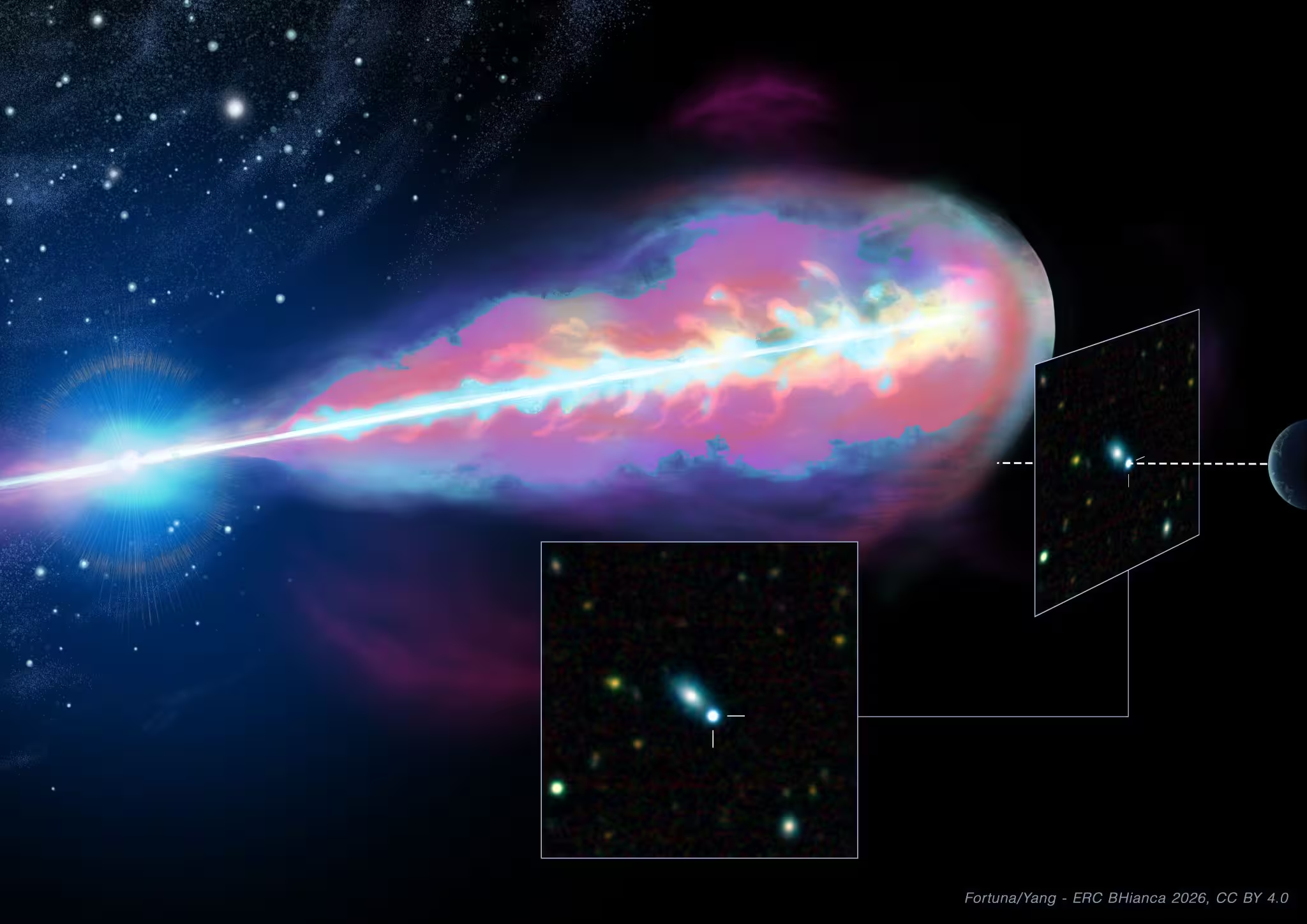
Artist’s impression of GRB 260310A. A massive star collapses and launches a jet made by a narrow, ultra-fast core (white beam) wrapped in a broader and slower outflow. The jet points away from Earth. We first saw light from the jet’s outer wings and only later from its energetic core. The inset shows the image acquired by the Large Binocular Telescope, displaying the bright optical afterglow (marked) next to its host galaxy.
An apparently ordinary burst that kept surprising observers
NASA’s Fermi Gamma-ray Space Telescope flagged the event, cataloged as GRB 260310A, and initial reports described it as a relatively low-energy gamma-ray burst. Low-energy compared to the most dramatic GRBs. Short-lived compared to cosmic catastrophes that can saturate detectors. Nothing about the first reading forecasted what would follow.
Hours later the optical afterglow brightened instead of fading. Over days the visible light outshone the host galaxy itself. At X-ray wavelengths the behavior was even more baffling. The source ranked among the top one percent of X-ray and optical afterglows known in the last two decades, and its radio signal placed it within the brightest five percent of radio-detected bursts. Then, roughly three weeks after the explosion, the X-ray brightness rose again and held at an unusually high level for more than a week.
Why would a burst that looked weak at first reveal so much power later on? For the international team studying the event, the answer points to perspective rather than physics alone: the jet did not aim straight at Earth.
Peeling back a structured jet to read its geometry
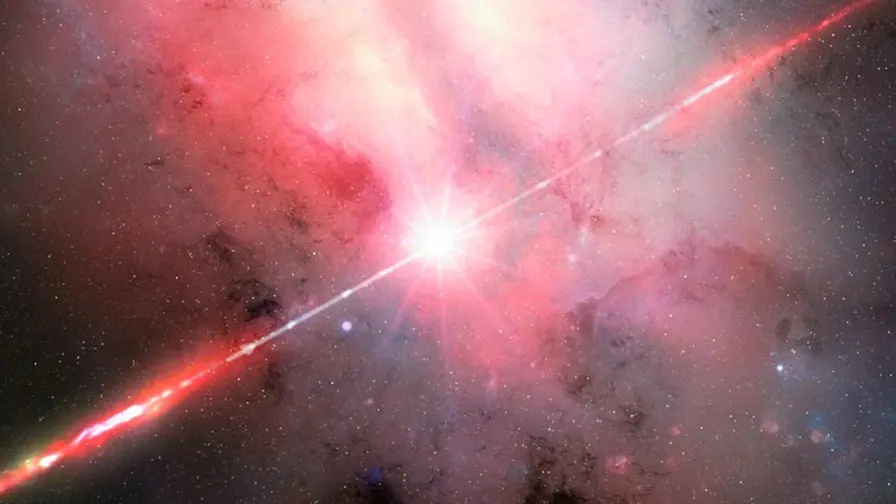
Gamma-ray bursts are violent, relativistic jets launched when certain massive stars collapse. When the jet is pointed close to our line of sight, the gamma-ray flash is intense and the afterglow evolution follows templates astronomers know well. What if the jet is angled away? What if the central spine of the jet hides behind a slower, broader sheath?
The lead hypothesis for GRB 260310A envisions a narrow, ultra-energetic core wrapped in a wider, slower outflow. From Earth we first saw emission from the jet’s outer wings. Those wings produced a rising optical and X-ray signal that dominated early observations. As the jet decelerated while plowing into the interstellar medium, emission from the energetic core broadened in angle and became visible to us. Radiation that was initially beamed elsewhere swept into our line of sight, producing the delayed X-ray brightening.
That picture explains several observational puzzles at once: the weak initial gamma-ray flash, the very bright optical afterglow that outshone its host, the radio luminosity ranking, and the late X-ray resurgence. It does not, however, uniquely fix the jet’s exact structure. Models can reproduce the broad features with a handful of geometries, but disentangling which one matches reality requires dense, multiwavelength sampling.
What instruments pieced the story together
- Fermi Gamma-ray Space Telescope detected the initial gamma rays.
- Chandra X-ray Observatory and ESA’s XMM-Newton tracked the evolving X-ray afterglow.
- The Einstein Probe contributed early X-ray monitoring.
- The Large Binocular Telescope provided high-quality optical imaging showing the bright afterglow beside its host galaxy.
- The Karl G. Jansky Very Large Array recorded strong radio emission, while Calar Alto Observatory identified supernova signatures associated with the collapse.
Combining these facilities let researchers estimate the jet energy distribution and infer that the central region likely carried vastly more energy than the gamma rays implied. Put another way: what looked unremarkable to our line of sight might have appeared cataclysmic to an observer sitting on-axis with the jet’s core.
Implications: a hidden population of powerful explosions
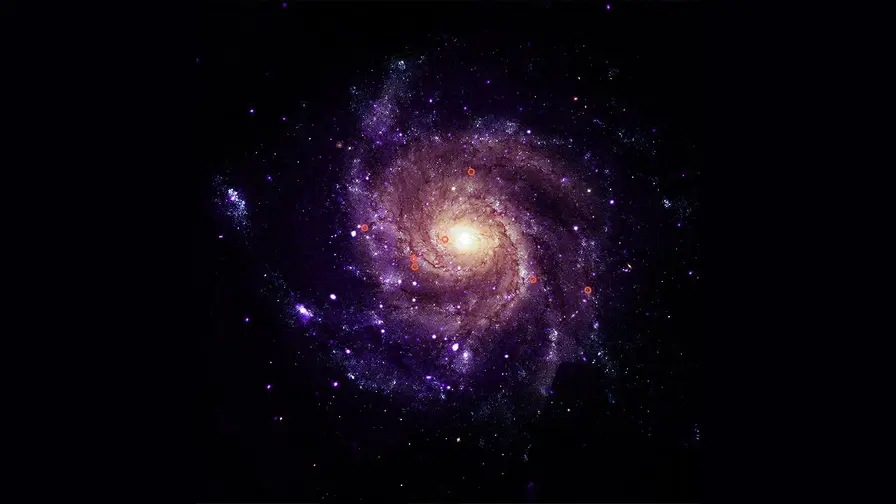
The structured-jet interpretation raises a provocative possibility. If some collapsing massive stars launch narrow, ultra-energetic cores surrounded by slower outflows, then many energetic explosions could hide from gamma-ray surveys simply because their cores point away from Earth. We may be undercounting the true rate of relativistic jets born in stellar deaths.
New wide-field time-domain surveys are about to change that. Facilities such as the Vera Rubin Observatory will sweep large swaths of sky repeatedly and will flag optical transients that do not have obvious gamma-ray counterparts. Those surveys should uncover more off-axis afterglows. The challenge will be sorting rare, jet-driven transients from the millions of variable stars, supernovae, and active galactic nuclei Rubin will detect.
Finding these hidden jets matters for several reasons. It constrains how often massive stars manage to punch a relativistic jet through their outer layers. It informs models of jet physics, energy partitioning, and how jets interact with the stellar envelope. And it refines the census of cosmic explosions that synthesize heavy elements and influence their galactic environments.
Expert Insight
"This event is a reminder that the universe can be deceptive," says Dr. Elena Marquez, an astrophysicist at the Institute for Cosmic Studies who was not part of the observing team. "Gamma-ray detectors give us a biased view. When we add X-ray, optical, and radio follow-up, the full story often has more layers. GRB 260310A is a textbook case of a structured jet revealing itself only after time and persistence."
Dr. Marquez highlights another practical point: coordinated follow-up across continents and wavelengths is essential. "No single observatory covers everything. To catch delayed emission or lateral jet spreading, you need long campaigns and flexible scheduling," she says. "This burst underlines the value of keeping eyes on afterglows for months, not just days."
Conclusion
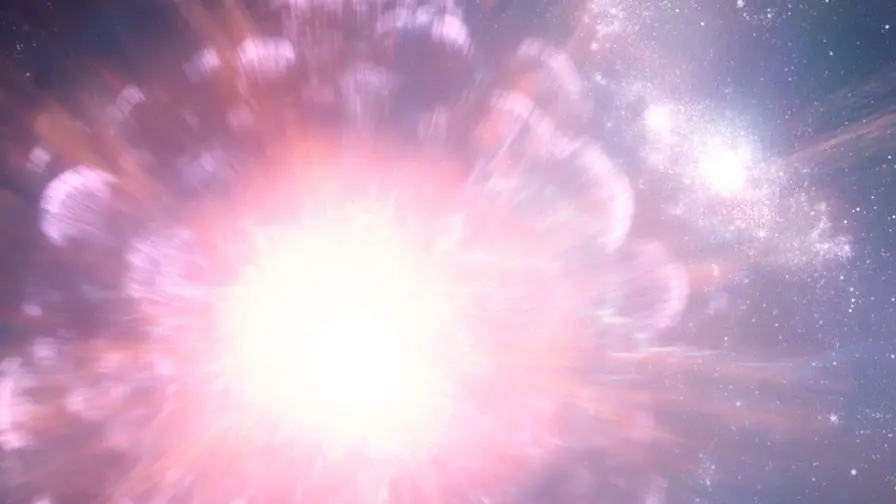
GRB 260310A began as an apparently modest gamma-ray event and evolved into one of the brightest afterglows recorded in recent decades. The most plausible explanation invokes a structured jet seen off-axis: a blazing, pencil-thin core wrapped in a broader, slower outflow. As the jet decelerated, emission from the energetic core became visible and produced a delayed, powerful X-ray flare.
The takeaway is twofold. First, perspective matters: a jet’s orientation can hide its intrinsic power. Second, wide and deep time-domain surveys paired with prompt, multiwavelength follow-up will reveal a richer population of stellar explosions than gamma-ray triggers alone can provide. The sky still keeps surprises. We only need to look long enough and from the right angles.

“My work centers on sustainability, energy, and environmental science — examining how innovation can lead to a greener future.”

Discussion
Leave a Comment
Comments (1)
Wow, didn't expect that. A faint burst that later flares up like crazy... the universe is sneaky. Teams kept staring and it paid off, nice