
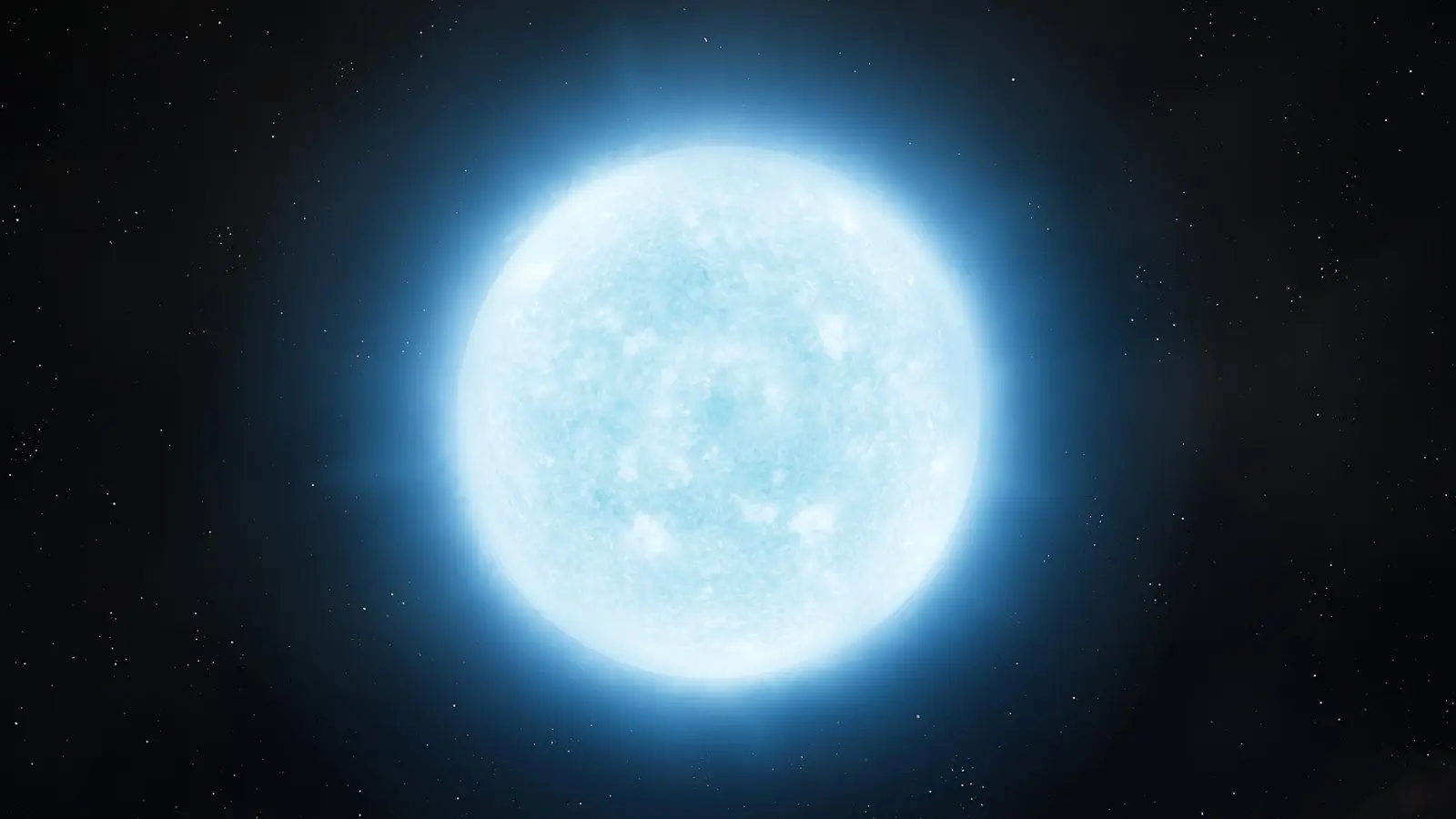
Think of a star compacted into a globe the size of Earth, yet packing in more mass than our Sun. Hard to imagine. Easier to imagine the rules breaking.
White dwarfs are the small, incredibly dense remnants left behind when stars like our Sun exhaust their nuclear fuel and shed their outer layers. Roughly the size of Earth, these stellar cores can contain a mass comparable to that of the Sun.
New computer simulations led by researchers at the Indian Institute of Science suggest that intense internal magnetic fields can change those rules. Under certain conditions a white dwarf can support far more mass than the long-standing Chandrasekhar limit of about 1.4 times the Sun’s mass. The models show support for objects approaching roughly 2.4 solar masses, an outcome with immediate implications for how we interpret unusually bright stellar explosions and how we measure cosmic distances.
The result is not a trivial tweak. It asks a basic question: can the physics we use to weigh stars miss a whole class of heavy, magnetized remnants? If yes, then some of the brightest Type Ia supernovae might come from progenitors very different from the textbook case.
Banibrata Mukhopadhyay (left) and Zenia Zuraiq (right)
When magnetism rewrites a mass limit
The Chandrasekhar limit is an elegant balance. Electron degeneracy pressure—the quantum mechanical resistance of electrons to being squeezed into the same state—holds a white dwarf up against gravity. Above roughly 1.4 solar masses, traditional theory says that degeneracy pressure can no longer resist collapse, so runaway fusion can ignite and lead to explosion.
The new simulations add a third player: magnetic pressure. As a white dwarf accretes material from a binary companion, its density climbs and its interior compresses. Compression intensifies the star’s internal magnetic field, and that magnetic field contributes extra pressure. When that magnetic pressure becomes significant, the star can support more mass than models that ignore magnetism predict.
That magnetic support also changes a white dwarf’s mass–radius relation. In plain terms: magnetized white dwarfs may be both heavier and larger than you would expect from non-magnetized models. Some observed low-mass white dwarfs that appear puffier than predicted might be signaling this effect, or the interactions that build such fields.
Following a star from birth to a heavy remnant
Instead of asking only whether a magnetized white dwarf could be stable, the team asked whether an ordinary star could realistically evolve into one. To answer that question they adapted STARS, a stellar evolution code developed at the University of Cambridge, to include magnetic field amplification and realistic white dwarf cooling. That allowed them to track an entire evolutionary chain: main-sequence star, mass loss, white dwarf formation, and subsequent mass gain from a companion.

In a representative run, an eight-solar-mass star left behind a carbon-oxygen white dwarf of about 1.02 solar masses. When that remnant accreted material at a slow but steady rate of 10^-9 solar masses per year, the interior magnetic field strengthened enough to raise the modeled mass limit to roughly 2.4 solar masses. Under the same accretion history but without magnetic effects, the star stalled near the classical 1.4 solar mass threshold.
"The important question was not simply whether a super-Chandrasekhar white dwarf is possible, but whether a star can actually evolve into one," said Zenia Zuraiq, the study's lead author and a PhD student at IISc. The simulations trace that evolutionary pathway, demonstrating what conditions make such an outcome plausible.
Why this matters for supernovae and cosmology
Type Ia supernovae arise when carbon-oxygen white dwarfs ignite runaway thermonuclear burning. Because many Type Ia events have similar light curves and peak brightness once standardized, astronomers use them as distance markers across the universe. Those distance estimates underpinned the discovery of cosmic acceleration and the inference of dark energy.
If certain Type Ia explosions originate from unusually massive, magnetized progenitors, their peak luminosities and light-curve shapes could differ from the canonical sample. Some previously puzzling, exceptionally bright supernovae might find a natural explanation in this class of magnetically supported white dwarfs. That, in turn, prompts careful reassessment of the range of physical models used to standardize Type Ia light curves and to infer cosmic expansion.
The work does not claim that magnetically inflated white dwarfs are common. It shows a feasible evolutionary route and quantifies the conditions—initial stellar mass, accretion rate, cooling behavior and magnetic amplification—under which such objects can form. Observational verification remains the next major step.
Expert Insight
Dr. Leah Park, an astrophysicist not involved with the study, commented: "These simulations are valuable because they bridge theoretical possibilities and astrophysical reality. The physics of magnetic-field amplification during accretion is complex, but modeling the whole life cycle gives us testable predictions—spectral signatures, rates, and explosion energies—that observers can hunt for. If even a small fraction of Type Ia supernovae come from these progenitors, it will matter for both explosion physics and cosmological samples."
Broader questions and next steps
How would astronomers definitively identify a super-Chandrasekhar, magnetized progenitor? Spectroscopy of supernova remnants, polarization measurements of explosion light, and population studies comparing observed supernova luminosity functions to model predictions are all promising approaches. Surveys that record early-time spectra and high-cadence light curves will be especially valuable, because the fingerprints of different progenitor masses and internal magnetic structures are often clearest near explosion.
On the theoretical side, adding multidimensional magnetohydrodynamics and improved microphysics will refine the thresholds and observable predictions. The current results are a robust demonstration that strong interior fields can alter the ledger of stellar endpoints; the detailed demographics remain to be worked out.
Conclusion

For decades the Chandrasekhar limit has been a cornerstone of stellar astrophysics. These new evolutionary simulations do not overturn that foundation; they add layers to it. Magnetic fields, often sidelined in one-dimensional models, can supply extra pressure and allow some white dwarfs to grow significantly heavier before detonating. The upshot is straightforward and consequential: a subset of Type Ia supernovae might trace back to magnetically supported, super-Chandrasekhar white dwarfs, and recognizing them will sharpen our understanding of both stellar death and the expanding universe.

“The cosmos has always fascinated me. I write about space missions, astronomy, and the technologies pushing humanity beyond Earth.”

Discussion
Leave a Comment
Comments
No comments yet. Be the first.