
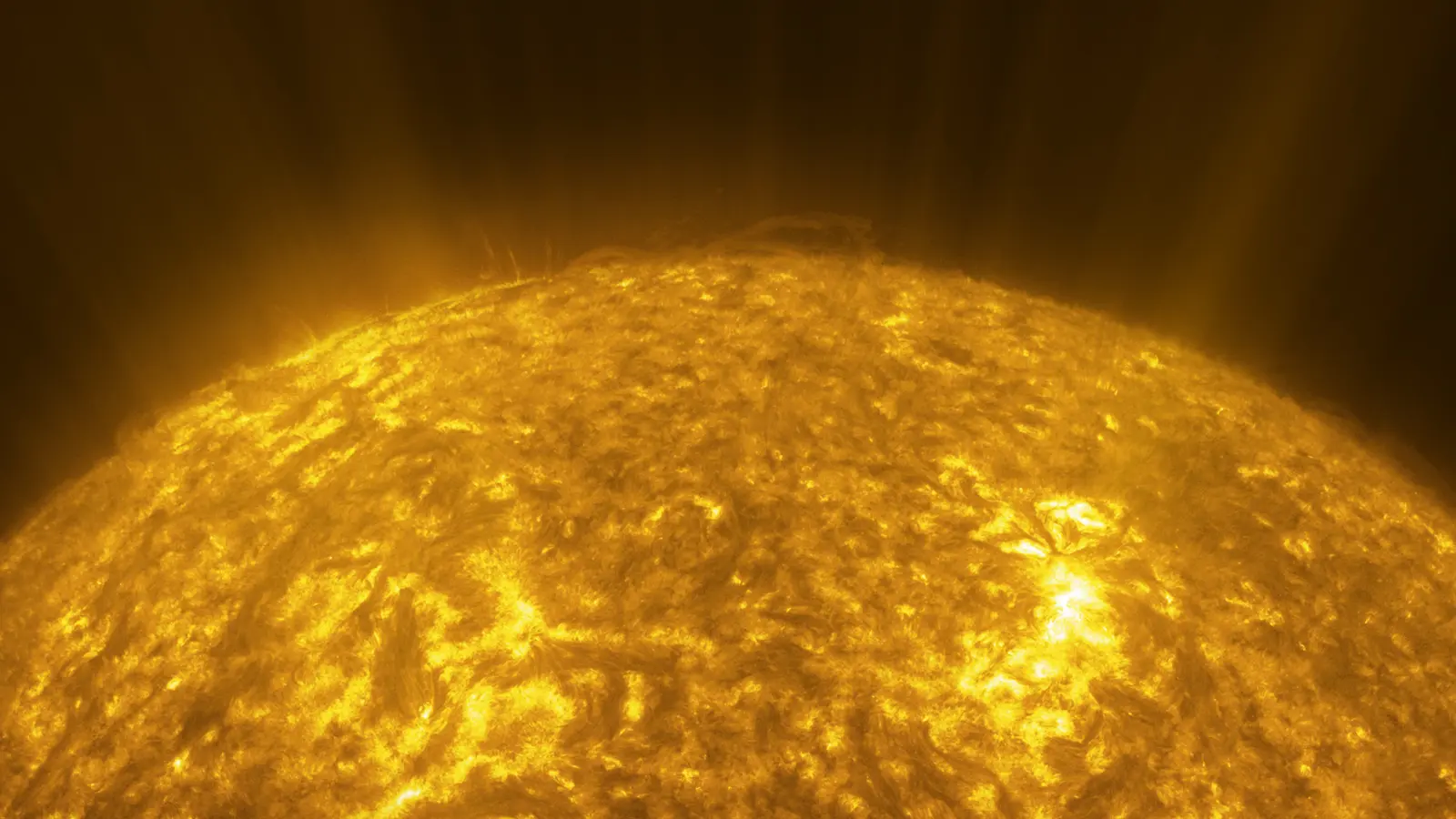
You step away from a crowded living room. One hug turns into five. Stories, recommendations, a final laugh. It takes ages to get to the door. That slow, stop-start stroll is a useful image for what happens to energy produced at the Sun's core.
Why escaping the Sun is a very long walk
We all know sunlight needs just over eight minutes to cross the 150 million kilometers to Earth. What is less obvious is the time it spends inside the Sun before it ever sees space. Energy born as gamma rays in the core does not stream outward freely. Instead, it collides, is absorbed, re-emitted, and scattered again and again. Physicists call this process a random walk or diffusion. The net effect: a photon produced at the center of the Sun can take on the order of 170,000 years to reach the visible surface.
That dramatic revision comes from work by Romas Mitalas and Kenneth R. Sills in a 1992 study. They identified a flaw in earlier estimates: the assumed distance a photon travels between interactions, called the step length, was treated as nearly constant throughout the Sun. When the step length is computed using a realistic density profile, the inner regions of the star become decisive.
Consider extremes. A photon flying in a straight line from core to photosphere would cover that distance in about 2.3 seconds. But the Sun is not empty. In the central regions the plasma is so dense that the mean free path of a high-energy photon can be far less than a millimeter. Mitalas and Sills showed that for more than half of the Sun's radius the step length drops below 0.1 centimeter. That tiny correction multiplies the time required for outward diffusion from tens of thousands to roughly 170,000 years.

What the numbers mean
Earlier, many textbook estimates used a step length between 0.5 and 1.0 centimeter. Those values implied diffusion times from about 3,000 to 30,000 years. The revised calculation, which accounts for the steep density gradient toward the core, compresses the photon's stride so dramatically that the cumulative delays add up to a geologic timescale.
Why care? Because the long residence time decouples what we see on the Sun's surface from conditions deep in the core. Neutrinos, produced alongside photons in fusion reactions, sail out almost without interaction and reach Earth in minutes. Photons, however, are trapped for millennia. The radiation reaching our planet now was generated before many civilizations arose, and perhaps before the last Ice Age. In that sense, sunlight is both immediate and ancient.

There are practical consequences for solar modeling. The diffusion time affects how quickly the star responds to changes in core fusion rates, and it sets a lag between internal processes and surface indicators. That lag is relevant when interpreting solar variability and long-term evolution of stellar outputs.
How physicists model the random walk
At its core, the problem reduces to statistical transport. A photon does a three-dimensional random walk where each step has a length set by local opacity and density. The diffusion time is proportional to the square of the effective distance and inversely proportional to the mean free path. That square-law dependence is why even modest reductions in step length produce outsized increases in travel time.
Modern stellar models combine nuclear reaction networks, radiative opacities, and convective transport to predict internal conditions. Observations such as helioseismology, which probes sound-speed profiles inside the Sun, help constrain those models. Together these tools let scientists refine estimates of how light escapes and how internal changes manifest at the surface.
Expert Insight
'The photon journey is a reminder that physical processes often hide long time constants,' says Dr. Elena Vargas, a solar physicist at the Institute for Stellar Studies. 'When we measure solar output we are sampling a kind of memory. The surface tells us about the core's past, not its instantaneous state. That matters for understanding solar evolution and for comparing models to observations.'
Her point highlights a subtlety: the Sun's apparent steadiness masks a deep time machine beneath the photosphere. Improvements in opacity calculations, particle interaction cross sections, and helioseismic measurements continue to narrow uncertainties, but the basic picture of a photon trapped for tens to hundreds of thousands of years remains robust.
Conclusion

Next time sunlight warms your face, remember this paradox: the warmth arrives quickly, but the journey that produced it likely began long before recorded history. From a crowded core to empty space, photons endure a labyrinth of interactions that stretch a brief emission into an ancient voyage. That slow exodus is not just an astrophysical curiosity. It is central to how stars shine and how we interpret the story written in their light.

“The cosmos has always fascinated me. I write about space missions, astronomy, and the technologies pushing humanity beyond Earth.”

Discussion
Leave a Comment
Comments (2)
Wait, 170,000 years?? Sounds huge. Are the models really that settled, or is this still debated among solar physicists? if so that's wild
wow, that blew my mind. sunlight born before cities? 170,000 years?? unreal, makes you feel tiny and lucky.