
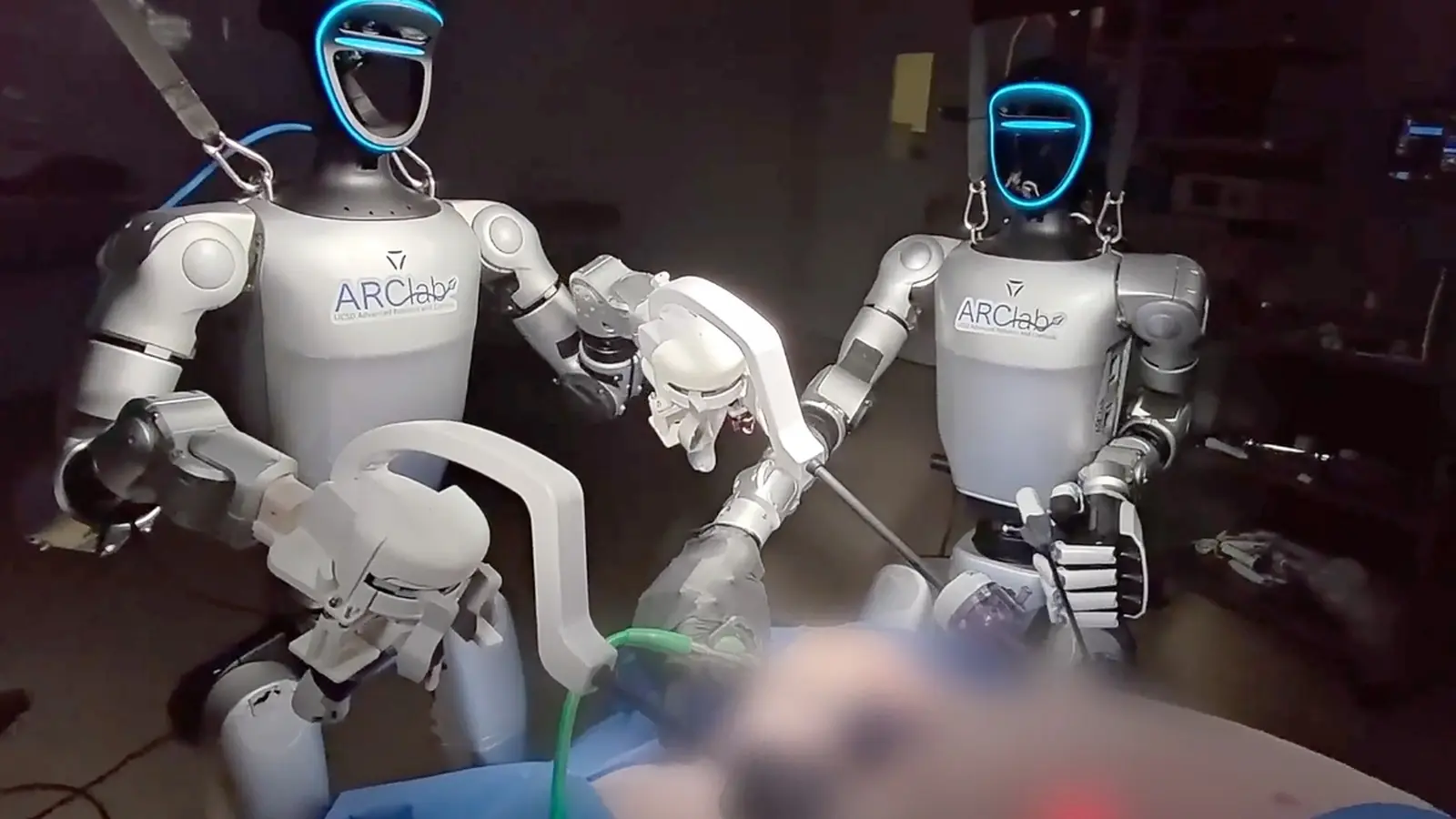
A pair of two-legged machines, guided by surgeons at a console, quietly proved something that would have sounded like science fiction a decade ago: humanoid robots can assist in live laparoscopic surgery. The setting was a preclinical operating room at the University of California, San Diego, and the patients were pigs, anesthetized and prepared for a gallbladder removal.
Small instruments, big questions
Surgical robotics is not new. Systems with multiple robotic arms and a console for the surgeon have been in clinical use for years. What changed in this experiment was the body plan of the robot. Instead of arm clusters bolted to a cart, the team used teleoperated humanoid platforms: bipedal robots with humanlike reach and the capacity to move in spaces designed for people.
For this feasibility study the UCSD team asked practical questions. Could humanoid robots handle the delicate, repetitive tasks of a keyhole operation? Could a surgeon sit at a console and control those robots with enough precision to remove a gallbladder? Would the humanoid form factor help or hinder workflow in a crowded operating room?
Instruments collided on occasion. Latency showed up. Repositioning was required repeatedly. Those are predictable problems, ones early robotic platforms also faced. Yet both planned procedures reached completion. In one operation a human-robot pairing — a humanoid robot plus a human surgeon at bedside as assistant — performed a laparoscopic cholecystectomy successfully. In a second operation the team briefly introduced a second humanoid to assist with the procedure. Minor bleeding occurred in one case and was controlled quickly.

In one surgery, a human-robot team made up of a humanoid robot and a human surgeon acting as an assistant successfully performed a gallbladder removal.
How the team prepared the robots
Nothing was rushed. The project began with benchtop trials that tested fine-motor tasks and the robots’ ability to handle surgical instruments. Surgeons guided every movement during those early phases, calibrating control, assessing force feedback, and refining the teleoperation interface. Only after the human-robot teams performed reliably on inanimate tasks did the researchers progress to live-tissue tests.
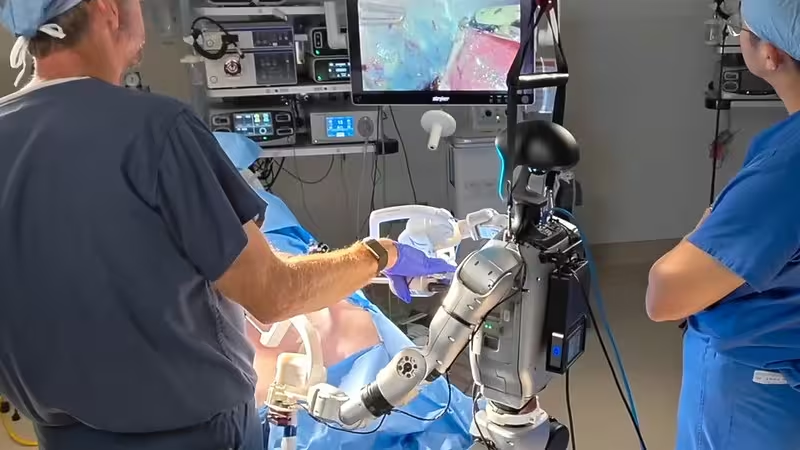
During the live procedures a surgeon operated from a remote console while another clinician remained at the animal’s side. The humanoids executed suturing motions, tissue retraction, and the careful tissue dissections needed in a gallbladder removal. The feel, surgeons said, was similar to using existing commercial systems, with the expected differences in latency and the need for adjustments during the operation.

A human surgeon controlled the robot from a console, with another doctor assisting at the bedside.
Implications beyond the hospital
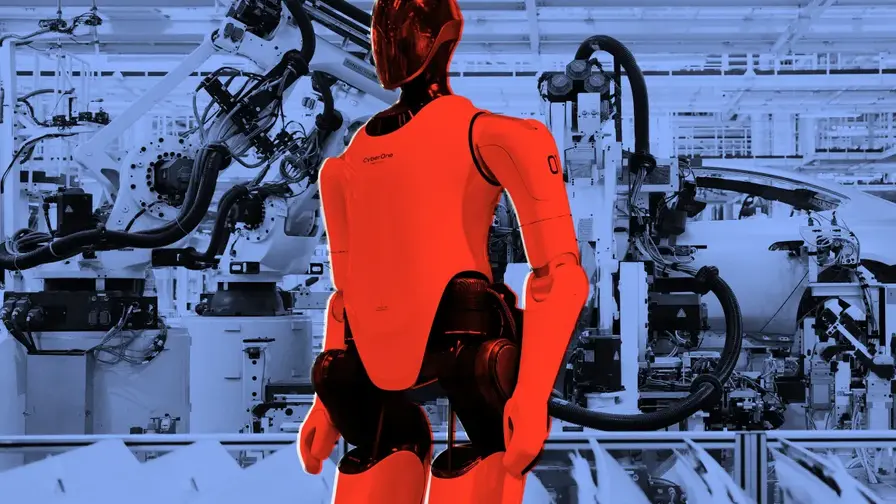
Why use a humanoid at all? Size matters. These platforms occupy less floor space than large arm-based systems and are easier to transport. That opens new use cases: remote clinics, battlefield medicine, disaster zones, or even off-world habitats. A portable humanoid surgical assistant could be a force multiplier where skilled personnel or sterile infrastructure are scarce.
"It may allow me or other surgeons to be able to operate remotely in locations with fewer resources where the precision of robotic surgery may be beneficial," UCSD surgeon Shanglei Liu said in interviews about the project. The team also emphasized speed: whereas the first generation of robotic surgery systems moved from concept to live-animal trials over decades, this humanoid effort took roughly nine months from concept to operating-room proof of concept.
"Any time we are trialing a new technology there is some degree of nervous anticipation," said Ryan Broderick, the surgeon who piloted the humanoid during the pig surgeries. "Still, we were comfortable with the system as it had been developed. It required recalibration during cases, but that is expected from proof-of-concept models."

Broderick at the console, controlling a humanoid robot during the gallbladder removal procedure.
Scientific context and next steps
These results are a feasibility demonstration, not a roadmap to immediate clinical deployment. Before humanoid-assisted surgery can move toward human trials, teams must quantify reliability, minimize latency, develop robust safety interlocks, and navigate regulatory pathways. Longitudinal studies will be needed to compare outcomes, complication rates, and cost-effectiveness against existing robotic and conventional techniques.
Related technologies will influence progress. Advances in haptic feedback, low-latency communication links, redundant safety systems, and machine-vision-assisted suturing could each shorten the path from lab to clinic. At the same time, ethical questions about remote control, liability, and autonomy will need clear answers.
Expert Insight
"From an aerospace medicine perspective the appeal is clear: compact, mobile systems that can deliver high-precision care where crews are small and conditions are constrained," said Dr. Maya Patel, a hypothetical senior engineer specializing in surgical robotics for extreme environments. "But space introduces unique challenges, like signal delay and radiation effects on electronics. To succeed, telesurgery will need hybrid approaches where onboard autonomy and human oversight share tasks."
Conclusion
The UCSD study does more than prove that humanoid robots can be teleoperated to perform a gallbladder removal in animal models. It reframes surgical robotics by showing that a humanlike form factor can operate within human spaces and perhaps extend surgical reach into places that are hard to staff or access. The path forward will be technical and regulatory, but the experiment demonstrates a promising new branch of surgical innovation: portable, humanoid assistants that could change where and how surgery is delivered.
The feasibility study was published in Nature.

“The cosmos has always fascinated me. I write about space missions, astronomy, and the technologies pushing humanity beyond Earth.”

Discussion
Leave a Comment
Comments (2)
Is this even ready for real patients? latency + instrument collisions sound minor but in humans thats scary. cool tech though, curious about long term outcomes...
wow didnt expect that... robots doing laparoscopy on pigs? crazy. impressed but nervous, latency and collisions worry me. if they nail safety this could be huge, but regulators gonna chew them up lol