
He felt the coil against his temple, heard the soft knocking, and for the first time in months there was a crack in the cloud. Small, sudden. Hope edged in. That is the moment many clinicians want to understand: when a physical nudge to the brain translates into measurable change in mood.
Inside the trial
A new randomized study from researchers at UiT The Arctic University of Norway, published in JAMA Network Open, puts intermittent theta-burst stimulation, or iTBS, under a controlled microscope. The technique is not new. It uses brief, patterned magnetic pulses delivered by a coil pressed to the scalp to activate neurons in the dorsolateral prefrontal cortex, a brain region linked to mood regulation and executive function. What this trial added was a rigorous sham control for a once-daily, fixed 10-session protocol, a comparison that has been scarce for this specific schedule.
The trial enrolled 73 adults diagnosed with major depressive disorder, aged 22 to 65. Participants were randomly assigned to two groups. Forty-one received true iTBS. Thirty-two received a sham procedure with a modified coil designed to produce the same sound and scalp sensations, but without generating a strong enough magnetic field to stimulate the cortex. Blinding was convincing; patients often could not tell which treatment they had.

Patients were either given iTBS or a sham treatment. Of the 83 people who were randomized to either treatment group, 73 completed the baseline assessment and were included in the final analysis.
Outcomes were measured in two ways. Clinicians scored depressive symptoms during structured interviews. Participants also reported their own symptoms. The results were clear early on. After five and ten daily sessions the iTBS group showed greater reductions on clinician-rated scales compared with the sham group. Change came quickly. Clinician-observed improvement was the headline.
Self-reports were less dramatic. Patients did not consistently register the same level of symptom change on their own questionnaires during the treatment weeks. Then the surprise: four weeks after the 10-day course ended, the sham group had caught up. Average clinician-rated scores in the control arm reached levels similar to those in the active arm. Short-term advantage, yes. Sustained separation, not in this protocol.
How iTBS works and why placebo matters
Intermittent theta-burst stimulation compresses a conventional transcranial magnetic stimulation session into a patterned burst sequence. Think of it as rapid-fire pulses timed to mimic brain rhythms associated with learning and plasticity. Delivered to the dorsolateral prefrontal cortex, those pulses can change synaptic activity and large-scale network communication.
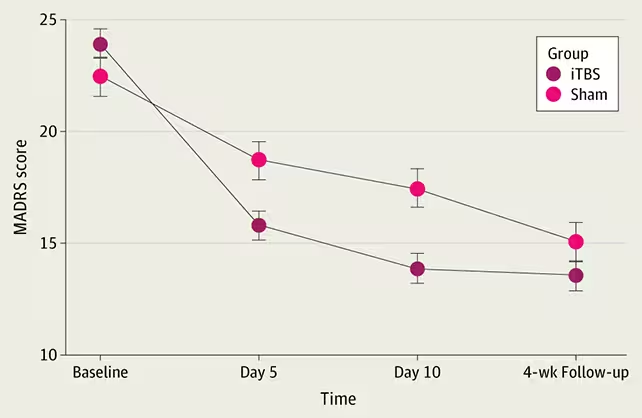
Clinical depression scores improved quickest for iTBS patients, but the sham group caught up.
But sham TMS is not inert. The sham coil used in this trial reversed certain winding configurations and added internal shielding, producing a diffuse and attenuated field that is insufficient to stimulate cortex, while preserving comparable auditory and scalp sensations. Those sensations matter. Expectation, context, and sensory cues can all fuel symptom change. The investigators note that non-specific effects likely contributed to the sizeable improvement seen in the sham group.
Clinical takeaway? A fixed, short course can speed symptom reduction as judged by clinicians. However, when treatment stops, some of that early lead may diminish. Longer or repeated courses could be necessary for durable benefit. And researchers designing future trials must reckon with the potency of the sham condition when estimating effect size and planning follow-up timing.
Implications and next steps
For patients and clinicians the study offers both promise and caution. Promise because a 10-day, once-daily iTBS schedule produced rapid clinical improvement in an experienced center. Caution because gains measured by clinicians did not remain uniquely tied to active stimulation at the one-month mark in this sample. The finding does not negate therapeutic potential. It does, however, reshape questions. How long should a course last? When should booster sessions be given? Which patients will hold gains and which will need maintenance?
Methodologically, the trial highlights how strong blinding and realistic sham procedures change the story. A treatment that feels convincing can trigger meaningful psychological effects. That is clinically useful, but it complicates efforts to isolate biological mechanisms.
Expert Insight
Dr. Emma Sørensen, a clinical neuropsychiatrist and researcher not involved in the study, commented, "This trial shows that sensory and contextual elements of brain stimulation are powerful. Fast clinical change is achievable, yet maintaining those improvements often requires a plan beyond a brief, fixed schedule. Future protocols should personalize duration and include scheduled follow-up sessions to consolidate gains."
Conclusion
The JAMA Network Open trial gives us sharper boundaries around iTBS. Ten daily sessions can produce quicker clinician-observed relief for depression. But the boundary between active treatment effect and placebo-associated improvement is thinner than many expected. For patients, the result is cautiously encouraging. For researchers, it is a call to design longer, better-controlled trials and to explore which patterns of stimulation and which patient characteristics predict lasting benefit.
Ultimately, iTBS remains a promising tool in the therapeutic toolbox for major depressive disorder. What this study adds is nuance: rapid gains are real, yet sustaining them may require more than a short, fixed course.

“My work centers on sustainability, energy, and environmental science — examining how innovation can lead to a greener future.”

Discussion
Leave a Comment
Comments (2)
Is this even true? Blinding seemed solid but sham effects huge. Are we measuring biology or just expectation? Self reports lagging is weird..
Wow, that moment with the coil gave me chills. Felt real hope, then ugh, sham catching up? if true we need longer followups. hmm..