
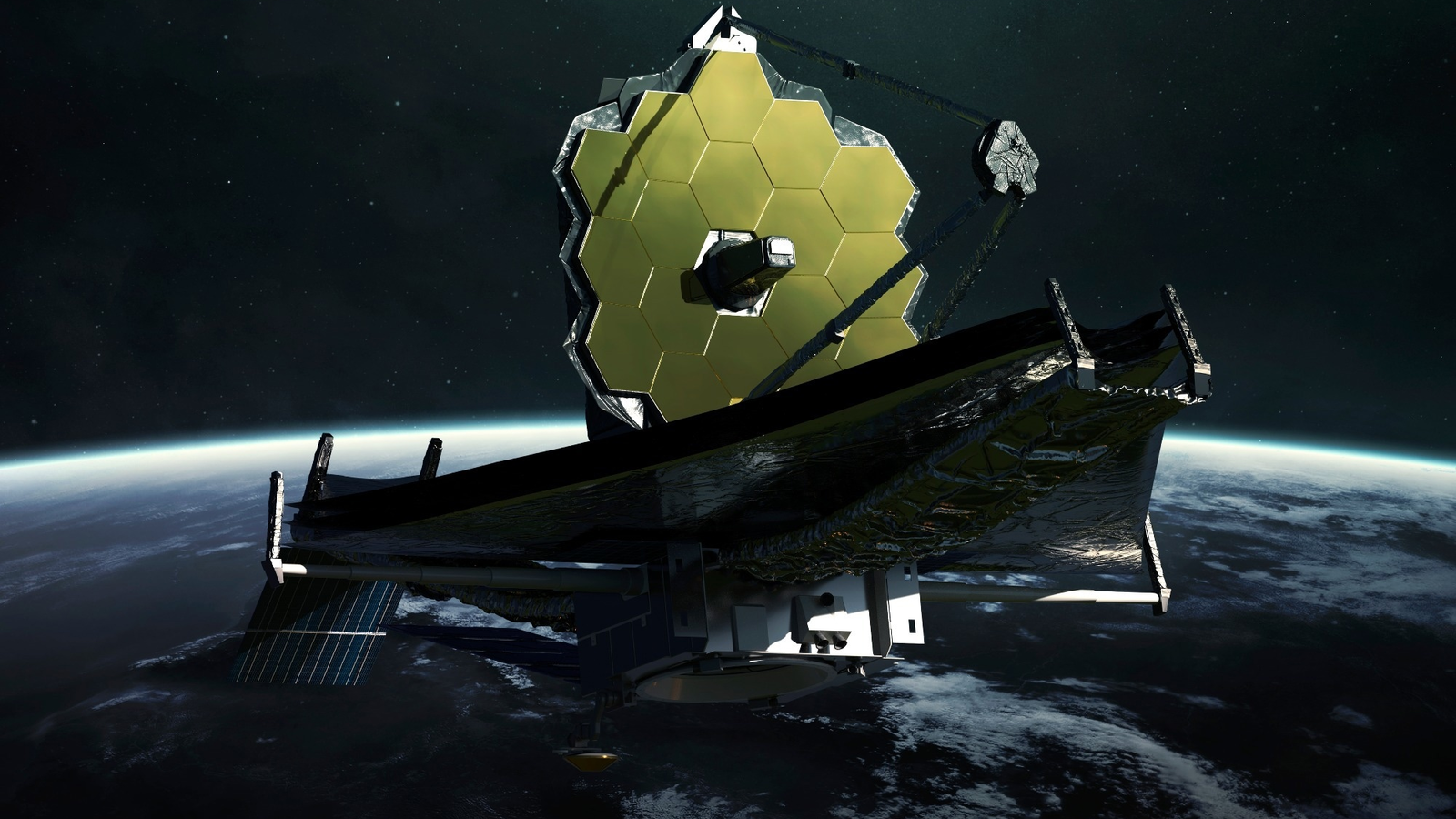
Imagine a newborn star exhaling the raw ingredients for planets, then watching those ingredients vanish. Some of that loss is violent. Some of it is gradual. Either way, the clock is ticking.

A representation of a young star surrounded by a protoplanetary disk of gas and dust. The winds from the center represent gas being energetically expelled from a young planetary system.
New observations from NASA’s James Webb Space Telescope are painting a far more dynamic picture of how planet-forming disks shed their gas than scientists expected. Rather than a single process slowly whittling away the atmosphere-building reservoir, Webb shows a sequence of changing forces: magnetic jets in the youngest systems give way to radiation-driven outflows as disks age. The result is a complex, time-dependent throttle on the formation of gas giants like Jupiter and Saturn.
How Webb maps shifting winds
The study, led by Naman Bajaj at the University of Arizona with coauthor Uma Gorti of the SETI Institute, examined 72 young, Sun-like stars using archival data from Webb’s Mid-Infrared Instrument, MIRI. That sample is one of the largest JWST surveys focused on planet formation to date. Taken together, the targets form a sequence of evolutionary stages that lets researchers trace how gas-loss mechanisms evolve as disks mature.
Webb’s sensitivity to warm molecular hydrogen and to ionized neon proved decisive. Molecular hydrogen, H2, is the most abundant molecule in protoplanetary disks but is notoriously hard to observe. Neon, in its ionized state, flags hotter, more energetic flows and jets. By separating broad molecular hydrogen winds from neon-traced jets, the team could tell which physical drivers dominate at different ages.
Two clear signatures
- Molecular hydrogen emission that appears broad and extended, marking slow, mass-loaded winds.
- Fast-moving ionized neon jets that trace narrow, high-speed outflows often linked to magnetically driven processes.
Of the 72 disks, 66 showed extended molecular hydrogen or ionized neon emission. Conical molecular hydrogen winds appeared in 46 systems, and 40 systems displayed neon jets. Notably, every disk with a neon jet also showed evidence for a molecular or atomic wind, hinting that multiple mechanisms can operate simultaneously.
From magnetic lungs to solar heat
In the youngest systems, where material still streams onto the central star, the dominant actors are magnetic fields. Magnetic field lines that thread the disk act as channels. Gas rides those lines outward. Mass escapes. Angular momentum is carried away. The observational fingerprints are strong jets and broad molecular outflows that contain both molecular and atomic gas.
As the star-disk system ages, accretion drops. The jets weaken. That change clears a path for high-energy photons to penetrate deeper into the disk. Ultraviolet and X-ray radiation from the star heat surface layers until gas reaches escape velocity. This process, known as photoevaporation, increasingly shapes disk dispersal in older systems. Webb’s direct detection of molecular hydrogen confirms predictions made before these wavelengths were routinely observable.
Gorti, who has studied photoevaporative winds for decades, summed up the connection between theory and observation: "These Webb measurements bridge long-standing models and real systems. We can now see how ultraviolet and X-ray-driven flows take over as magnetic activity wanes."

Why gas loss sets planetary fates
Gas is not just background material. It is the fuel that allows a young protoplanetary core to balloon into a gas giant. If that fuel disappears too quickly, cores that might have become Jupiters could be left as smaller, Neptune-like or even rocky planets. The changing balance between magnetically driven winds and photoevaporation therefore defines a time window for giant-planet assembly.
"Planet formation is a race against time," Bajaj said. "Gas giants must assemble their atmospheres while the disk remains substantial. Once winds and jets have carried that material away, the opportunity is gone."
The Webb survey suggests that dispersal is not a single deadline but a staged removal. Early, magnetically dominated epochs can expel material from inner and intermediate disk regions quickly. Later, radiation-driven evaporation chips away at surface layers across larger radii. Which regions lose gas fastest will influence where and when different planet types can form.
Expert Insight
Dr. Elena Martín, an observational astrophysicist not involved with the paper, commented: "These results are crucial because they provide observational anchors for models that previously relied on indirect tracers. Webb’s ability to detect warm H2 across many systems lets us quantify mass-loss modes and their timing. That helps answer where gas giants can form and how migration patterns might be affected."
Her point underscores a larger ambition: translating Webb’s detections into mass-loss rates and spatial maps of escaping gas. Knowing how much mass winds carry away, and from what radial zones in the disk, will let theorists refine formation timescales for different planet types.
What comes next for observers and modelers
Future steps include quantifying the mass-loss rates associated with molecular and atomic winds, and identifying the specific disk regions that feed those outflows. Combining Webb mid-infrared spectroscopy with complementary data at other wavelengths — such as radio interferometry that maps dust structure and ultraviolet and X-ray observations that characterize stellar irradiation — will build a fuller, multiwavelength picture of disk dispersal.
The results also inform exoplanet demographics. Disk lifetimes and the timing of dispersal mechanisms feed directly into population synthesis models that predict the frequencies of gas giants, ice giants, and terrestrial worlds. If disks tend to lose gas earlier than assumed, models will need to shift favored pathways for producing the observed variety of exoplanets.
Conclusion
Webb has opened a new chapter in our understanding of planet formation by revealing a time-dependent choreography of gas-loss processes. Young systems start with magnetically driven jets and broad molecular winds. Later, radiation-driven photoevaporation takes center stage. That evolution shortens or extends the window for forming gas giants, sculpting the architecture of planetary systems long before planets settle into stable orbits.
As astronomers convert these spectroscopic snapshots into mass budgets and spatial maps, we will gain a clearer sense of where and when different planets can assemble. The race against time is now mapped in detail, and Webb is the stopwatch.

“The cosmos has always fascinated me. I write about space missions, astronomy, and the technologies pushing humanity beyond Earth.”

Discussion
Leave a Comment
Comments (3)
Is the sequence universal or just biased by the sample? 72 stars ok but selection effects matter, right?
Nice data but feels a bit overhyped; mass-loss rates still fuzzy. Need numbers, not just pretty spectra. still promising tho
wow didn't expect Webb to actually watch disks lose gas. poetic and kinda cruel, like stars breathing then coughing up their kids. wild.