
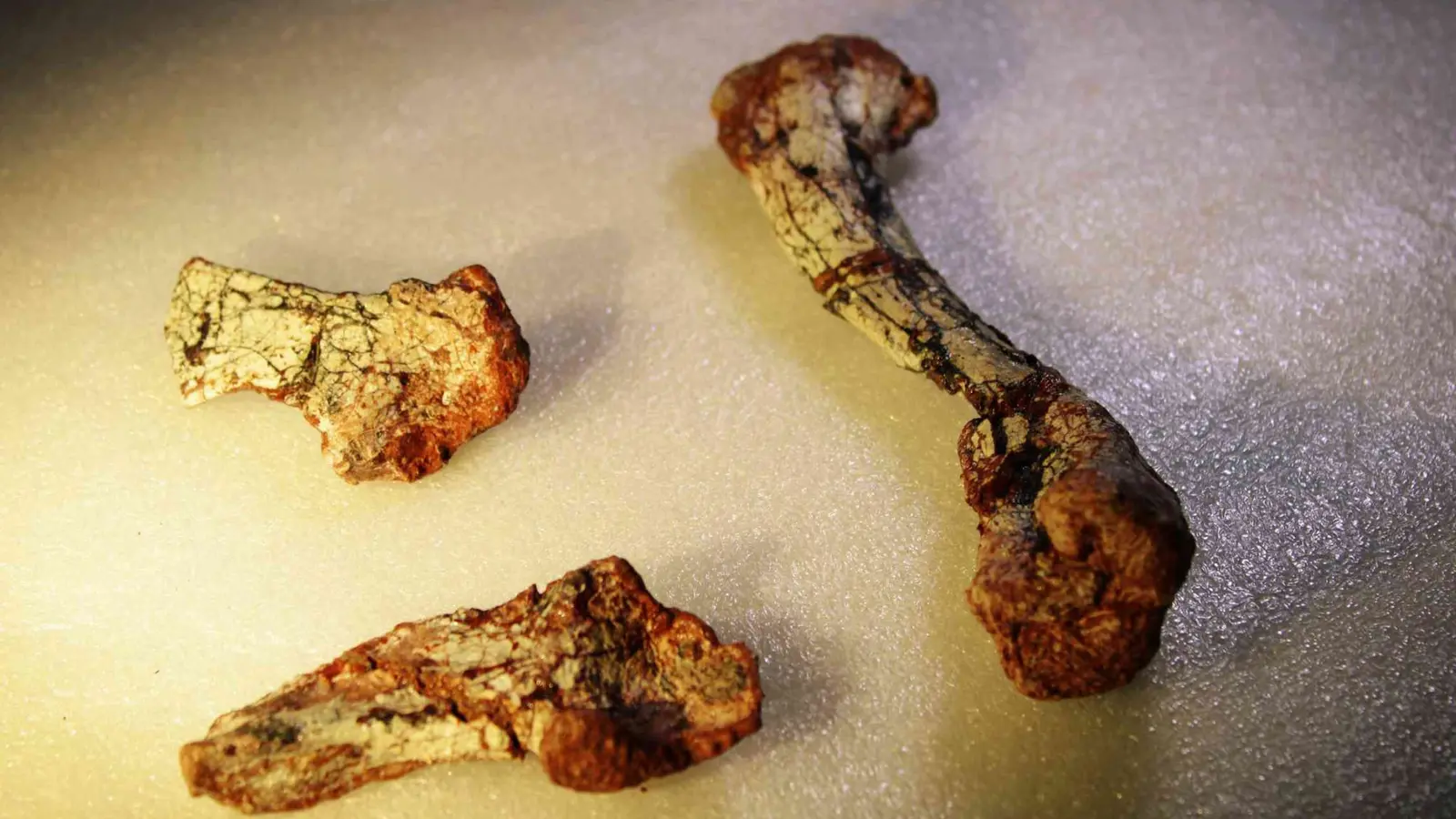
A scrap of bone sat mislabeled in a university drawer for more than two decades. Silence kept it company. When that small piece resurfaced, it rewrote a corner of deep time.
In central Rio Grande do Sul, Brazil, fragmentary limb bones uncovered from Middle Triassic rocks now point to a previously unknown reptile. The species, named Silescelida acristata, dates to roughly 240 million years ago, a time when Earth was rebuilding after the Permian extinction and new reptile lineages were experimenting with body plans and locomotion.
Small bones, big story
The remains are not dramatic. There is no complete skull to parade. Mostly what survives are pieces of the limbs, and especially the femur. Yet this modest material carries a clear message about posture and motion. The thigh bone of Silescelida acristata shows adaptations toward a semi-erect stance, with legs positioned lower under the body than in sprawling reptiles. The change is subtle. The implications are not.

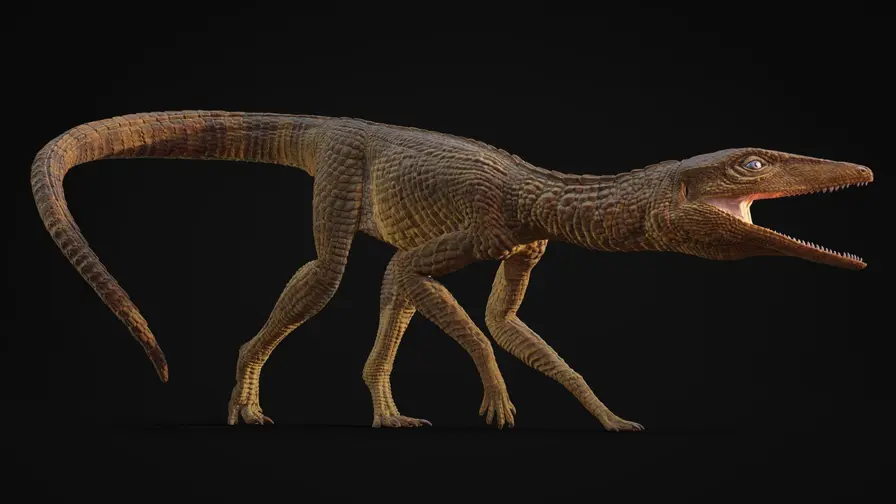
Relatively small, with a slender body and quadrupedal locomotion, Silescelida acristata belonged to a lineage that predated dinosaurs and crocodiles.
Why focus on posture? Because how an animal carries its limbs reflects constraints and opportunities: breathing mechanics, speed, endurance, predator prey interactions. Moving the legs beneath the body reduces drag during locomotion and foreshadows the limb geometry later perfected by archosaurs, the group that eventually produced crocodiles, dinosaurs and, through them, birds.
Phylogenetic analysis places Silescelida within the broader archosauriform radiation, and possibly close to Euparkeriidae, a small but pivotal cluster of Triassic reptiles. Until now, euparkeriid relatives were mostly known from Africa, Asia and Europe. Finding a close relative in South America expands the geographic map of these animals and argues for a more cosmopolitan early distribution than the fossil record alone suggested.
What the bones reveal
- Femoral morphology consistent with a semi-erect limb posture.
- Absence of a prominent femoral crest, which is why the species name includes the phrase acristata, meaning without a crest.
- Small body size, roughly comparable to a modern small alligator, implying a predatory lifestyle focused on smaller prey.

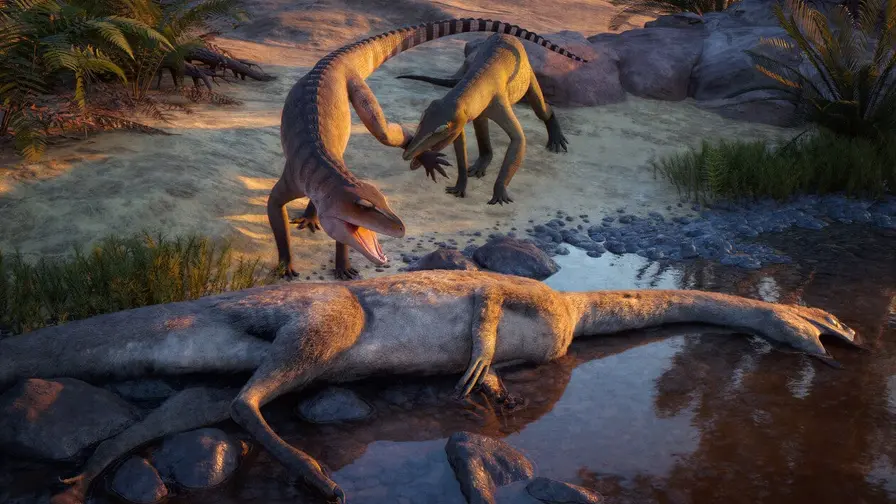
About the size of a small alligator, the Silescelida acristata lived 240 million years ago and holds clues to the origin of animal groups that would transform terrestrial ecosystems forever.
Although incomplete fossils can frustrate, they also concentrate information. Limb elements encode biomechanics, muscle attachments and joint range. From these details researchers inferred both lifestyle and evolutionary affinities.
The specimen was excavated near Dona Francisca and curiously lost a critical provenance-bearing fragment soon after discovery. The missing piece was only recovered in 2022 during a review of collections at the Pontifical Catholic University of Rio Grande do Sul, allowing scientists to tie the bones securely to the Quarta Colônia Geopark strata and to formally name the species.
Why this discovery matters
There are several layers of importance. First, Silescelida acristata adds a datapoint to the timeline of archosauriform diversification during the Triassic. Second, it shows that euparkeriid-like animals reached South America, helping fill a biogeographic gap. Third, it highlights how fragmentary remains can inform evolution when combined with careful comparative anatomy and modern phylogenetic methods.
The research was led by teams at the Quarta Colônia Center for Paleontological Research, Federal University of Santa Maria (CAPPA/UFSM), with collaborators from the Federal University of Rio Grande do Sul and PUCRS. Their work appears in Scientific Reports.
Context matters. The Middle Triassic ecosystem was a laboratory of evolutionary experimentation. The mass extinction at the end of the Permian annihilated much of terrestrial fauna and cleared ecological space. In the subsequent recovery, archosauriforms diversified and occupied niches that would, over millions of years, be dominated by dinosaurs and crocodile-line archosaurs.
Silescelida acirstata, with its slender build and quadrupedal gait, probably hunted small animals. It was not a giant. Yet its anatomy captures a transitional stage in limb reorientation and muscle attachment patterning that anticipate later archosaur success.
Expert Insight
"Fragmentary specimens are often dismissed, but they can be keystones," said Dr. Mauricio Garcia, lead author and paleontologist at the Federal University of Santa Maria. "This little femur helps us see the steps that led to more efficient upright movement in archosaur ancestors. It is one small bone and one large story."
Dr. Ana Ribeiro, a comparative anatomist who contributed to the phylogenetic analysis, added: "The absence of a trochanteral crest on the femur is unusual among close relatives. That absence is itself informative because it alters interpretations of muscle arrangement and locomotor capability."
These remarks capture how anatomy and careful curation intersect. The rediscovery of the lost fragment at PUCRS underlines how museum collections are active research resources. Objects misfiled and forgotten can yield major advances when reexamined with new questions and fresh methods.
Broader implications and future directions
What does Silescelida mean for broader debates in paleontology? It emphasizes the patchy nature of the Triassic fossil record and the need to integrate data from multiple continents when reconstructing early archosauriform evolution. It also reinforces South America, and particularly Rio Grande do Sul, as a key region for Triassic paleobiology.
Ongoing fieldwork in the Quarta Colônia Geopark aims to recover more complete material from the same horizons. Better-preserved specimens could resolve remaining questions about cranial anatomy, ontogeny and precise ecological role. In the meantime, morphometric and biomechanical modeling of the existing bones will refine estimates of gait and speed.
Finally, the story is a reminder that paleontology relies on patient curation and periodic reexamination. Collections are not static archives. They are libraries that sometimes reveal a new chapter when a page thought lost is found again.
Conclusion
Silescelida acristata is not a headline-grabbing giant, and it does not overturn the fundamentals of vertebrate evolution. But it does fill a meaningful gap. Through a handful of limb bones, and through the chance recovery of a lost fragment, researchers have added nuance to our picture of Triassic ecosystems and the early steps that led toward archosaurs.
In science, small recoveries sometimes change big stories. This fossil, silent for years in a drawer, has begun to speak.

“My work centers on sustainability, energy, and environmental science — examining how innovation can lead to a greener future.”

Discussion
Leave a Comment
Comments (3)
neat piece of detective work. feels slightly overhyped tho, bones tell stories but need more than one fragment to be sure. still cool.
Hmmm, cool find but is one femur enough to stake a phylogenetic claim? If the rest is fragmentary, could this be convergent? curious about the stats and comparisons
wow that tiny femur carrying that much weight in the story, wild! Makes me wanna dig through museum drawers now, who knows what else is sleeping in boxes