
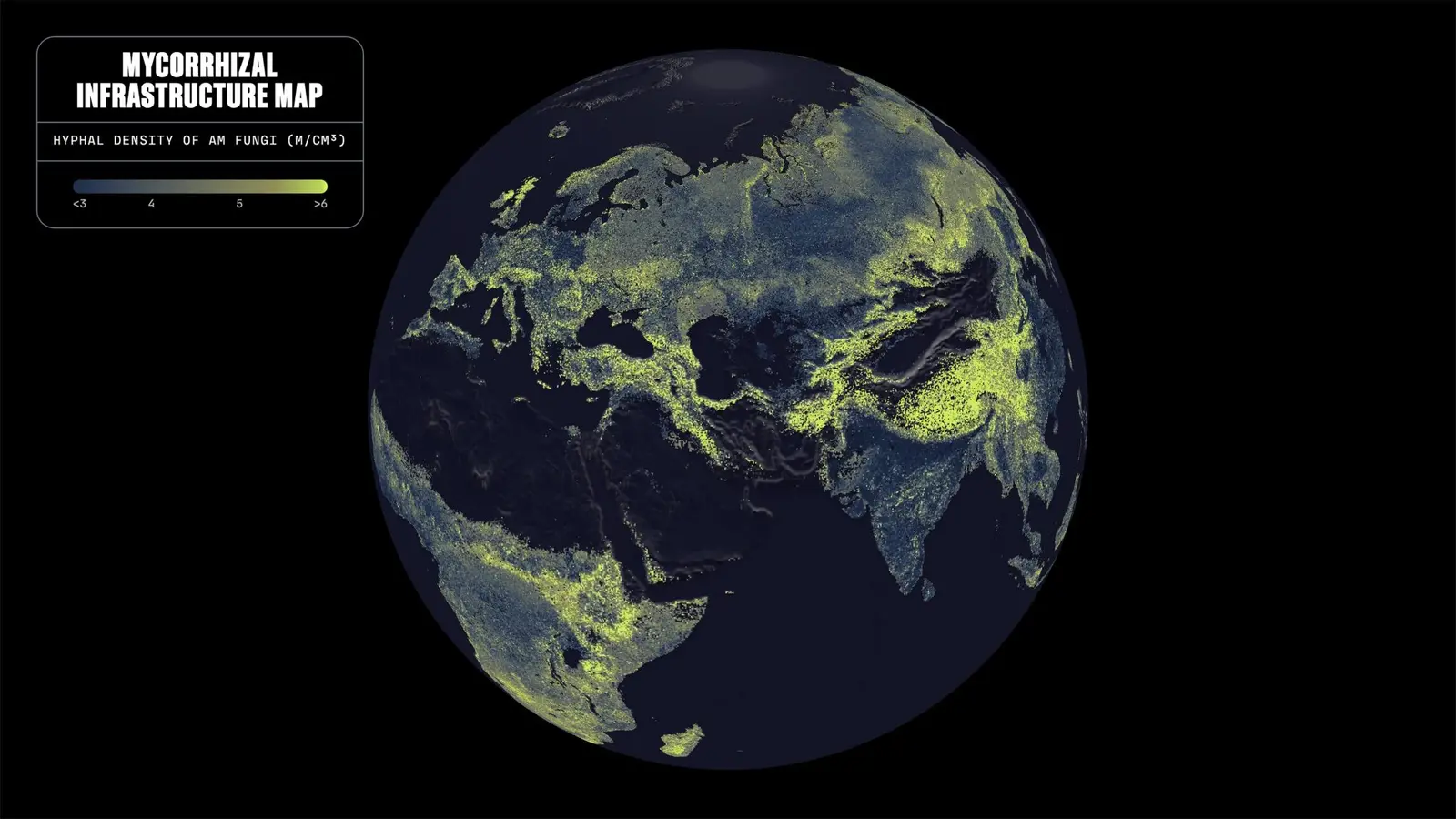
Step into a teaspoon of healthy soil and you will find more than dirt. You will find a city of threads: a living, shifting web that plants rely on, that stores carbon, that quietly links ecosystems across continents. Scientists have now sketched that web at planetary scale, revealing an underground infrastructure so vast it retools how we think about soil, vegetation, and climate.
Mapping the invisible and the immense
The new global map focuses on arbuscular mycorrhizal fungi, or AM fungi, a group that forms partnerships with roughly 70 percent of the world’s plant species. These fungi thread microscopic filaments called hyphae through soil, creating networks that extend the reach of roots and shuttle water, nutrients, and carbon where they're needed. To estimate how much hyphal road exists beneath our feet, researchers combined more than 16,000 soil cores from around the world with machine-learning models and robotic imaging.
That synthesis produced a startling figure: an estimated 110 quadrillion kilometers of AM fungal hyphae sit within global topsoils. In more familiar terms, that distance is about 68 quadrillion miles, a network that is nearly a billion times the distance from Earth to the Sun. The authors also estimate these networks store roughly 300 megatons of carbon, a mass several times greater than the weight of all living humans.

Network architecture of fungal mycelium. Mycelial architecture varies across strains and species. Networks imaged at the AMOLF biophysics institute in Amsterdam.
Reaching this global picture required multiple datasets and methods. Field samples provided ground truth. Environmental layers—climate, soil type, vegetation—helped the models project density into unsampled regions. And at AMOLF, researchers grew hundreds of thousands of living hyphae under controlled conditions, then used robotic imaging to measure the shapes and growth patterns that feed the predictive models. The result is a 1-kilometer resolution estimate for most terrestrial land where sufficient data exist, plus an interactive visualization released alongside the paper.
Why these fungal networks matter for carbon and ecosystems
Think of AM fungal networks as a circulatory system for landscapes. Plants photosynthesize and pass a share of their carbon to fungal partners. Hyphae then move that carbon into mineral soils where it can persist, feed microbes, or return to plants. In healthy soils, these networks extend the effective surface area of roots by orders of magnitude and can supply most of a plant’s phosphorus needs.
The new study quantifies the scale of that movement. Researchers estimate AM networks transfer about 4 billion tons of CO2-equivalent into soils each year, roughly 11 percent of anthropogenic carbon dioxide emissions. That is a rough, system-level figure, but it underscores how mycorrhizal dynamics influence Earth's carbon budget and why soil biology matters for climate mitigation.
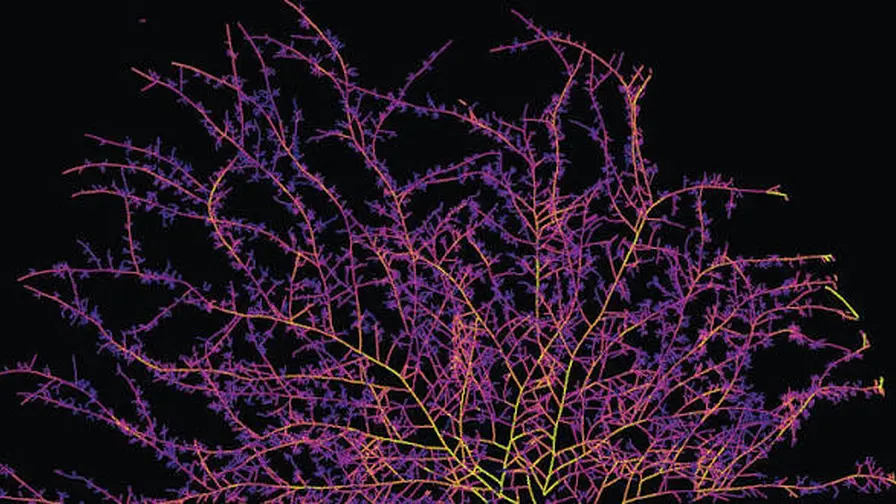

Mycorrizhal fungi under the microscope at AMOLF biophysics institute in Amsterdam. The circular structures are spores. Color is altered for legibility.
Not all landscapes are equal. The models show grasslands hold about 40 percent of the world’s AM fungal infrastructure, and hotspots of hyphal density appear in places like the flooded grasslands of South Sudan, Florida’s Everglades, and the Tibetan Plateau. By contrast, large-scale croplands are predicted to have roughly half the network density found in wild systems, a difference that could blunt soils’ capacity to store carbon, recycle nutrients, and buffer plants against drought or disease.
Threats, policy implications, and practical questions
These maps do more than measure—they point to vulnerability. Grasslands, which contain a disproportionate share of AM biomass, are poorly protected globally and are being converted to agriculture at rates higher than forests. The study’s spatial detail shows that most mycorrhizal biodiversity hotspots lie outside formal protected areas, a finding that should interest conservation planners and climate policy makers alike.
But the work also raises practical questions: which agricultural practices preserve or restore network density? Can no-till methods, crop rotations, reduced fertilizer inputs, or cover crops help rebuild hyphal continuity? The models do not yet answer those mechanistic questions, and the authors emphasize the need for targeted field experiments to map practices to fungal outcomes. Still, the implication is straightforward: soil management matters for both food security and carbon sequestration.
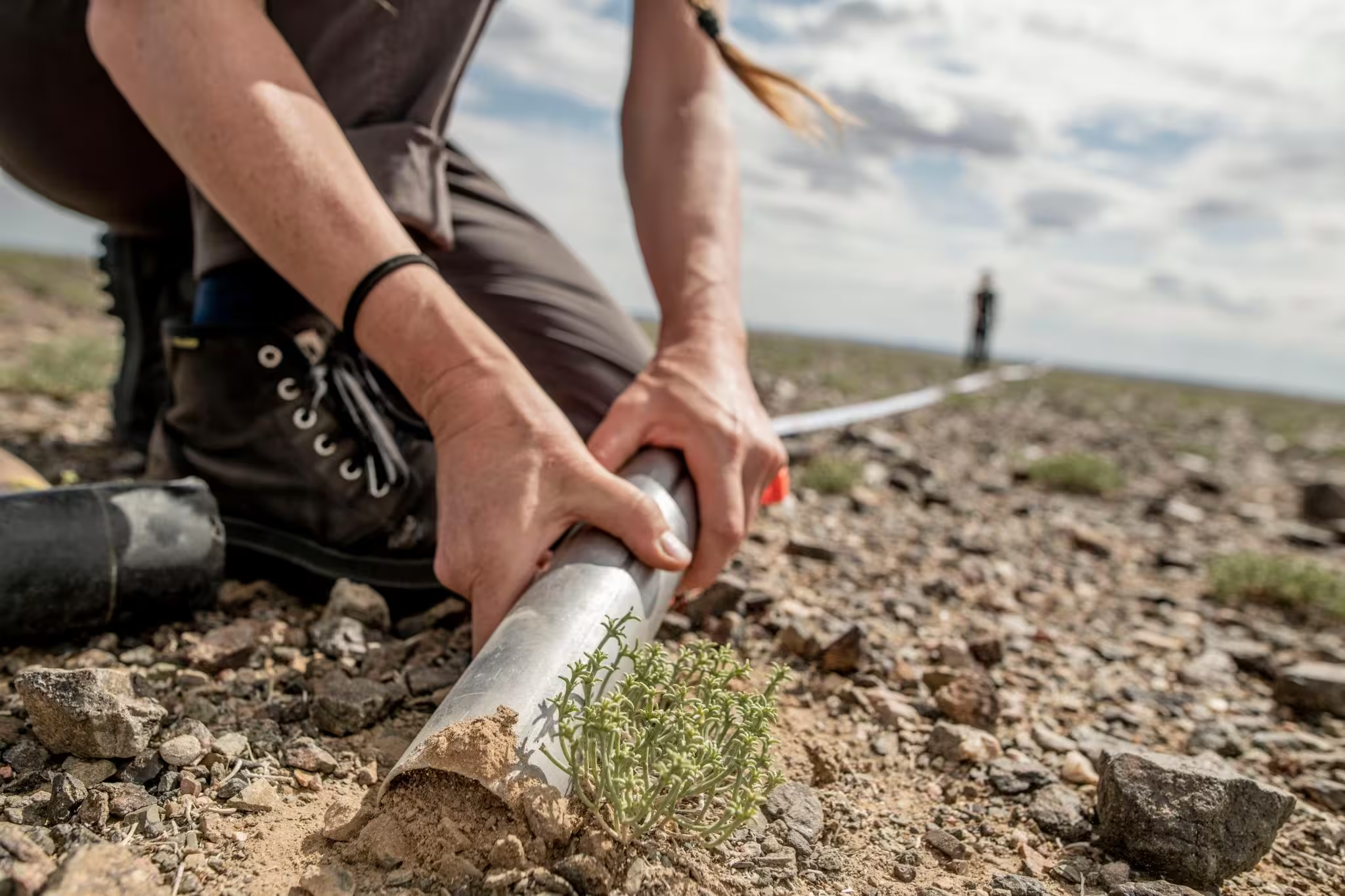
Close up of soil core extraction.
There are broader policy levers as well. If fungal networks materially affect how much carbon soils can hold, then national inventories and climate models should incorporate mycorrhizal processes more explicitly. The researchers have made their underlying data public to help governments and land managers begin monitoring these invisible assets.
Methods and validation: models, robotics, and microscopes
.webp "Earth's Magnetic Field Funnels Atmosphere to the Moon")
A notable strength of this project is its mixture of tools. The global map rests on three pillars. First, in situ soil cores provide point measurements of hyphal density across biomes. Second, environmental covariates feed machine-learning algorithms that interpolate density across unsampled terrain. Third, laboratory-grown material and robotic imaging calibrate how observed structures relate to model inputs.
That calibration matters. Hyphae vary by species and strain in diameter, branching, and growth habit. By imaging more than 300,000 living hyphae in the lab, the team reduced a key uncertainty: what a given hyphal mass actually looks like under different conditions. This kind of cross-scale work—linking micrometers in the microscope to kilometers on the map—is essential when moving from natural history to policy-relevant metrics.

Fungal networks imaged using a microscope at AMOLF biophysics institute in Amsterdam. Threads are arbuscular mycorrhizal hyphae.
Expert Insight
“We have treated soils like static boxes for too long,” says Dr. Elena Vargas, a soil ecologist at the University of Edinburgh who was not involved with the study. “This map reframes soil as an active, patterned network. It forces us to ask different questions—about connectivity, resilience, and how human land use severs or restores subterranean links. From a management perspective, that is actionable information.”
Dr. Vargas highlights a practical point: monitoring network density over time will be crucial. “A single snapshot is valuable, but the next step is tracking trends as land use or climate changes. Detecting decline early could let managers intervene before ecosystem services collapse.”
Open questions and future prospects
For all its reach, the map admits uncertainty. Large swathes of the planet remain undersampled. The models assume that environmental covariates reliably predict hyphal density everywhere, but local soil histories, microbial communities, and plant assemblages can shift outcomes in ways the models cannot yet resolve. The research team is candid about these limits and frames the work as an invitation to expand field sampling and experimental work.
Scientifically, the next frontiers include resolving species-level roles within the AM guild, linking fungal architecture to function under stress (for instance drought), and quantifying how specific agricultural practices alter network connectivity. Technologically, advances in in situ imaging, environmental DNA, and remote-sensing proxies for belowground health could accelerate progress.
Conclusion
This global cartography of fungal hyphae reframes soil as a dynamic, measurable component of Earth’s life-support systems. The map does not just reveal scale; it exposes patterns of risk and opportunity. Protecting and restoring the subterranean web promises co-benefits for biodiversity, food production, and the climate. If policymakers, farmers, and conservationists act on these insights, the next revolution in land stewardship may come not from aboveground treaties, but from attending to the threads beneath our feet.

“My work centers on sustainability, energy, and environmental science — examining how innovation can lead to a greener future.”

Discussion
Leave a Comment
Comments (3)
Feels kinda overhyped, still useful. If croplands really have half the hyphae density thats huge, but we need long term monitoring, field trials pronto
Is this even true? 16k cores + ML + robotics sounds impressive, but big unsampled regions worry me. how sensitive are the models to local quirks...
wow, didnt expect soil to be literally a world-spanning web. 110 quadrillion km? mind blown. Makes me wanna stop tilling my garden, for real