
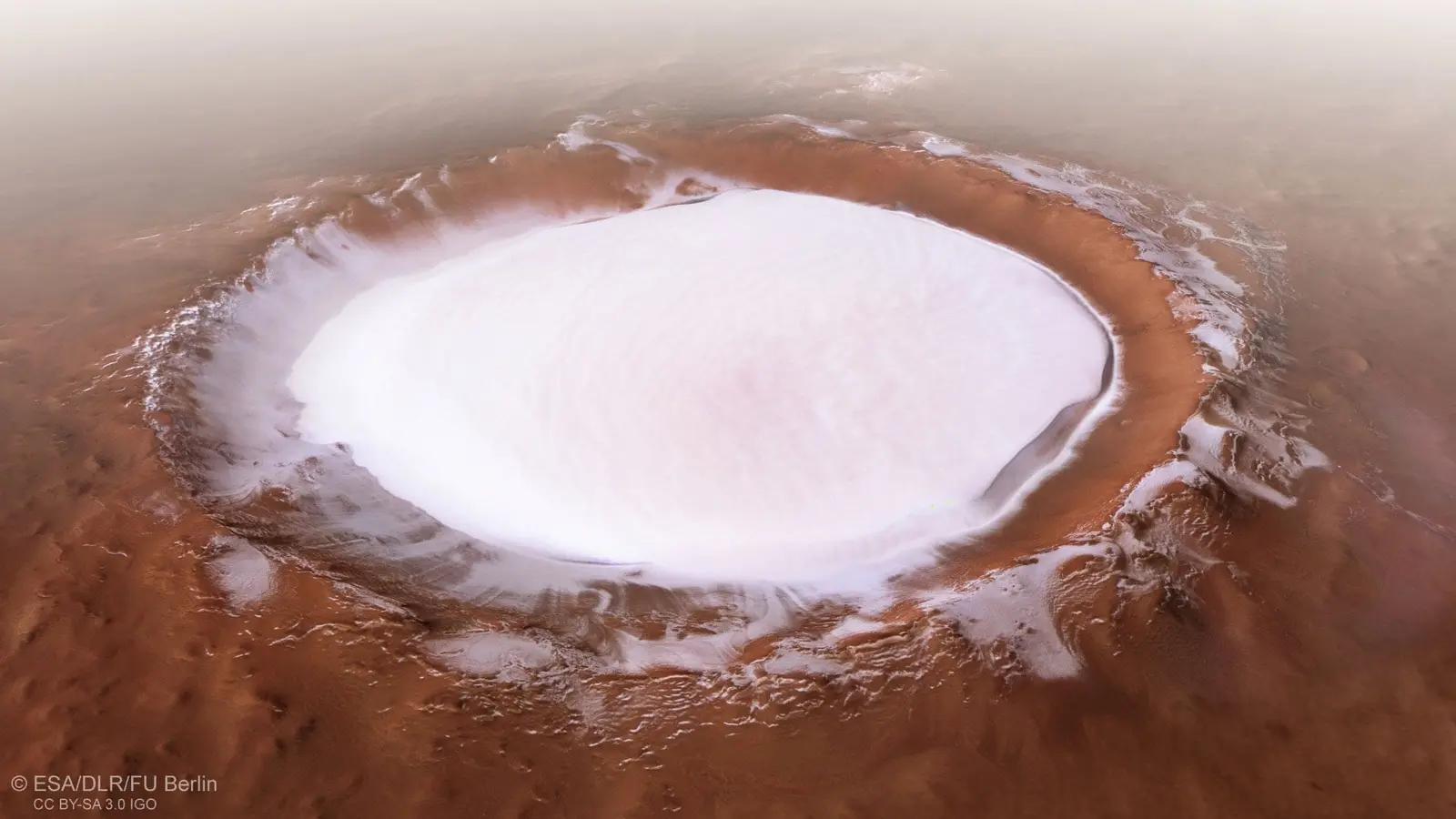
Imagine standing at the rim of a pale crater on Mars and looking down at layers of ice so pure they might act as a geological memory. Light plays oddly across the surface. Shadows fall where dust is thin. Bright, almost pristine slabs alternate with thin, darker seams. What looks like a frozen sandwich turns out to be a record book of Martian climate, written in layers of water and grit.
When Mars' tilt rewrites its climate
Earth stays steady because our large moon tethers its tilt. Mars has only two small satellites. Without a heavy stabilizer, Mars wobbles. Its axis swings across angles that, over tens of thousands to millions of years, produce dramatic swings in climate. Ice builds. Ice retreats. Dust drifts and settles. The result is a polar region layered with shallow frozen deposits that together cloak roughly a third of the planet.
Those layers are more than surface decoration. They are a chronological archive, the Martian equivalent of tree rings or deep ice cores on Earth. On our planet, climate scientists drill kilometers into Antarctic ice to read past atmospheres and temperature swings. On Mars, physically extracting such cores is far more difficult. Landing at the poles remains a technological challenge. The Phoenix lander did sample northern ice in 2008, and earlier attempts such as the Mars Polar Lander failed. So for now, orbital and lander measurements are the primary ways to read what the ice has to tell us.
Reworking assumptions changes the picture
How dirty is that ice? The answer matters. Small amounts of dust can darken the surface, change how much sunlight the ice reflects, and accelerate warming and sublimation. For years, estimates of dust mixed into the polar ice varied widely. Some models implied top layers might be as much as a quarter dust by mass. That would make the polar cap much darker and more susceptible to seasonal loss.
But a fresh look at the problem, led by researchers at the University of Washington, suggests a very different story. The team found that a widely used analysis technique, originally developed for the Moon, can misrepresent how light interacts with Martian ice. Instead of relying on lunar soil models, the researchers adapted methods long used to study snow and firn on Earth. The result: the upper layers of north polar ice appear far cleaner than many earlier estimates indicated. What had been counted as perhaps 25 percent dust is more likely close to 3 percent by mass.
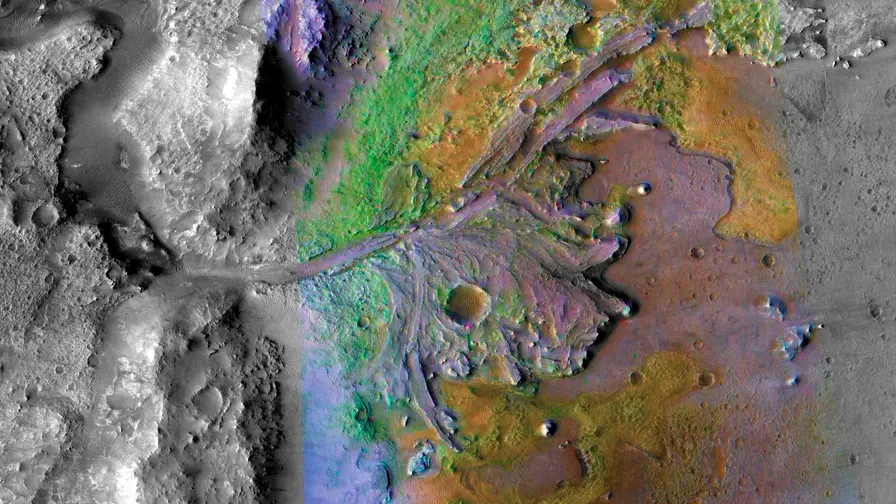
This matters for two reasons. First, cleaner ice reflects more sunlight and is therefore more stable. Second, the arrangement of dust and ice itself contains information. The researchers observed brightness changes across Martian seasons that point to a stratified structure. A relatively dusty frost forms over the surface each winter. In summer that seasonal coat sublimates, exposing older, clearer ice beneath. In cross section the deposits stack up like a layered dessert, with dirtier bands sandwiched between cleaner slabs.
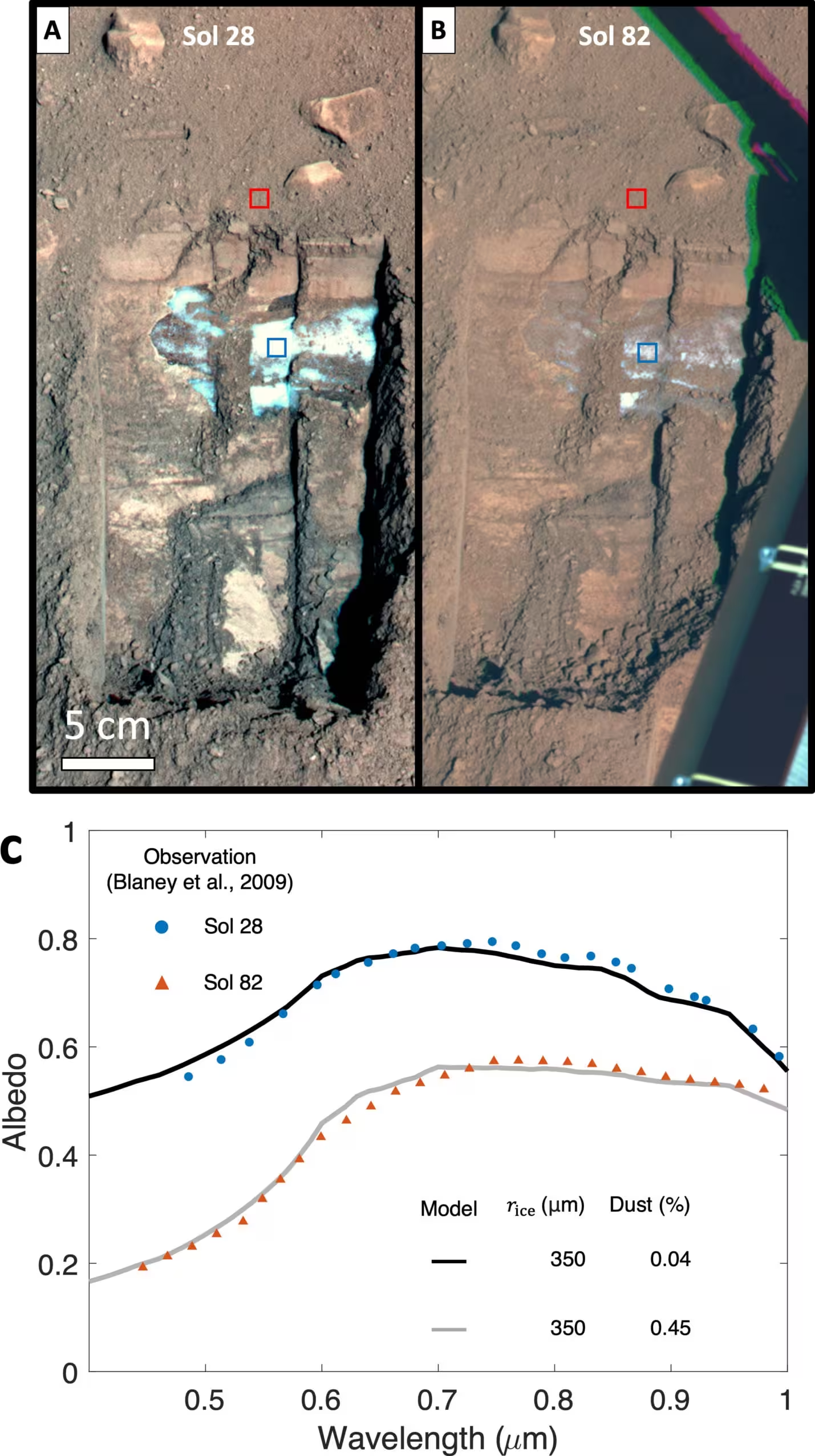
This figure compares dust content at the same site. On Sol 28 (a Martian day), the study reported dust content of 0.04%. Dust content increased to 0.45% after 58 sols.
Why the difference matters for climate and habitability
Layers of relatively pure ice, interrupted by thin dusty seams, are more than geological curiosities. They are potential time capsules. If those cleaner slabs accumulated through snowfall during different phases of Mars' axial tilt, then each buried sheet preserves the atmospheric signature of its time. Dust trapped between layers records windiness and volcanic or impact events. Gases occluded in the ice could provide clues about ancient air composition.
There is also a more provocative consequence. Dust can act like a solar heater. Darker layers absorb sunlight and convert it to heat, potentially creating microenvironments where ice melts into slush or even brief liquid water films. On Earth, shallow melt pockets in icy, dusty systems can support microbial life during warm seasons. If similar transient melt zones existed beneath Martian dust seams, they would change how scientists think about the planet's near-surface habitability, at least episodically.
That possibility has driven previous theoretical work from the same group, suggesting dusty layers could concentrate heat enough to produce localized melting. Cleaner ice around those seams would then be a reservoir. The presence or absence of such melt events matters for astrobiology and for future missions planning in-situ resource utilization and potential drilling targets.

How the methods came together
The new estimates draw on a combination of orbital imaging, spectral data, and the Phoenix lander observations. A critical step was recognizing that techniques proven for lunar soils do not translate cleanly to Martian polar ice. Steve Warren, an emeritus professor at the University of Washington with decades of work on snow optics, provided analytical approaches better suited to layered, low-density ice. Graduate researcher Pari Mohan and research scientist Aditya Khuller adapted those tools to re-evaluate the measurements. The result is a simpler, and perhaps more realistic, picture of how much dust is actually mixed into the north polar cap.
Better numbers help refine models of sublimation, deposition, and the long-term evolution of the polar caps. They also adjust where scientists might look first for preserved biosignatures or accessible ice for human exploration. If the topmost meters are cleaner and more reflective, then heat-driven losses over time are lower and buried layers may be more intact than previously assumed.
Expert Insight
"Finding cleaner ice reshapes our expectations about the polar record," says Dr. Elena Marquez, a planetary geophysicist who has worked on radar sounding of icy bodies. "It does not mean Mars was warm and wet in the way Earth is. It means the archive may be better preserved, and that gives us a clearer target for future sampling. The contrast between dusty seams and clean slabs is precisely the kind of signal we want when reconstructing past climates."
"If a dusty layer can produce short-lived melt, it would be localized and transient, not a stable ocean," she adds. "But for microbes, localized is sometimes enough."
Conclusion

Revisiting assumptions with tools honed on Earth has produced a meaningful revision to our view of Martian polar ice. Cleaner upper layers make the north pole a more reliable archive of past climate and slightly alter the odds for transient liquid conditions. The work illustrates a basic lesson in planetary science: methods matter. Adapting Earth-tested techniques to alien environments can yield surprises, and those surprises change where we aim our next missions, instruments, and hypotheses.
As researchers apply this improved analysis across other polar and midlatitude ice deposits, we should get a sharper timeline of Mars' climatic swings. That timeline will tell a story of a planet that wobbles spectacularly through space, alternately writing and erasing its icy record. For scientists hunting for clues about habitability and climate evolution, cleaner ice is an invitation to read more carefully.

“The cosmos has always fascinated me. I write about space missions, astronomy, and the technologies pushing humanity beyond Earth.”

Discussion
Leave a Comment
Comments
No comments yet. Be the first.