
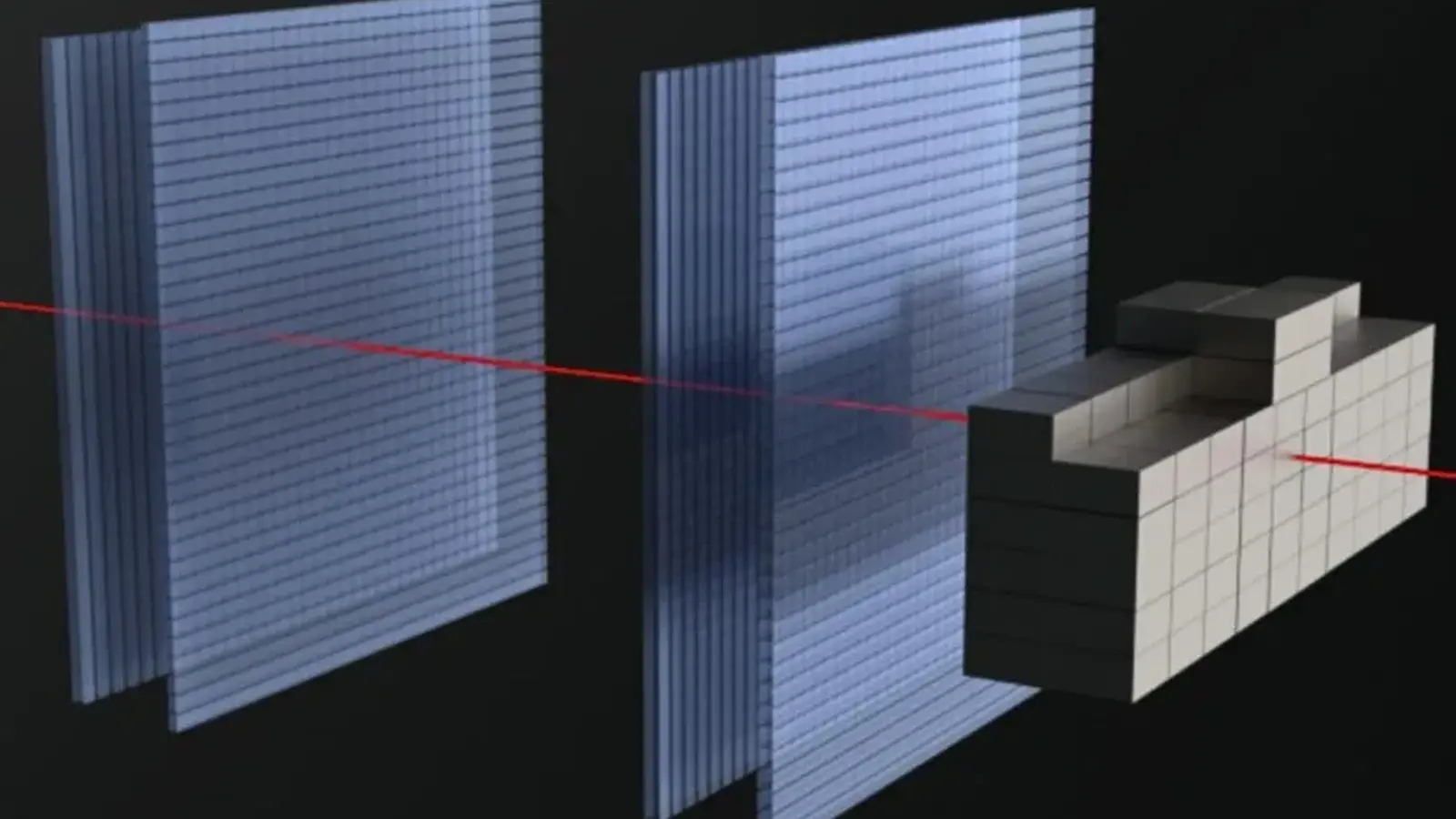
Imagine a beam powerful enough to create particles that pass clean through nearly two metres of reinforced concrete and cast a shadow of hidden objects on the other side. That is essentially what researchers at ELI-NP in Romania have just demonstrated: a first-of-its-kind image made using muons generated by the world’s most powerful laser.
How muons became a camera
Muons are cousins of the electron, heavier and short-lived, normally produced when cosmic rays strike Earth’s atmosphere. They behave like tiny, high-penetration bullets: some travel through dense rock and metal that even strong X-rays cannot traverse. Scientists have exploited natural muon showers before, using them to map Egyptian pyramids and peer into mine shafts. But natural muons arrive with limited angles and low flux, which makes rapid, directional imaging difficult.
To overcome that constraint, teams have turned to artificial production. Fire a high-intensity laser at a target, accelerate electrons to extreme energies, and let those electrons strike a converter: out come pions, and then muons. Last year, collaborative efforts in China, the United States and the United Kingdom proved the basic technique for laser-driven muon generation. The ELI-NP experiment takes the next step by using a 10 petawatt laser to produce a beam strong enough to image objects behind an almost two-metre-thick concrete barrier.
Inside the Romanian experiment
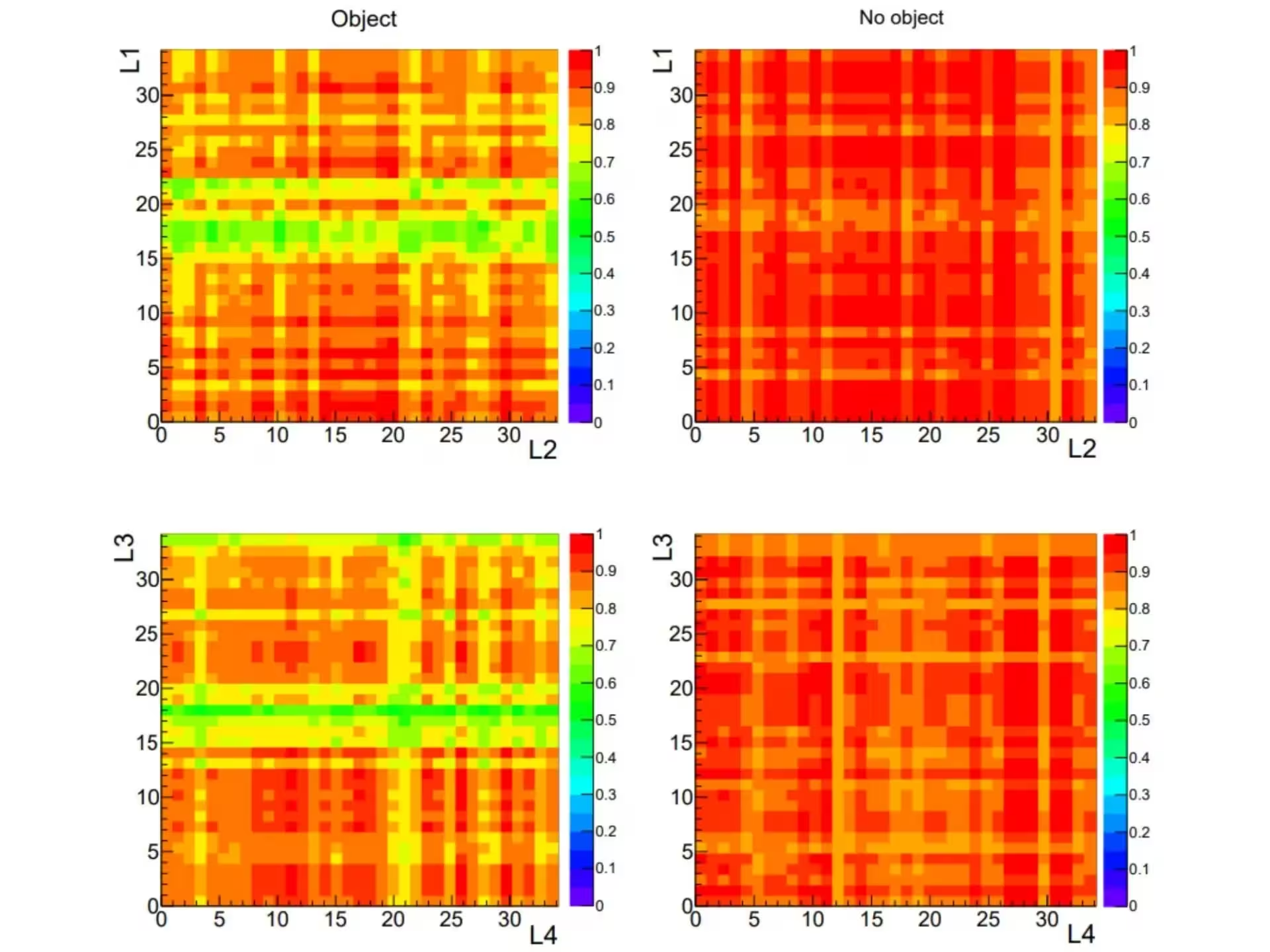
The ELI-NP team focused a 10 petawatt pulse to accelerate electrons, directing them into a lead converter to spawn a cascade of secondary particles. A filtering stack made of polyethylene sheets and paraffin blocks removed many unwanted charged particles, leaving a relatively pure stream of muons. Those muons then traversed a 1.8 metre concrete wall and struck detectors arranged inside a van on the far side. What the detectors recorded was not a high-definition photograph, but a clear muonographic silhouette: lead blocks positioned behind the wall produced discernible shadows compared with an empty baseline.

Early images are grainy. They lack the crisp detail of optical cameras. Still, the result matters. It demonstrates a controlled way to generate muons on demand and use them for directed imaging rather than waiting for the slow and stochastic rain of cosmic muons.
Previous trials have shown related possibilities. An earlier test imaged lead weights inside a truck, but researchers could not confidently quantify how many of the recorded particles were true muons, leaving the record of the first artificial-muon image disputed. The ELI-NP work strengthens that record by combining a high-power laser source with physical filters and a clear detector arrangement.
Implications and next steps
What could a laser-driven muon camera be good for? Think non-invasive inspection where traditional probes fail: scanning thick concrete and rock for mining exploration, checking the integrity of buried foundations or the cores of historical stone structures, and screening dense cargo or ship hulls without destructive entry. In aerospace and security, engineers could use such imaging to verify internal metalwork in rocket stages or bulk carriers where access is limited.
Challenges remain. Muon production must become more efficient and compact. Detector systems need faster readout and improved resolution. The research team notes these are early demonstrations rather than ready-made field systems. They envision, however, a future portable instrument inspired by the laboratory setup—a smaller accelerator and detector suite that could be deployed for targeted inspections.
A draft paper describing the experiment is available on arXiv, and the community will be watching how the technique matures. For now, ELI-NP’s result is a significant proof of concept: controlled muon generation can do something natural muons do already, but on demand and with potentially new angles and speeds. That control could change how we peer inside the densest parts of our world.

“My work centers on sustainability, energy, and environmental science — examining how innovation can lead to a greener future.”

Discussion
Leave a Comment
Comments (1)
wow, muons as a camera? that's wild, like sci-fi but real... imagine scanning ancient tombs without a drill. hope detectors get faster tho, and production gets smaller asap