
Picture this: you recognize the face, the image seems familiar, but the name or the accompanying detail slips away. For many people, that moment starts not in old age but in middle age. New imaging research from Binghamton University suggests memory becomes tangled earlier than most of us expect.
How a simple lab task revealed a surprising pattern
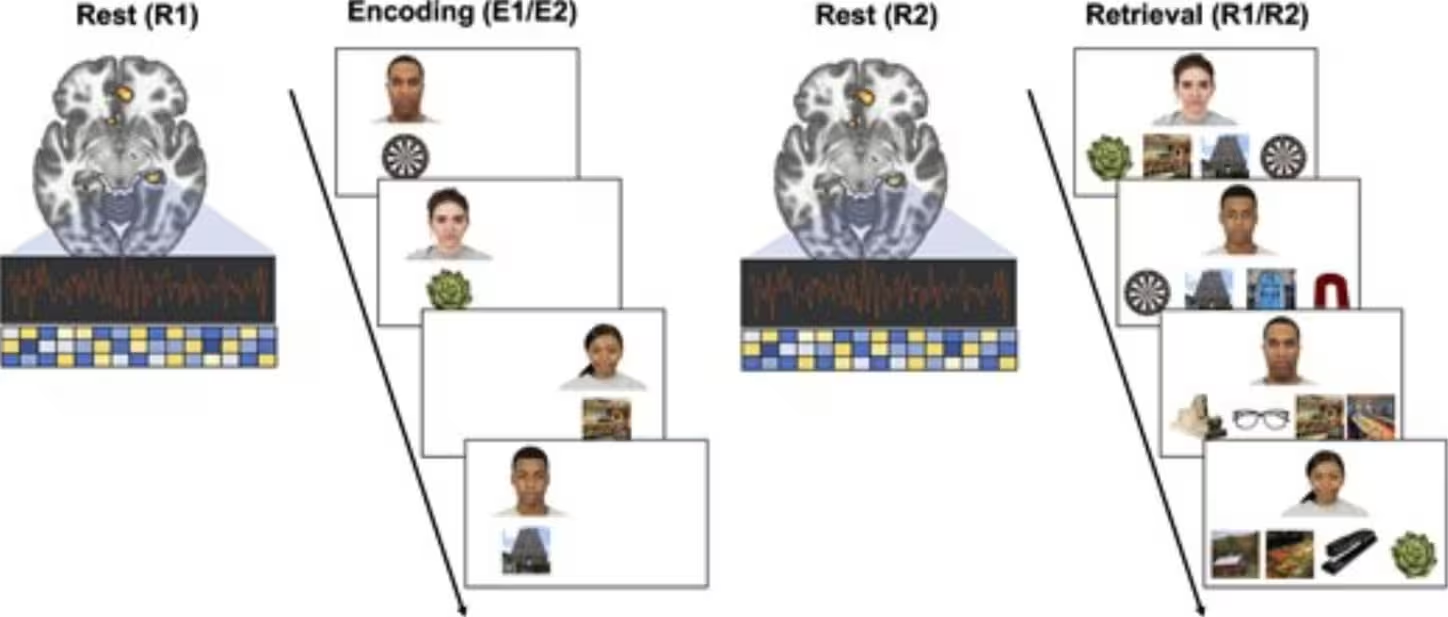
Researchers led by Ian McDonough enrolled roughly 60 adults spanning ages 18 to 74. The experiment was deceptively straightforward. Participants viewed faces paired with either objects or scenes. After a brief rest, they saw the faces again and had to pick which item had originally been paired with each face while an MRI tracked hippocampal activity.
At stake was not just recognition. The task tested associative memory — the ability to remember links between separate pieces of information, for example which object appeared with which face. That kind of memory is critical for everyday tasks: remembering where you put your keys, who told you what, or which medication goes with which container.
Familiarity can be misleading
Middle-aged participants showed a distinct pattern. Many could sense that an object or scene had been seen before. They knew it was familiar. But they often attached it to the wrong face. Recognition remained intact; precision did not. Why does that happen?
One line of thought is that as we age certain processes that maintain the fidelity of associations weaken. The brain sees the parts. But it struggles to tie them together correctly. Suddenly, multiple items on the screen are all familiar, and the specific link — the binding — becomes the weak point.
Reactivation that misleads
The team expected memory errors in older adults to follow a simple logic: weaker brain reactivation during retrieval would predict mistakes. That held true for younger adults. When younger participants erred, their hippocampus did not strongly reinstate the activity patterns recorded during learning. Simple and sensible.
With older adults, the story flipped. Mistakes coincided with relatively strong hippocampal reactivation of the original learning patterns. In other words, the hippocampus appeared to replay the earlier experience — but the replay did not guarantee an accurate answer. Strong reactivation was, paradoxically, linked to wrong choices.
That finding is counterintuitive and important. It suggests that reactivation alone is not a universal marker of successful memory retrieval. The content and context of the reactivation matter. A vivid but misdirected replay might reinforce the wrong association, creating confident but incorrect memories.

Why middle age matters
McDonough and colleagues point to a broader implication: memory decline is not a cliff that appears only late in life. Some hippocampal mechanisms start to change by midlife. The data show a marked drop in associative memory accuracy from the young adult groups into the 50s.
That makes middle age a transition period worth studying on its own. Too often research contrasts only young versus older adults, missing the gradual and region-specific shifts that happen decades earlier. Longitudinal tracking across midlife could reveal when specific brain systems begin to diverge and which cognitive skills are most vulnerable first.
Implications and next steps
The study raises practical and scientific questions. If strong hippocampal reactivation can support erroneous recall, how can we distinguish constructive replays from misleading ones? Can targeted interventions — behavioral training or noninvasive brain stimulation timed after learning — improve associative fidelity?
Future experiments could examine encoding quality, short-term consolidation, and retrieval dynamics within the same individuals. They could also test whether post-learning interventions alter the balance between correct and incorrect reactivation. Improved imaging analyses that track the content of reactivated patterns might help separate faithful replays from noisy ones.
Expert Insight
"This study nudges us to rethink a simple equation between reactivation and accurate memory," says Dr. Maya Fernandez, a cognitive neuroscientist who studies aging at a major research university. "People often assume that a stronger replay equals a stronger memory. But the brain can replay the wrong trace with high fidelity. Understanding when and why that happens—especially in midlife—could reshape how we design cognitive interventions."
Dr. Fernandez adds: "The practical takeaway is subtle but real. We should pay attention to associative memory complaints in middle age and use them as an early window into brain health rather than dismissing them as normal forgetfulness."
Conclusion
The Binghamton study challenges a tidy narrative. Memory errors are not always the product of failing to reactivate a past experience. At least for some people, particularly in middle age, the hippocampus may reactivate a strong but misleading pattern. Recognizing midlife as a distinct phase for memory change opens new avenues for research and possible early interventions. That recognition changes how we think about aging: not as a late breakdown but as a staggered series of shifts, some of which begin decades earlier than many expect.

“The cosmos has always fascinated me. I write about space missions, astronomy, and the technologies pushing humanity beyond Earth.”

Discussion
Leave a Comment
Comments
No comments yet. Be the first.