

They are the invisible backbone of Mars exploration: engineers, scientists, and technicians coordinating across institutions to keep spacecraft healthy and data flowing. Two of NASA’s most important assets at Mars, the Perseverance rover and the Mars Reconnaissance Orbiter, depend on a network of specialized teams on Earth, each with distinct skills and long-term responsibilities.
Who runs the missions and what they do
Operations for both Perseverance and the Mars Reconnaissance Orbiter are managed from NASA’s Jet Propulsion Laboratory in Southern California. JPL plans activities, uplinks commands, and interprets telemetry on behalf of NASA’s Science Mission Directorate. Caltech oversees JPL’s management, providing the institutional support behind daily mission decisions.

This is an annotated version of the image at the top with a yellow circle indicating Perseverance.
Lockheed Martin Space in Denver built the Mars Reconnaissance Orbiter and remains a key partner, offering engineering support and platform expertise. Their work keeps the orbiter functioning as a communications relay and as a high-resolution surveyor of the Martian surface.
The imaging team and HiRISE
The HiRISE camera, famous for its sharp, postcard-like views, is operated out of the University of Arizona in Tucson. HiRISE was constructed by BAE Systems in Boulder, Colorado. Scientists at the university schedule observations, process raw images, and archive data used to study geology, monitor seasonal changes, and scout safe landing sites.

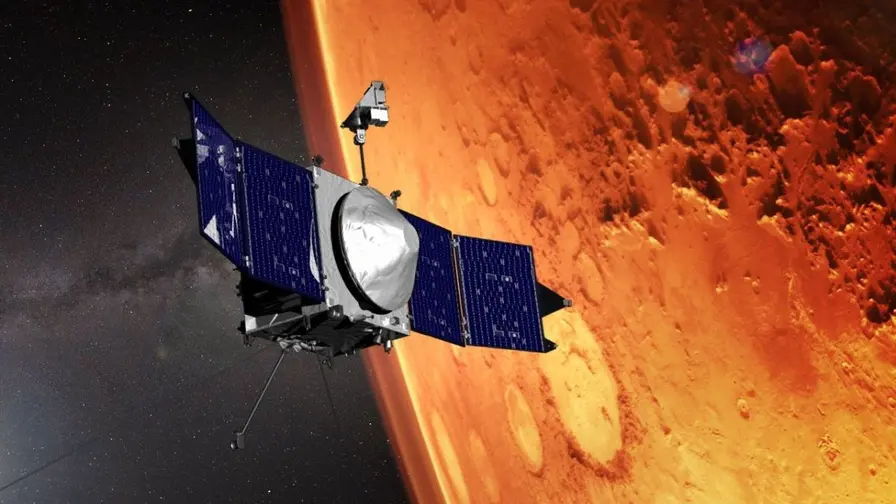
Artist Concept of Mars Reconnaissance Orbiter.
Together these teams form a pipeline: builders ensure hardware integrity, mission operators choreograph daily science, and instrument teams turn raw signals into discoveries. The partnership model combines government leadership, academic insight, and commercial engineering, a mix that has repeatedly proven effective for complex planetary missions.
As Mars exploration advances, these institutional collaborations will remain central to new science goals, from detailed surface mapping to supporting future sample return campaigns. The success of Perseverance and the Mars Reconnaissance Orbiter is not just technological; it is institutional, depending on long-standing relationships and sustained expertise.

“My work centers on sustainability, energy, and environmental science — examining how innovation can lead to a greener future.”

Discussion
Leave a Comment
Comments
No comments yet. Be the first.