
For decades astronomers have chased a missing breath at the heart of our galaxy. Theory said a wind must be there. Observations kept coming up empty. The result felt like a half-finished sentence: we knew something unseen was shaping gas and stars near Sagittarius A*, but we could not point to the culprit.
Now, using deeper radio maps and a careful comparison with X-ray images, a team led by researchers at Northwestern University reports the clearest evidence to date that Sgr A*, the Milky Way’s central supermassive black hole, is quietly blowing a wind. The structure they found is subtle, cone-shaped, and small on cosmic scales—just a few light-years across—but its discovery changes how we picture our galaxy’s center and how black holes influence their surroundings when they are not in a violent outburst.

This composite image shows evidence for a wind blowing away from Sagittarius A* (Sgr A*), the supermassive black hole in the center of our galaxy. The white dot in the center of the image shows Sgr A*. In orange is data from the Atacama Large Millimeter/Submillimeter Array (ALMA) radio telescopes in Chile, mapping the location of cold gas composed of carbon monoxide in the image. In blue is X-ray data from NASA’s Chandra X-ray Observatory. A large cone-shaped cavity, visible as an absence of cold gas in the ALMA data, is filled by hot X-ray-emitting gas in the Chandra data. Researchers think a hot, energetic wind blowing from Sgr A* created this structure by sweeping the cold gas away or heating it up.
A wind where none was expected
Black holes are often described by what they swallow. But they also return energy to their environments. As matter spirals inward and releases gravitational energy, some of that energy can drive outflows: winds, broad-angle flows, or tightly focused jets. Theoretical models predicted that Sgr A* must produce a wind whenever material is present near it. For half a century, however, empirical proof was elusive.
Mark Gorski and Elena Murchikova, co-leads of the study, approached the problem with patience and technique rather than a single dramatic observation. They stacked five years of data from the Atacama Large Millimeter/Submillimeter Array (ALMA), a radio observatory uniquely sensitive to cold molecular gas traced by carbon monoxide. Then they calibrated and subtracted the black hole’s bright radio signature to reveal fainter structures nearby. The resulting image was about 100 times deeper and 80 times sharper than earlier maps of the region. New features emerged.
One of those features caught the team’s attention immediately: a cone-shaped cavity nearly one parsec long and spanning roughly 45 degrees, containing little to no cold molecular gas. When the ALMA map was placed against archival X-ray observations from NASA’s Chandra X-ray Observatory, the cavity was filled with hot, X-ray-emitting gas. The alignment was more than coincidence. It suggested a coherent flow of hot material carving a channel through the colder gas around the black hole.
"Unless a black hole exists in a perfect vacuum, it must blow a wind somehow," Gorski said. "With new observations, this is the first time we’ve had a clean enough view to see the wind’s imprint. We looked at the data and said, ‘There it is. There is the thing that everybody’s been looking for for 50 years.'"
Stars near the galactic center also produce winds. Massive stars shed mass and generate shocks that stir gas. The team, however, calculated the available stellar energy and found it insufficient to clear such a large, coherent cone-shaped cavity. The geometry points back toward Sgr A* itself as the most plausible origin.

Composite image of the Milky Way center, combining radio date from ALMA and X-ray data from Chandra.
How the discovery was made
Detecting faint gas structures near the galactic center is hard. Earth sits within the plane of the Milky Way, so observations toward the center must peer through layers of dust, ionized gas, and interfering radio emission. ALMA's high resolution and sensitivity, combined with a careful technique to remove Sgr A*'s strong central radio source, let the researchers see cold molecular clouds within about one parsec, or roughly three light-years, of the black hole.
They used carbon monoxide emission as a tracer because CO lines are bright and common in cold molecular gas. Once the bright continuum from Sgr A* was subtracted, faint CO features that had been drowned out previously became visible. The team traced the CO distribution and velocity structure and then compared these maps to Chandra's X-ray images. The X-rays filled the CO void.
.avif)
Data from the Atacama Large Millimeter/Submillimeter Array (ALMA) radio telescopes in Chile, mapping the location of cold gas composed of carbon monoxide in the image.
Timescales and energy
By measuring how the putative wind affects nearby ionized gas streams, the team estimated the outflow has been influencing the central region for at least 20,000 years. That is short in galactic terms, but long enough to alter the immediate ecosystem of gas and young stars.
The energy required to excavate the cavity exceeds what the local stars can inject, implying that the black hole, even in its relative quiet state, contributes notable mechanical energy. The wind is not powerful compared with the spectacular jets we see in active galaxies. It is modest, wandering in direction over time, and intermittent. Yet those modest outflows matter. They redistribute cold gas and heat it, which can slow or alter star formation in the central parsec.
"The wind is not powerful, and its direction probably wanders with time," Murchikova explained. "It shows that our black hole is not unique, and our place in the universe is not unique."
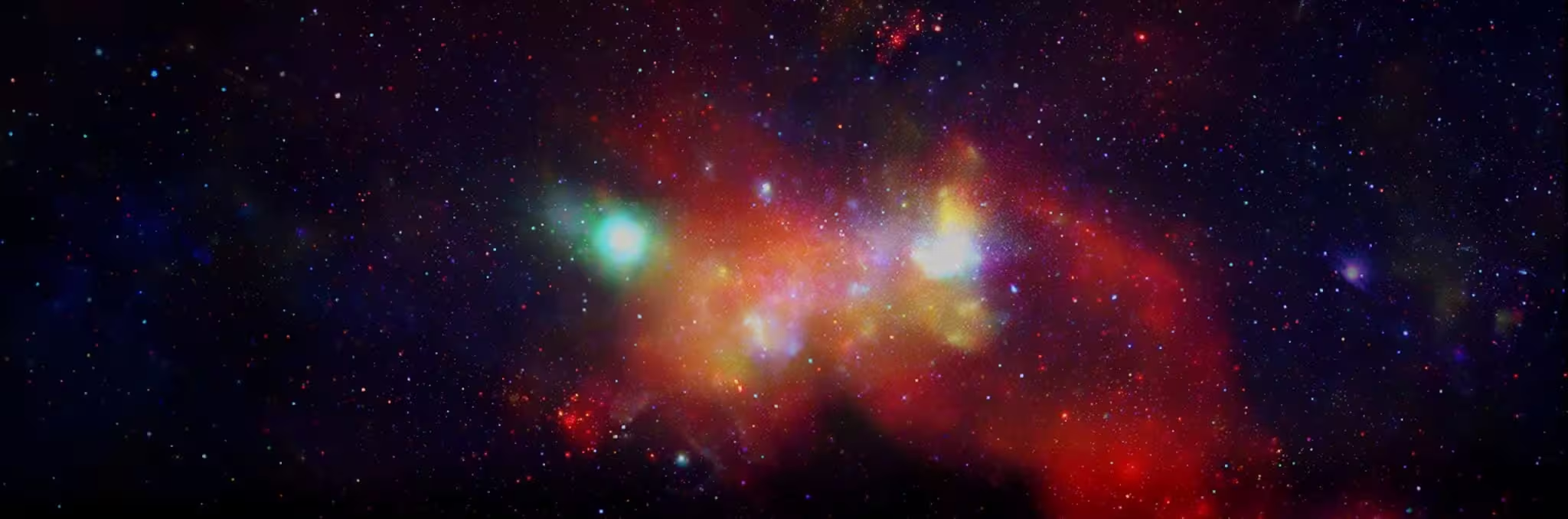
Image of the Milky Way center from NASA’s Chandra X-ray Observatory.
Expert Insight
Dr. Priya Raman, an astrophysicist at the Space Science Institute who was not involved with the study, called the finding an important step toward filling a conceptual gap between models and observations. "We have built detailed models of how low-luminosity black holes should interact with their environments, but direct observational evidence has lagged behind. This ALMA plus Chandra comparison gives us a real laboratory. It lets us test how winds distribute energy and momentum within a few light-years of a black hole — the scales that matter for fueling and feedback."
Raman stressed that the discovery is not an isolated curiosity. "When you look at more distant galaxies, you often see winds and bubbles on much larger scales during active episodes. The Milky Way shows us the gentler side of black hole feedback. That matters because most black holes spend most of their lives in these quieter phases."
Why this subtle wind matters for galaxy evolution
Feedback from supermassive black holes is a central element in modern theories of galaxy evolution. In energetic active galactic nuclei, strong winds and jets can sweep gas from galaxy centers, quench star formation, and shape large-scale structure. But galaxies are not always in a fireworks stage. Most of their lifetimes are quiet, and the imprint of low-level feedback is harder to observe.
Finding a continuous, if weak, outflow from Sgr A* demonstrates a mode of interaction that operates outside dramatic outbursts. Even modest winds influence how cold gas collects, how quickly it cools, and where stars can form. Over tens of thousands of years, these effects can change the central mass distribution and the supply of material available to feed the black hole itself. The discovery therefore provides an empirical anchor for simulations that attempt to capture both violent and quiescent feedback regimes.
On another level, the discovery is a reminder about observational limits. A phenomenon can be theoretically inevitable yet observationally invisible until instrumentation and analysis catch up. The study underlines the value of patient, deep observations and meticulous calibration when the signal is faint and the foreground messy.
Future directions and questions
The Northwestern team’s result raises several questions that observers and modelers will want to address. How does the wind vary in time? What mechanism launches it from Sgr A*: thermal pressure, radiation pressure, magnetic processes, or a combination? How does the wind interact with stellar winds and with the complex, rotating streams of gas found in the central parsec?
Upcoming and planned facilities can push these tests further. Continued ALMA campaigns can monitor changes in the cold gas distribution and velocity. Deeper, higher-resolution X-ray mapping could reveal finer structure in the hot gas. Next-generation infrared and radio instruments, including those on thirty-meter-class telescopes, will improve our ability to trace both the ionized and molecular components. In parallel, refined theoretical models that include realistic gas physics and magnetic fields will be needed to translate observations into mechanistic understanding.
Practically speaking, the Milky Way offers the best available close-up to study black hole feedback in a low-activity state. Because Sgr A* is nearby, researchers can probe spatial scales and time variability that are inaccessible in more distant galaxies. The new wind detection opens this window wider.
Conclusion
The Milky Way’s central black hole has revealed a quiet but consequential habit: it blows a wind that sculpts its immediate environment. The discovery is the product of deeper, cleaner radio maps and a careful match to X-ray data. It confirms a decades-old expectation and supplies fresh data to test how modest black hole feedback operates. Far from being simply a curiosity, the wind offers a laboratory to study how gas is moved, heated, and prevented from forming stars, even when a galaxy’s central engine is not in a dramatic outburst.


“The cosmos has always fascinated me. I write about space missions, astronomy, and the technologies pushing humanity beyond Earth.”

Discussion
Leave a Comment
Comments (4)
Feels a bit overhyped? The detection is neat but relying on CO subtraction could hide systematics. Still cool tho.
Ive run sims of low-luminosity AGN winds, this matches some results. Timescales look right, but mag fields could flip things, kinda excited.
Is this definitive proof or just best interp? Stellar winds could still matter, hmm. Need more obs to be sure.
Wow, didnt expect a gentle wind carving a cone near Sgr A*. Quiet but real, weirdly beautiful curious how it wanders over time.