
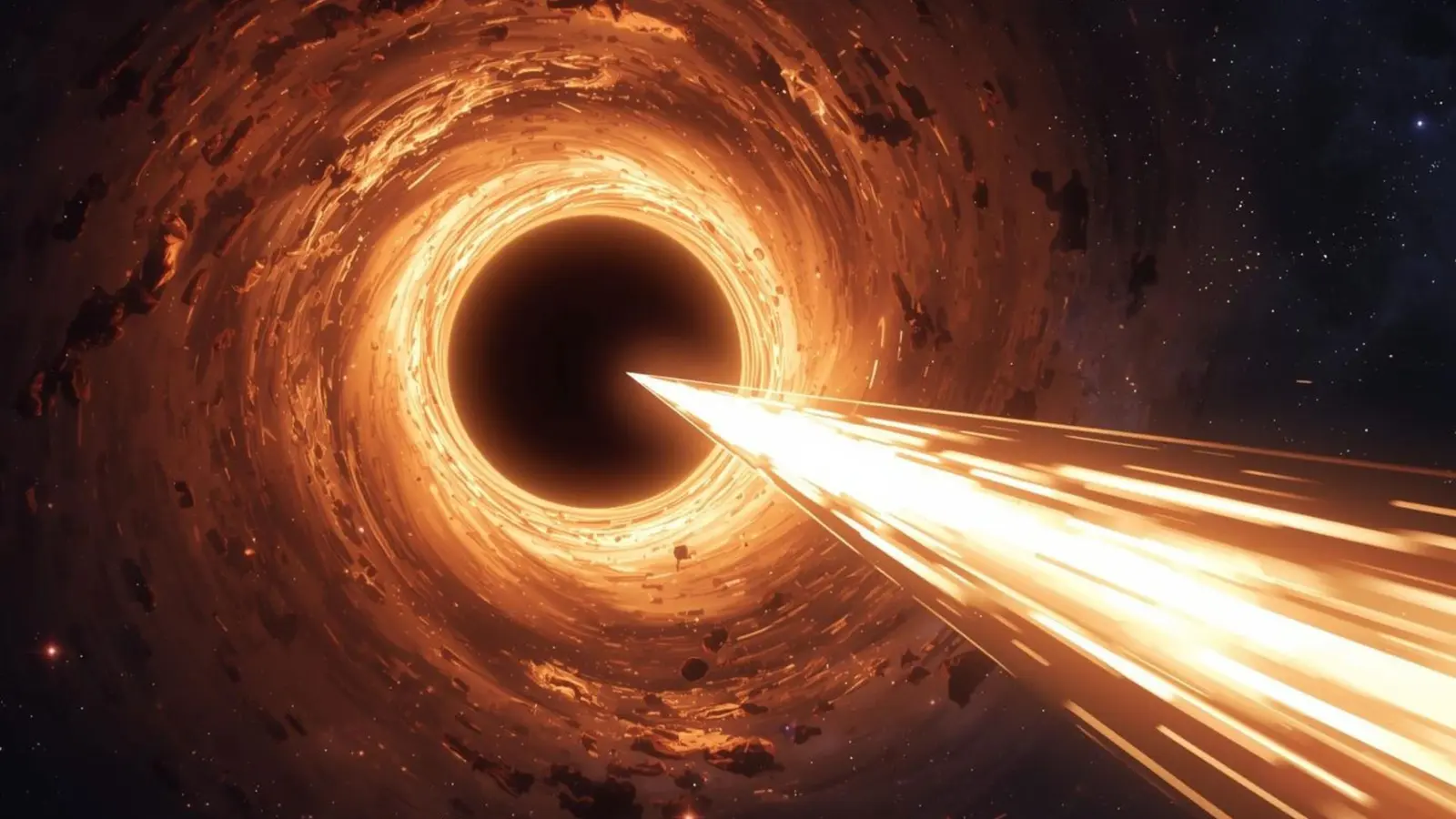
Imagine a lighthouse at the edge of the cosmos switching on and never dimming. That is the puzzle astronomers now face after a black hole in a nearby spiral galaxy suddenly became an exceptionally loud radio source and has stayed bright for more than eight years.
The galaxy, catalogued as SDSS J110546.07+145202.4 and lying roughly 1.8 billion light-years away in Leo, transformed from a modest radio source into something extraordinarily loud. Its central black hole began emitting radio waves more than 20 times stronger than before. In many transient systems, such an outburst fades quickly. Not here. The signal persists. Years have passed. The radio brightness remains.
A surprising behaviour from a small powerhouse
This object belongs to the narrow-line Seyfert 1 class of active galaxies. That classification points to a comparatively low-mass black hole consuming matter at a high rate. Those black holes are often energetic in X-rays and optical light, but strong, long-lived radio jets are rare among them. The sustained radio output in SDSS J110546.07+145202.4 appears to be the first clear example of a long-duration radio changing-look event in this kind of galaxy.
What fuels such a beacon? The leading idea is familiar: gas and dust fall toward the black hole, forming a rotating accretion disk. Friction and magnetic forces heat the inflowing material and, under certain conditions, funnel some of it into narrow, relativistic jets. Those jets can produce powerful radio emission when charged particles spiral along magnetic field lines.
In this case, researchers suspect a sudden increase in the supply of gas fed the accretion disk. That supply change may have allowed a jet to launch and remain active. The implied radio luminosity is massive. The emission is about 10 quadrillion times the Sun’s radio output. Yet the central black hole itself is relatively lightweight compared with monsters in massive elliptical galaxies.
New observations combined with archival data spanning radio to X-rays show no obvious twin flare in optical or infrared bands that would match the radio rise. That absence complicates straightforward explanations such as a tidal disruption event, where a star is torn apart and briefly brightens the nucleus across many wavelengths. The behaviour also differs from blazars, whose jets point almost directly toward Earth and typically show rapid, variable emission signatures.
Follow-up measurements used a suite of instruments: the 100-meter radio telescope in Effelsberg, CSIRO’s Australia Telescope Compact Array, and space-based X-ray telescopes among others. Each dataset supports the same surprising conclusion: this is not a short-lived radio flash. It is a sustained state change.
The discovery paper, led by Stefanie Komossa at the Max Planck Institute for Radio Astronomy, frames SDSS J110546.07+145202.4 as a prototype of a possibly new class of rapidly switching radio galaxies. If that classification holds, it will force astronomers to revisit theories about how small, fast-growing black holes can form and sustain jets.
Why this matters beyond one galaxy
There is a deeper reason why this single object matters. In the early Universe, rapidly growing, lower-mass black holes were far more common. They likely powered bright sources that shaped their surroundings with radiation and jets. But those distant systems are faint and hard to resolve. A nearby analogue gives researchers a laboratory to study jet formation, jet propagation, and the interaction between a jet and the host galaxy’s gas in far greater detail.
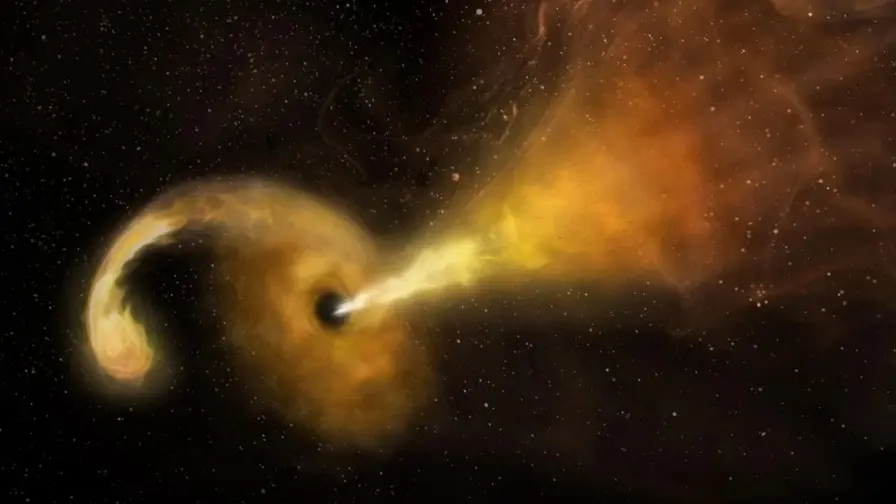
High-resolution radio imaging could help. Very Long Baseline Interferometry arrays can combine signals from widely separated antennas to produce angular resolution equivalent to a single, continent-sized dish. Planned observations with the Very Long Baseline Array may reveal the jet’s structure, direction, and evolution, helping to determine whether the radio emission arises from a compact core, a new jet knot, or larger-scale interactions with surrounding gas.
Looking ahead, the coming generation of radio facilities such as the Square Kilometre Array will survey the sky with unprecedented sensitivity. Those telescopes should detect many more radio transients and long-duration changes, enabling astronomers to know whether SDSS J110546.07+145202.4 is an oddball or the first recognized member of a larger population.
The galaxy is also visually striking. It is close enough that its two spiral arms are clearly visible in optical and near-infrared images, offering a context for the energetic core activity. The combined view helps link the central engine to its host galaxy.

The galaxy SDSS J110546.07+145202.4 is so close to Earth that its shape, with its two spiral arms, can be clearly seen in images. The photograph is a composite of visible light and near-infrared radiation.
Expert Insight
"This object gives us a rare nearby test case for processes that were common in the young Universe," says Dr. Elena Morales, an observational astrophysicist unaffiliated with the discovery team. "We can watch how a new jet establishes itself and how it affects the galaxy. That tells us about feedback, about how black holes regulate star formation, and about the conditions needed to sustain a jet over years rather than days or months."
Her point cuts to the heart of why sustained radio emission matters. Jets do more than light up telescopes. They transport energy to scales where they can heat gas, push it around, and suppress or trigger star formation. Observing the birth and persistence of a jet in real time provides data to test computer models of these feedback processes.
Conclusion
SDSS J110546.07+145202.4 has become a rare and valuable case study. It challenges expectations about how lower-mass, rapidly accreting black holes behave. It also offers a proximate analog for the kinds of active nuclei that likely shaped the early cosmos. Continued monitoring across the electromagnetic spectrum, higher-resolution radio imaging, and the sensitive sky surveys of tomorrow will reveal whether this galaxy is a singular oddity or the first flag in a larger, previously hidden population of long-lived radio transients.
Until then, the lighthouse stays lit. Astronomers will keep watching.


“The cosmos has always fascinated me. I write about space missions, astronomy, and the technologies pushing humanity beyond Earth.”

Discussion
Leave a Comment
Comments (3)
Feels a bit overhyped but also kinda thrilling. If it's a new class, follow up must be quick 👀 Need spectra and more epochs
Is this even real? No optical or IR flare but 8+ yrs of radio bright, curious if orientation or some weird instrument bias..
wow, a lighthouse at the edge of the cosmos?! mind blown... small black hole, huge radio roar. gotta see VLBI pics