
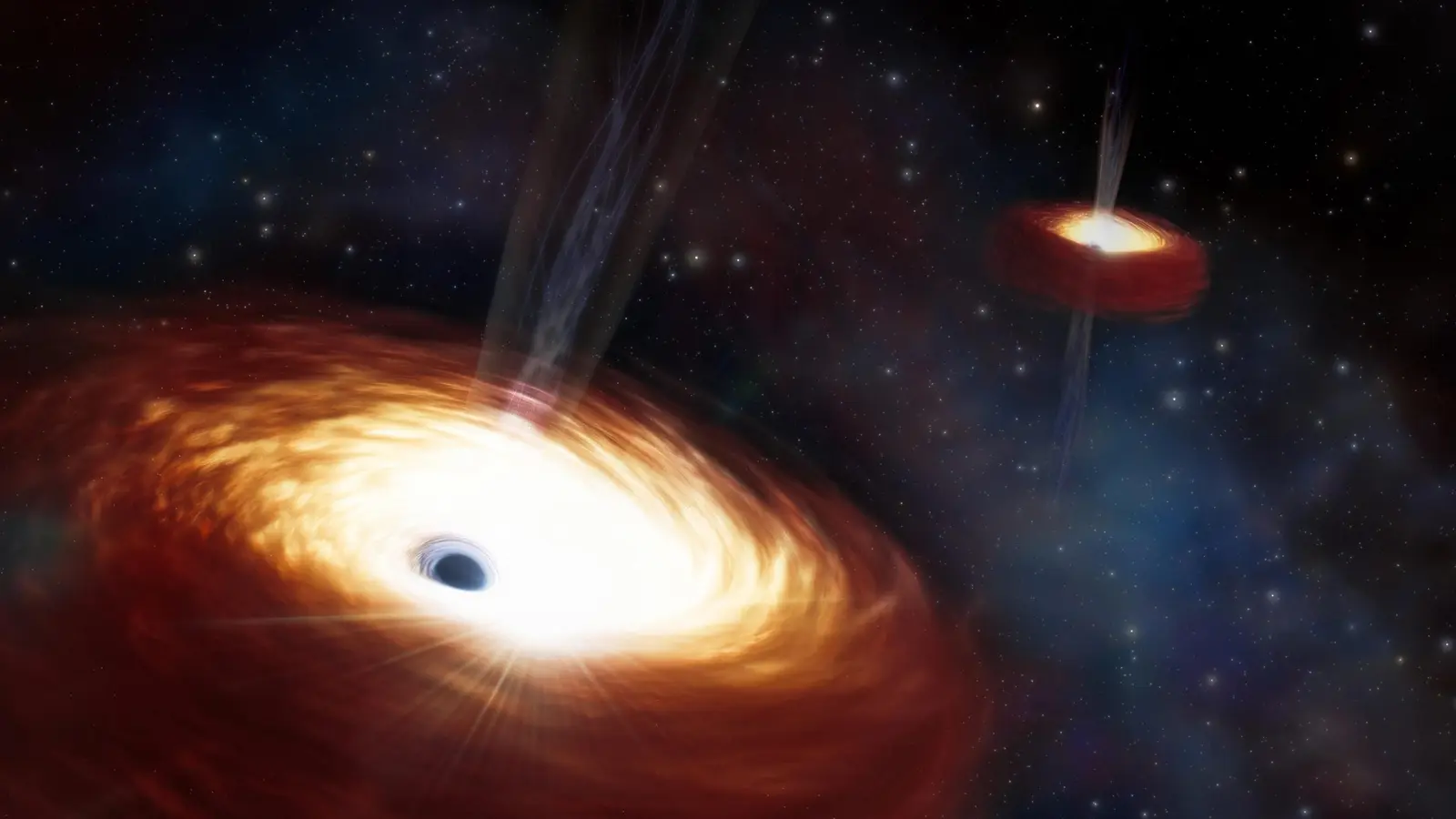
Imagine a law that only works when nothing changes. That would be odd in meteorology, and it is striking in the physics of black holes, objects defined by extreme change: collisions, growth spurts, slow evaporation. For fifty years the textbook story—born in the 1970s from Stephen Hawking and others—tied black holes to thermodynamics by using the area of the event horizon as a stand-in for entropy. Elegant. Powerful. But incomplete.

Illustration of a black hole that is growing in response to an influx of energy. New research from Penn State suggests a new measure for a black hole’s entropy that extends Stephen Hawking’s laws of black hole mechanics to such out-of-equilibrium, dynamic black holes that form, merge, and evaporate.
When equilibrium becomes a liability
Black hole thermodynamics grew from a paradox. Classical general relativity seemed to demand that black holes could only absorb and never emit, so their temperature would be zero and their entropy undefined or infinite. Then Hawking showed that quantum effects let black holes radiate. Temperature and entropy were rescued and married to geometry: horizon area equated to entropy; surface gravity to temperature. The result knitted two pillars of physics together.
But there was a hidden caveat. Those relationships were derived assuming equilibrium. In other words, they apply when a black hole is not changing. That is a serious caveat. Real black holes rarely sit still. They feed on gas, slam into other black holes, and slowly leak mass via quantum radiation. The mathematical object at the heart of Hawking's picture, the event horizon, is defined globally in space-time. Its location may depend on what happens far in the future. That makes it teleological: you must know the future to characterize the present.
“Hawking’s laws of black hole mechanics provided a satisfying connection between extreme and ordinary physics and have been the paradigm for 50 years, but they have a serious limitation,” said Abhay Ashtekar, Atherton University Professor and Evan Pugh Professor of Physics Emeritus at Penn State. “They were formulated for black holes at equilibrium, but black holes are constantly changing. We wanted to find a way to extend the laws to black holes that are out of equilibrium.”
A local alternative: dynamical horizons

What if entropy could be tied to a surface defined by local physics at a moment in time? That is the route taken by the team led by Ashtekar and reported in Physical Review Letters. Instead of relying on the event horizon, which can stretch into future contingencies, they propose using dynamical horizons. These are surfaces identified by the immediate geometry and matter content near the black hole. They behave like horizons in simulations and respond directly to infalling energy, angular momentum, and radiation.
Why does that matter? Because a dynamical horizon can be located using information available now. It does not require prophecy. That eliminates the teleological awkwardness and opens the door to a thermodynamic bookkeeping that works while a black hole grows, merges, or evaporates.
Daniel Paraizo, a graduate student and coauthor, explained the shift in perspective: “Because you cannot see into a black hole, it seemed that there could be an infinite number of ways to make a black hole, making their entropy infinite as well. Hawking radiation changed that picture and made entropy and temperature physically meaningful. Our work pushes that further by anchoring entropy to quantities measurable at a given time.”
How the new entropy is measured
The revised definition links entropy more directly to the black hole's energy and spin. In practice, the method tracks how the horizon area of a dynamical horizon changes in response to incoming fluxes of mass-energy and angular momentum, producing a generalized first law of black hole mechanics for non-equilibrium situations. The second law, the statement that entropy does not decrease, also finds a natural extension within this framework.
Jonathan Shu, another graduate student on the project, highlighted a specific technical advantage. “Event horizons can form and grow in regions of space-time where nothing local happens,” he noted. “That makes them unsuitable as a physical entropy measure for dynamical black holes. Dynamical horizons avoid that problem because they are defined locally.”
At a conceptual level, this is a tidy fix. At a practical level, it is significant. Numerical relativity codes that model black hole collisions already use quantities akin to dynamical horizons. The Penn State proposal maps the thermodynamic language onto those same quantities, making it easier to interpret the entropy balance during mergers detected by gravitational-wave observatories.
Implications for gravitational waves and quantum evaporation
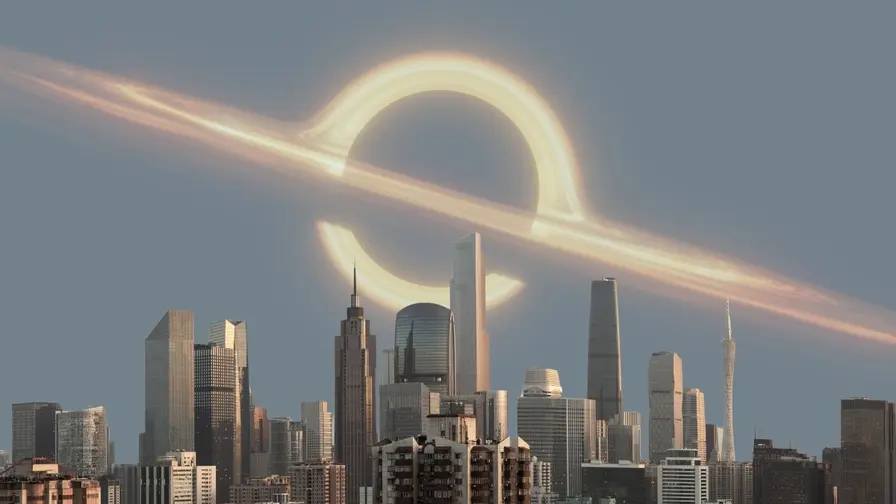
Gravitational-wave astronomy has made black hole mergers an empirical subject. When LIGO and its partners record the inspiral and merger of two black holes, they measure masses and spins before and after the event. But interpreting how thermodynamic-like quantities change during the violent non-equilibrium phase requires caution. The new framework gives theorists a physically meaningful entropy to compute during those epochs, improving comparisons between simulations and observations.
On the quantum side, black hole evaporation remains a deep puzzle. Hawking's original calculation uses quantum fields on a fixed background space-time and yields a slow loss of mass through radiation. How that process respects or modifies thermodynamic laws when the black hole is far from equilibrium is an open question. A dynamical-horizon-based entropy gives a better-defined target for any quantum theory of gravity aiming to reproduce or extend Hawking's result.
This new entropy measure makes thermodynamic laws usable for real, changing black holes.
Expert Insight
“The move from a global horizon to a locally determined dynamical horizon is a practical and philosophically satisfying step,” said Dr. Maya Gonzalez, an astrophysicist who works on numerical simulations of compact objects. “It brings the language of thermodynamics into the regimes where gravitational-wave detectors actually probe. That will help link theory, simulation, and observation more tightly.”
Gonzalez added that the approach does not yet solve every paradox associated with black hole information and evaporation, but it does supply a clearer thermodynamic ledger for processes that change rapidly. “That alone is a big step forward,” she said.
Conclusion
Physics advances by finding the right language for phenomena as they present themselves in nature. For half a century the language of horizon area worked beautifully for stationary black holes. The Penn State team's proposal supplies grammar for sentences that change mid-phrase. By defining entropy through dynamical horizons and tying it to local energy and spin, they make thermodynamic statements applicable to the black holes we can observe and simulate.
There is more work ahead. Researchers will want to test these generalized laws in detailed simulations of mergers and in models of quantum evaporation. They will also explore whether the new entropy behaves as expected in extreme cases and whether it yields new observational signatures in gravitational waves. For now, the move toward locality restores a feature physicists prize: predictive power based on accessible data rather than on knowledge of the future.

“The cosmos has always fascinated me. I write about space missions, astronomy, and the technologies pushing humanity beyond Earth.”

Discussion
Leave a Comment
Comments (3)
Interesting shift, makes simulations cleaner. still, seems pretty theoretical, will observations actually care or is this mostly math and bookkeeping?
is this even testable tho? dynamical horizons sound neat but how do you measure them during a noisy merger, practically seems tricky
Wow, tying entropy to local horizons actually feels satisfying. But does it fix info loss? also curious how measurable this will be in real LIGO data