

Imagine a clear Chilean night, a mountain-top dome yawning open, and a detector waiting for photons that traveled for billions of years. Then a bright streak arcs across the frame and ruins an exposure. That simple annoyance may become routine if current plans for vast satellite networks continue to expand.
When connectivity and astronomy collide
Europe's Southern Observatory has run simulations to see what a sky crowded with low Earth orbit satellites would do to ground-based astronomy. The results are blunt. Even satellites that are too faint to see with the naked eye can scatter sunlight in ways that reduce a powerful instrument's usable field. According to ESO models, the Very Large Telescope in Chile could lose roughly 28 percent of its effective observing area under a very crowded-sky scenario.
And that is not just a numbers game. The Vera C. Rubin Observatory, built to capture wide, deep surveys of the transient sky, is especially vulnerable. A moderate increase in satellite brightness could render many of its images unusable for several hours each night. Entire nights of transient hunts, supernova searches, and faint galaxy mapping could be compromised.

Why the problem is growing so fast
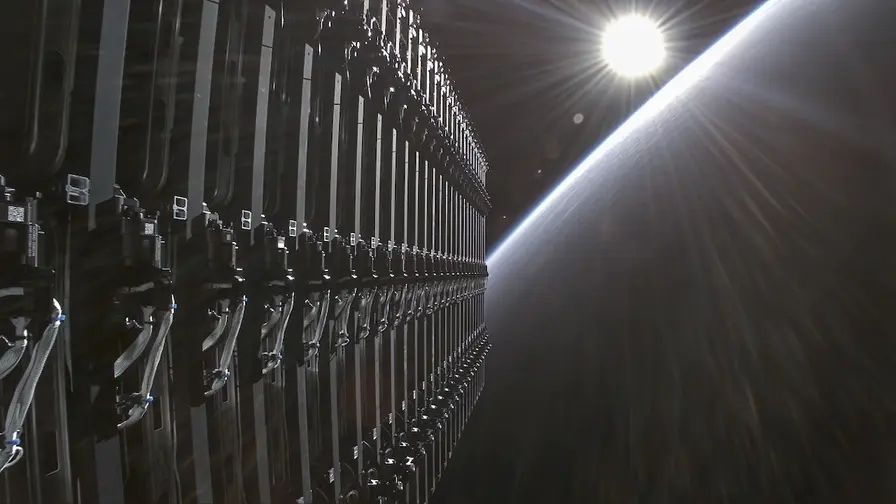
Satellite megaconstellations have scaled up at breakneck speed. Starlink alone now operates on the order of 10,400 satellites. For context, before 2022 humanity had launched roughly 14,450 satellites in total. Some industry long-term plans envision orders of magnitude more craft. One controversial idea frames networks of hundreds of thousands to a million small satellites as 'orbital data centers' for global internet access.
Brightness matters as much as quantity. A handful of bright reflectors can scatter far more sunlight into a telescope than many dim ones. That is why engineers and astronomers are both focused on how satellites reflect light, how they are oriented, and what kinds of surface treatments or sunshades might reduce their impact.
Policy, engineering, and compromise
Stopping internet-from-space is not ESO's aim. Instead, the observatory has proposed an internationally agreed cap: a ceiling of about 100,000 low-brightness satellites in low Earth orbit. The logic is simple. A managed ceiling could preserve a balance between expanding global broadband access and protecting long-term astronomical research. It would also force satellite operators to invest in darker designs and operational measures that minimize stray light.
Industry activity is not slowing. Amazon plans to roll out Project Kuiper in the coming years, and more companies are preparing to enter the field. That increases the urgency of coordinated standards for satellite brightness, orbital distribution, and data sharing with observatories so astronomers can plan around predictable interference.
Some technical fixes exist. Dark coatings, deployable visors, active attitude control, and improved image-processing algorithms reduce visible streaks and recover lost data. But none of these is a magic bullet if the sky's occupancy continues to grow unchecked. The trade-offs are complex. Every satellite launched for a social or economic good should be weighed against the lasting value of an uncluttered sky for science and culture.
What happens next depends on collaboration. Engineers, regulators, and astronomers will need to agree on limits, design standards, and observation strategies. Otherwise, we risk trading pieces of the night sky for transient gains in connectivity.

“My work centers on sustainability, energy, and environmental science — examining how innovation can lead to a greener future.”

Discussion
Leave a Comment
Comments (2)
Is that 100k cap even enforceable? Seems like companies will lobby around it, who watches the orbit police lol
wow, imagine losing whole nights for a wifi upgrade... I get global internet but the sky is irreplaceable. regulators step in asap