
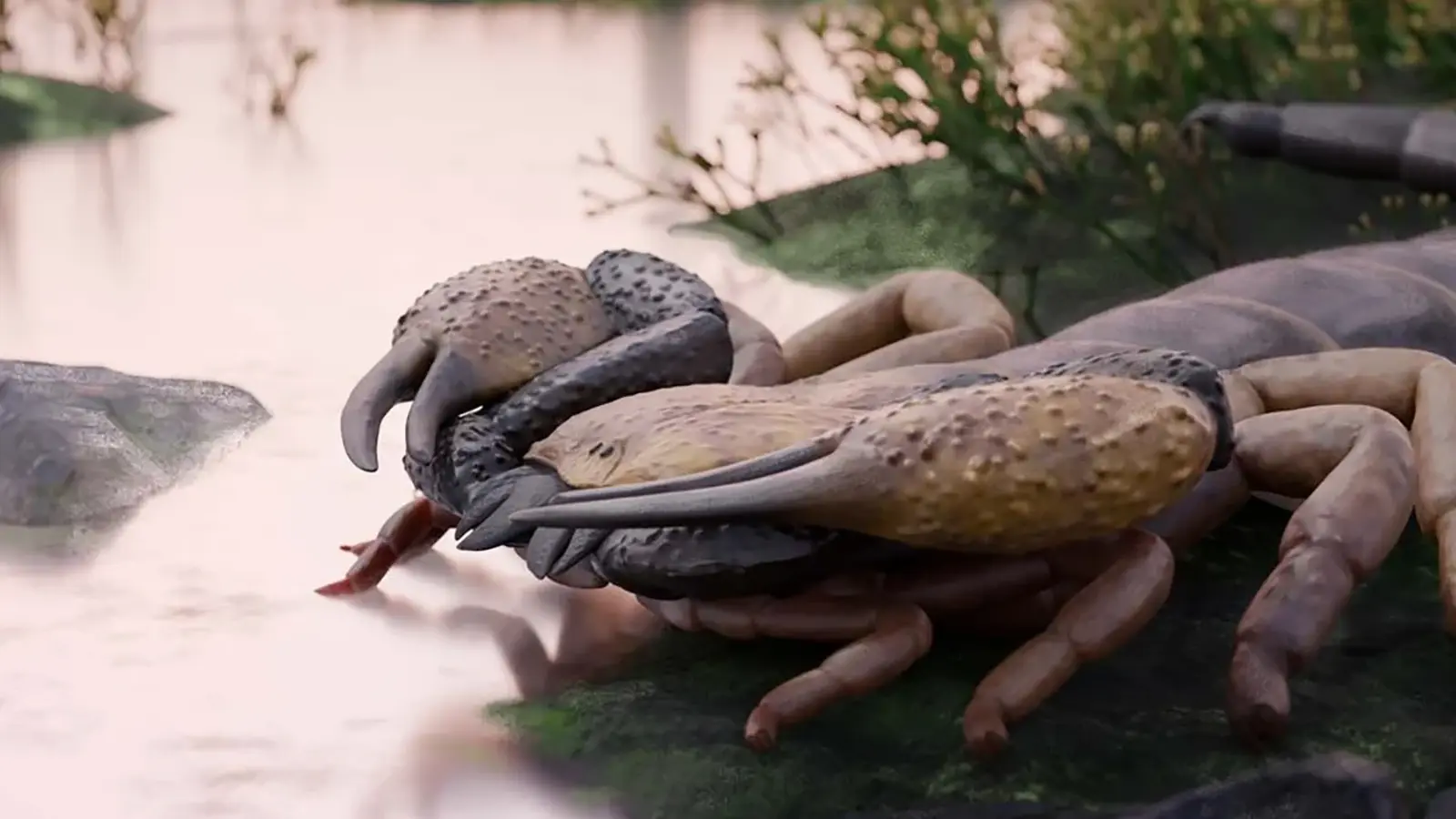
Imagine walking across a soggy floodplain 415 million years ago and seeing something the size of a medium dog skittering among the primitive plants. Not a mammal in sight, but a predator with pincers longer than many modern scorpions are from head to tail. That animal, now confirmed by a new UK study, is Praearcturus gigas.
Unraveling a 150-year mystery
Fossils of this enormous arthropod were first dug up in 1870, and for more than a century scientists debated what they represented. Were they crustaceans, amphibious arachnids, or some other strange lineage? Recent work using a fresh toolkit of techniques has finally narrowed the answers. Researchers combined new camera lucida tracings with high-resolution computed tomography scans and systematic comparisons to other Early Devonian finds to show that Praearcturus is best interpreted as a true scorpion.
The physical details help explain why the identification matters. The team measured pincers about 16 centimetres long, which is astonishing because those claws alone are longer than the entire bodies of many living scorpion species. Limb surfaces with regular ridges point to stridulation, a sound-producing behavior seen in other fossil scorpions. Some specimens also show plate-like lateral flaps, known as epimera, comparable in form to structures on lobsters and crabs. Those features together paint a picture of an animal adapted to both land and water.

What the anatomy tells us about lifestyle and ecology
Praearcturus lived at a time when terrestrial ecosystems were nascent. Groundcover was mostly small plants and fungi. Large vertebrate predators had not yet evolved. In that context, an arthropod with huge claws and a partly amphibious repertoire could become the apex hunter of shallow streams and shoreline flats.
Why get so big? One plausible answer is ecological opportunity. With few competitors on land, arthropods could evolve toward larger sizes without being outcompeted by vertebrate predators. Yet size has trade-offs. Complex food webs and dense forests that would appear later in the Devonian brought more competition, likely favoring smaller, more specialized species. The new analysis suggests Praearcturus may have persisted for tens of millions of years before fading from the fossil record as ecosystems changed.
Evidence for a mixed life
The anatomy supports a mixed life strategy. Epimera and limb structures resemble features that help other arthropods manage respiration and movement in water. The presence of stridulatory ridges implies behavioral complexity, possibly used for communication or mating displays. Combined with the morphology of the pincers and the body, these traits make a strong case that Praearcturus hunted both in water and on land.

As Richie Howard, the lead author from the Natural History Museum in London, notes, this creature lived when life on land was just starting to organize into more complex communities. The study helps clarify when certain lineages walked onto dry ground and how some later returned to aquatic habits for part of their life cycle.
Comparative material played a key role. The researchers drew on earlier work describing Eramoscorpius from Canada and compared specimens from several UK sites dated to the Early Devonian. By aligning anatomical characters across these finds, they could place Praearcturus more securely within scorpion evolution.
Broader implications for terrestrialization
Scorpions are often discussed alongside spiders and other arachnids because they share complex features like book lungs. Molecular family trees suggest scorpions descended from air-breathing ancestors, implying some ancient lineages that had left the sea later readopted aquatic habits. If Praearcturus is indeed a scorpion that spent time both on land and in the water, it becomes a vivid example of how flexible early arthropods could be during the transition from sea to land.
That flexibility matters for paleontologists trying to reconstruct early ecosystems. Identifying which creatures were terrestrial, and when, narrows down scenarios for how lungs, walking limbs, and new feeding strategies evolved. The new study adds a datapoint showing that, even at an early stage in terrestrialization, large-bodied predators were possible.
Expert Insight
Dr. Elena Marquez, a paleobiologist not involved with the study, suggests the find recalibrates our sense of Devonian shorelines: "This is more than a curiosity. Praearcturus shows that early land ecosystems could support top predators with complex behaviour. Future discoveries could tell us whether such giants were rare pioneers or a persistent ecological strategy."
The next steps are straightforward and exciting. More fieldwork in Early Devonian deposits, reexamination of museum collections, and targeted imaging of fragmentary specimens could refine the timeline and anatomical picture. Molecular evidence from living arachnids will continue to be important for testing whether these fossil forms truly represent reversals to aquatic life or parallel experiments in body plan and function.
For now, Praearcturus gigas joins a select roster of prehistoric arthropods that challenge modern expectations about size, behavior, and the pace of ecological change. It reminds us that, even hundreds of millions of years ago, life was experimenting with every available niche, producing odd and formidable creatures that shaped the early history of life on land.

“The cosmos has always fascinated me. I write about space missions, astronomy, and the technologies pushing humanity beyond Earth.”

Discussion
Leave a Comment
Comments (2)
is this for real? CT scans sound convincing but could those epimera be just taphonomic artifacts or compression effects? would love more pics, sample sizes
Wow didnt expect a scorpion that big! 415 million yrs ago... imagine the shoreline chaos. Creepy but awesome, and kinda sad for the little plants